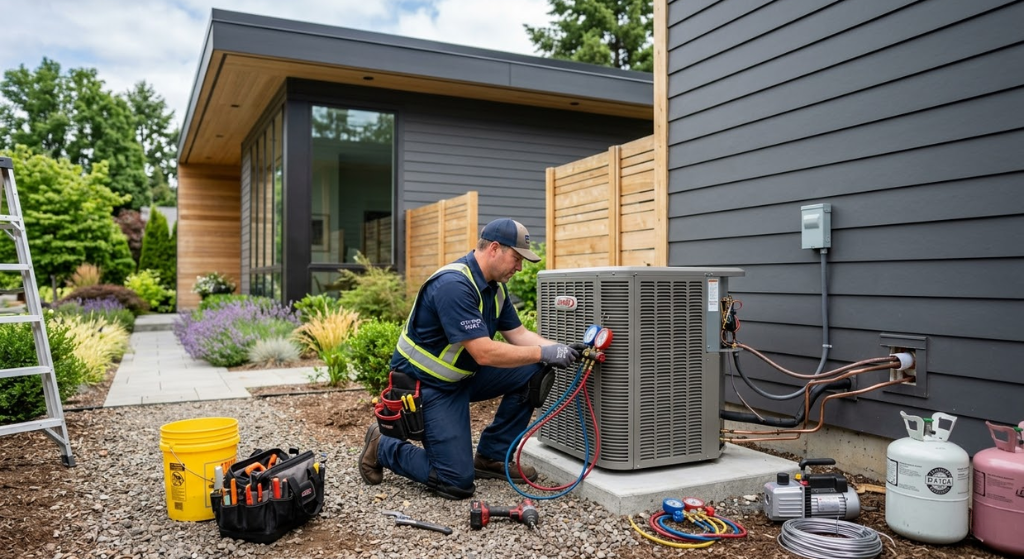
Summer arrives early, the old condenser rattles, then dies entirely. Or maybe you just bought a house where the AC is 18 years old and you know the clock is ticking. Either way, you’re about to have a conversation with an HVAC contractor about a project that could cost anywhere from $3,000 to $15,000 — and right now, you’re not sure which end of that range is actually fair.
That uncertainty is expensive. In the AC installation business, a homeowner who doesn’t know the market can easily pay $1,500–$3,000 more than necessary — for the exact same equipment and the exact same labor. The HVAC industry knows this. This guide is your equalizer.
We’re going to break down every cost factor involved in AC installation: system type, efficiency ratings, tonnage, labor, ductwork, refrigerant, brands, permits, and the hidden line items that routinely blow budgets. By the time you finish reading, you’ll know exactly what a fair price looks like for your specific situation — and you’ll have the questions ready to hold any contractor accountable.
Average AC Unit Installation Cost in 2025
The national average for a complete central air conditioner installation — new condenser, air handler or coil, refrigerant charge, and standard labor — sits between $4,500 and $6,200 in 2025. But that average conceals a wide distribution shaped by equipment choices, home size, regional labor markets, and the condition of your existing ductwork.
Why the Range Is So Wide
A 2-ton 14 SEER2 system for a 1,200 sq ft bungalow in Georgia and a 5-ton 20 SEER2 variable-speed system for a 3,500 sq ft home in Arizona are both “AC installations” — but they might cost $3,000 and $11,000 respectively. The variables that actually drive your cost are:
- System size (tonnage): More sq footage = more tons = more money
- Efficiency (SEER2 rating): Higher efficiency costs more upfront, saves more monthly
- System type: Central air, mini-split, heat pump, or window unit
- Ductwork condition: Existing + good vs. needing replacement vs. no ducts at all
- Refrigerant type: R-410A systems are being phased out; new R-454B/R-32 units cost more initially
- Regional labor rates: Phoenix labor runs 30–40% less than Boston or San Francisco
- Brand tier: Goodman vs. Lennox is often a $1,000–$2,500 equipment cost difference
Cost by Region
| Region | Avg. Installed (Central AC) | Labor Rate ($/hr) | Notes |
|---|---|---|---|
| Northeast (NY, MA, CT, NJ) | $5,200–$9,500 | $95–$160 | High labor; strict code compliance |
| Southeast (FL, GA, TX, SC) | $3,200–$6,500 | $55–$90 | High demand but competitive market |
| Midwest (IL, OH, MI, MN) | $3,800–$7,000 | $65–$110 | Shorter cooling season; balanced pricing |
| Southwest (AZ, NV, NM) | $3,500–$7,200 | $60–$100 | High tonnage demands, competitive labor |
| Pacific Coast (CA, OR, WA) | $4,500–$9,000 | $85–$150 | Strict Title 24 codes; high labor |
| Mountain West (CO, UT, ID) | $4,000–$7,500 | $70–$115 | Growing demand, moderate competition |
AC Installation Cost by System Type
Choosing the right AC system type isn’t just about upfront cost — it’s about your home’s structure, your ductwork situation, and how you want to zone your cooling. Here’s a complete breakdown of every major option.
Central Air Conditioning (Split System)
The most common setup in American homes: an outdoor condenser unit, an indoor air handler (or evaporator coil mounted on the furnace), and refrigerant lines connecting them. Requires existing ductwork. This is the go-to choice for whole-home cooling in homes that already have a ducted heating system.
| System Tier | Unit Cost | Installed Cost | SEER2 | Best For |
|---|---|---|---|---|
| Builder Grade | $1,100–$1,800 | $3,000–$4,500 | 14–14.3 | Rentals, budget builds |
| Mid-Range Two-Stage | $1,700–$2,800 | $4,200–$6,200 | 16–18 | Most homeowners; great value |
| Variable-Speed Best Value | $2,800–$4,500 | $6,000–$9,500 | 18–26 | Long-term residents, hot climates |
Ductless Mini-Split Systems
Mini-splits have no ductwork — refrigerant lines run directly from the outdoor compressor to wall-mounted indoor air handlers. Ideal for room additions, converted garages, homes without ducts, or homeowners who want zone-by-zone temperature control without a full duct renovation.
| Configuration | Installed Cost | SEER2 | Notes |
|---|---|---|---|
| Single-Zone (1 indoor head) | $1,800–$5,000 | 16–33 | One room or open area |
| Dual-Zone (2 heads) | $3,500–$7,500 | 16–30 | Two separate rooms/zones |
| 3-Zone System | $5,500–$10,000 | 15–28 | Full floor or multi-room coverage |
| 4–5 Zone System | $8,000–$14,000 | 15–25 | Whole-home without ducts |
✅ Mini-Split Advantages
- No ductwork needed (avoids $8K–$15K)
- Zone-by-zone temperature control
- Very high SEER2 ratings (up to 33)
- Quiet indoor operation
- Both cooling and heating in one unit
- Eligible for IRA tax credits
⚠️ Mini-Split Drawbacks
- Higher per-zone cost than central AC
- Wall-mounted heads visible in rooms
- Requires multiple refrigerant line sets
- Fewer contractors familiar with installation
- Multi-zone systems complex to balance
Window and Portable AC Units
For homeowners who need spot cooling without a major installation — apartments, single rooms, supplemental cooling — window and portable units remain viable. They’re not a whole-home solution, but they’re fast and cheap to deploy.
| Type | Cost Range | BTU Range | Installation |
|---|---|---|---|
| Window AC | $150–$700 | 5,000–25,000 BTU | DIY possible; 30–60 min |
| Portable AC | $250–$800 | 8,000–14,000 BTU | DIY; vent hose to window |
| Through-Wall AC | $400–$1,200 + install | 8,000–18,000 BTU | Requires wall sleeve; $200–$500 labor |
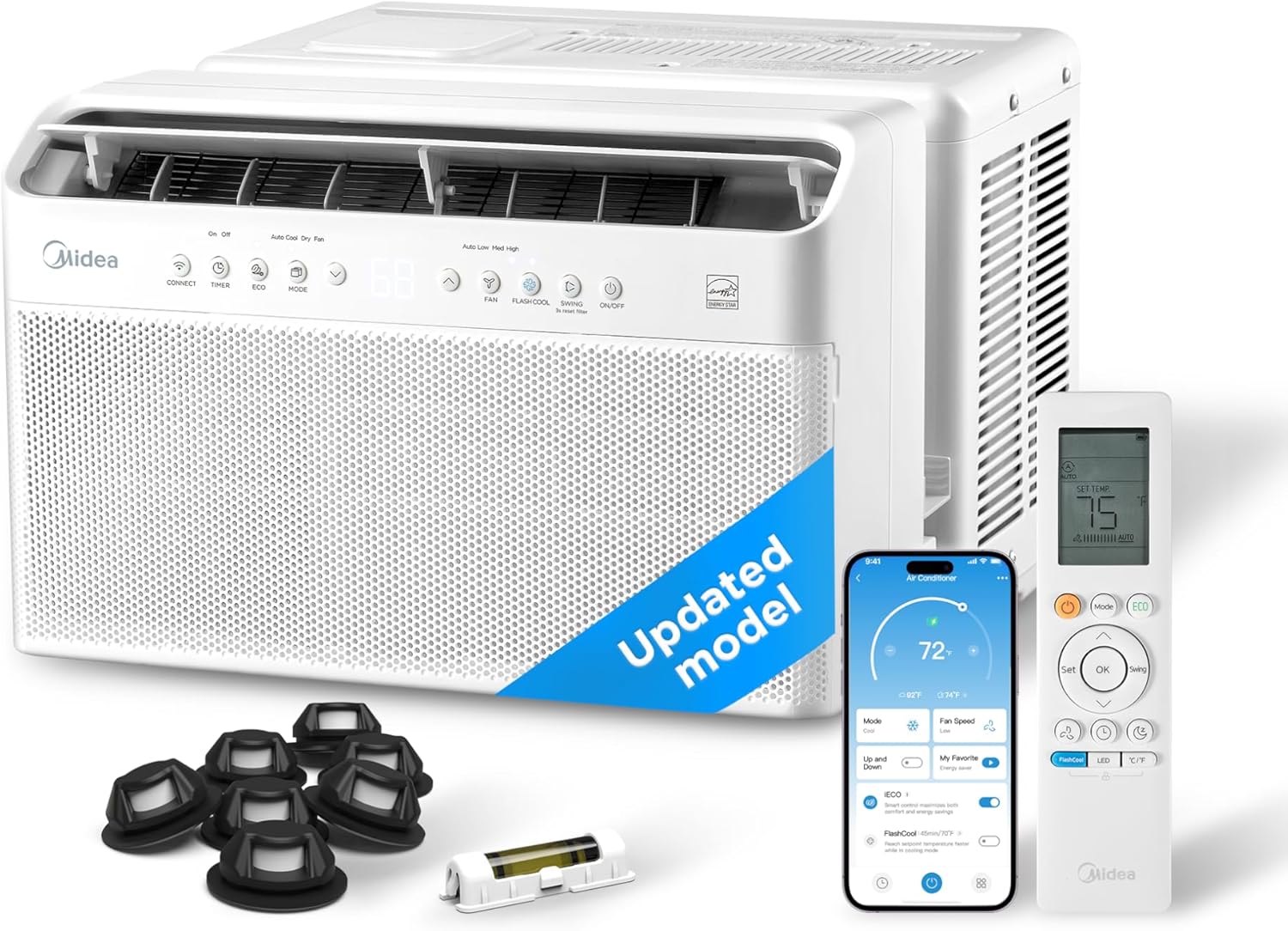
Midea U-Shaped Inverter Window AC — Up to 12,000 BTU — One of the most energy-efficient window units available in 2025. Ultra-quiet, Wi-Fi enabled, and works with Alexa. Perfect for rooms up to 550 sq ft.
Check Price on Amazon →SEER2 Efficiency Ratings and Real-World Savings
SEER2 — Seasonal Energy Efficiency Ratio 2 — replaced the older SEER rating in January 2023 with a stricter test methodology that more accurately reflects real-world installation conditions. The new standard applies slight downward pressure on ratings: a unit that was 16 SEER under the old test might be roughly 15.2 SEER2 under the new protocol. Always compare units using SEER2 when shopping in 2025.
Federal Minimum SEER2 Requirements (2023+)
- Southern states (FL, TX, most of the South): 15 SEER2 minimum for central AC
- Northern states: 14.3 SEER2 minimum for central AC
- Heat pumps (nationwide): 15.2 SEER2 minimum
Any contractor selling you a 14 SEER2 system in a Southern state in 2025 is selling you equipment that doesn’t meet code. Always verify the SEER2 rating before signing.
Annual Savings by SEER2 Rating
Below is what the efficiency difference actually means for your electricity bill, assuming a 2,500 sq ft home, 2,000 cooling hours per year, average electricity at $0.15/kWh, and a 4-ton system:
The jump from 14 SEER2 to 18 SEER2 saves roughly $380/year. Over a 15-year system lifespan, that’s $5,700 in electricity savings — often more than the premium you pay for the more efficient unit. In hot climates like Arizona or Texas where AC runs 3,000+ hours per year, the savings are even more dramatic.
Single-Stage vs. Two-Stage vs. Variable-Speed
Like furnaces, AC compressors come in three operating modes, each with different efficiency and comfort profiles:
| Type | Operation | SEER2 Range | Humidity Control | Noise |
|---|---|---|---|---|
| Single-Stage | 100% on or off | 14–16 | Poor (short cycles) | Loud starts/stops |
| Two-Stage | 65% or 100% | 16–20 | Good | Moderate |
| Variable-Speed Best | 20–100% continuously | 18–26+ | Excellent | Near-silent |
AC Sizing: Tonnage, BTUs, and Why Getting It Right Saves Money
AC capacity is measured in tons — not weight, but cooling power. One ton = 12,000 BTU per hour of heat removal. A correctly sized system runs efficiently and keeps both temperature and humidity in control. The wrong size causes real problems that follow you for the system’s entire 15–20 year lifespan.
The Sizing Problem No One Talks About
Oversizing is rampant in the HVAC industry. Contractors frequently size AC systems 20–30% too large because it’s an easy sell (“more powerful = better, right?”) and because larger equipment often means more profit margin. The reality is that an oversized AC short-cycles — it cools the space to setpoint so quickly that it shuts off before it has time to dehumidify the air. You get a cold, clammy house instead of a cool, comfortable one.
Rough Sizing by Home Size and Climate
| Home Size (sq ft) | Mild Climate | Moderate Climate | Hot/Humid Climate |
|---|---|---|---|
| 800–1,000 | 1.5 ton | 1.5–2 ton | 2 ton |
| 1,000–1,500 | 1.5–2 ton | 2–2.5 ton | 2.5–3 ton |
| 1,500–2,000 | 2–2.5 ton | 2.5–3.5 ton | 3–3.5 ton |
| 2,000–2,500 | 2.5–3 ton | 3–4 ton | 3.5–4 ton |
| 2,500–3,500 | 3–4 ton | 4–5 ton | 4–5 ton |
| 3,500+ | 4–5 ton | 5 ton+ | 5 ton+ (or zoned system) |
How System Size Affects Cost
Each half-ton increase in capacity adds roughly $300–$600 to the equipment cost and about $100–$200 in additional labor. Here’s how installed costs typically scale for a mid-tier central AC system:
| System Size | Unit Cost (16 SEER2) | Typical Installed Cost | Home Size Fit |
|---|---|---|---|
| 1.5 Ton | $1,200–$1,900 | $3,000–$4,500 | Up to 1,200 sq ft |
| 2 Ton | $1,400–$2,200 | $3,400–$5,200 | 1,000–1,600 sq ft |
| 2.5 Ton | $1,600–$2,500 | $3,800–$5,800 | 1,400–2,000 sq ft |
| 3 Ton | $1,800–$2,900 | $4,300–$6,500 | 1,800–2,500 sq ft |
| 4 Ton | $2,300–$3,600 | $5,200–$8,000 | 2,400–3,200 sq ft |
| 5 Ton | $2,800–$4,500 | $6,000–$10,000 | 3,000–4,000 sq ft |
Labor Costs: The Invisible Half of Your Bill
Labor typically accounts for 30–50% of your total AC installation cost. On a $6,000 job, that’s $1,800–$3,000 going to the technicians and their time — not the equipment. Understanding what labor covers helps you evaluate whether you’re being quoted fairly or padded.
What Standard AC Installation Labor Includes
- Removing and disposing of the old outdoor condenser unit
- Removing and replacing the indoor air handler or evaporator coil
- Refrigerant line connections (lineset) and insulation
- Electrical connections to the disconnect box and condenser
- Thermostat wiring verification and reconnection
- Refrigerant charging and leak testing
- Condensate drain line inspection and connection
- System startup, test run, and airflow balancing
- Permit coordination and final inspection paperwork
Labor Cost Benchmarks
| Task | Time | Labor Cost |
|---|---|---|
| Standard central AC replacement | 4–8 hrs | $700–$1,400 |
| New line set installation (if needed) | 2–4 hrs | $300–$700 |
| Single-zone mini-split install | 4–6 hrs | $600–$1,200 |
| Each additional mini-split zone | 2–4 hrs/zone | $400–$900/zone |
| Air handler relocation | 6–12 hrs | $800–$2,000 |
| Emergency/weekend installation | Varies | Add 25–50% |
The ECM Blower Motor Factor
The indoor air handler contains a blower motor that circulates air through your ducts. Budget air handlers include PSC (permanent split capacitor) motors that run at fixed speeds and consume 400–800 watts continuously. Higher-end air handlers include ECM (electronically commutated motor) blowers that consume 60–80% less electricity and enable variable airflow — critical for matching the performance of a variable-speed compressor.
For a complete technical breakdown of the energy and cost differences, see our guide on HVAC blower wattage: PSC vs. ECM costs explained. The electricity savings from an ECM blower can add $100–$200 per year — worth factoring into your system comparison.
Ductwork Costs: The Variable That Changes Everything
For central air conditioning, your duct system is as important as the AC unit itself. Even the most efficient, perfectly sized condenser in the world can’t perform if it’s pushing cold air through leaky, undersized, or deteriorating ducts. Ductwork is also the primary reason some AC installations cost $4,000 and others cost $14,000 for what appears to be the same house.
If Your Ducts Are Already in Good Shape
Lucky you. A straightforward swap of the outdoor condenser and indoor coil on an existing, well-maintained duct system is the simplest possible AC installation. Labor is minimal, and your total cost stays closer to the low end of the range. Ask your contractor to inspect the ducts during the quote — many will pressure-test them for an additional $150–$300.
Duct Sealing
The average American home loses 20–30% of its conditioned air through duct leaks before it ever reaches the living space. Duct sealing with mastic sealant or metal tape (not household duct tape, which fails in a few years) can recover a significant portion of that loss. Professional duct sealing costs $300–$700 and can improve effective system efficiency by 15–20%.
Partial Duct Replacement
If specific trunk lines or branch ducts are deteriorating, crushed, or improperly sized, targeted replacement of problem sections costs $500–$2,000 depending on location and scope. A contractor with a duct camera can identify problem sections without tearing out everything.
Full Duct Replacement
When the entire duct system is beyond reasonable repair — common in homes with original flex duct from the 1980s or older sheet metal in poor condition — full replacement is the only real option. Budget:
- 1,000–1,500 sq ft home: $2,500–$5,000
- 1,500–2,500 sq ft home: $4,000–$8,000
- 2,500–3,500 sq ft home: $7,000–$13,000
Installing AC in a Home with No Ducts
Adding central air conditioning to a home that has never had it — older homes heated with radiators or baseboard electric heat — requires either installing an entirely new duct system ($8,000–$18,000) or going ductless with a multi-zone mini-split. In most cases for ductless homes, a 3–5 zone mini-split system ($8,000–$14,000) is more cost-effective than new ductwork plus a central AC unit.
Hidden and Add-On Costs That Inflate Your Final Bill
The quoted number and the check you write rarely match. Here are the most common line items that appear mid-project or at installation, and what they should actually cost:
1. Refrigerant Upgrade / Line Flush
If you’re replacing an older system that used R-410A refrigerant and connecting to existing copper linesets, the contractor may recommend flushing the lines with nitrogen (to remove residual oil) before connecting the new equipment. Cost: $150–$400. This is legitimate — skipping it can contaminate your new system’s compressor.
2. New Lineset
If your existing refrigerant lines are the wrong diameter for your new system, too short, or damaged, a new lineset is required. Copper linesets run $3–$8 per linear foot installed, with most residential runs being 15–50 feet. Budget $200–$600 for a typical lineset replacement.
3. Disconnect Box Upgrade
The outdoor AC disconnect box (where the breaker serving the condenser lives) must be rated for the new unit’s amperage. Older 30-amp disconnect boxes may not support newer 40–60 amp compressors. A disconnect upgrade costs $100–$300.
4. Electrical Panel Work
If your main panel doesn’t have an available double-pole breaker slot for the new AC circuit (typically 30–60 amps), you’ll need an electrician to either add a tandem breaker or expand the panel. Add $150–$800 depending on the scope.
5. Condensate Drain and Float Switch
All central AC systems produce condensate (water) that must drain away. If you’re installing a new air handler in a different location, or the existing drain path is inadequate, a new condensate line and float switch (which shuts the system off if the drain clogs) costs $100–$350.
6. Concrete Pad for Condenser
The outdoor condenser must sit on a stable, level surface. If the old concrete pad is cracked or needs replacement, or if the unit is moving to a new location, a new pad costs $75–$200 for a pre-formed composite pad, or $150–$400 for poured concrete.
7. Permits and Inspections
Mechanical permits for AC installation run $50–$300 depending on your municipality. Always insist your contractor pulls the permit — it’s the only way to ensure the installation is inspected for safety and code compliance. Unpermitted AC work can complicate home sales and insurance claims.
8. Thermostat Upgrade
Many new high-efficiency two-stage and variable-speed systems require a compatible thermostat to operate correctly. If your existing thermostat doesn’t support multi-stage cooling, the contractor may charge $50–$300 for a basic upgrade. Upgrading to a smart thermostat yourself (before the installation, so wiring is already verified) often costs less and gives you better options.
Top AC Brands Compared: Where to Spend and Where to Save
Just like with furnaces, the AC market is controlled by a small number of parent companies. The brand on the side of the unit matters less than most homeowners think — and the contractor who installs it matters significantly more. That said, brand quality differences are real, particularly at the premium tier.
The Brand Family Tree
- Carrier Global: Carrier, Bryant, Payne, Heil, Tempstar, Arcoaire, Comfortmaker, Day & Night
- Trane Technologies: Trane, American Standard
- Lennox International: Lennox, Armstrong, Ducane
- Daikin: Goodman, Amana, Daikin (residential)
- Johnson Controls / Bosch: York, Coleman, Luxaire, Bosch
| Brand | Tier | Unit Cost (3-ton) | Max SEER2 | Warranty | Verdict |
|---|---|---|---|---|---|
| Goodman / Amana | Budget | $900–$1,700 | 18 | 10 yr parts / LTD compressor | Solid value; improved quality |
| Rheem / Ruud | Mid | $1,100–$2,100 | 20 | 10 yr parts | Reliable, well-supported |
| York / Coleman | Mid | $1,100–$2,200 | 21 | 10 yr parts | Strong dealer network |
| Bryant / Payne | Mid | $1,200–$2,400 | 22 | 10 yr parts | Carrier quality at lower price |
| Carrier | Mid-Premium | $1,500–$3,200 | 24 | 10 yr (ext. warranty available) | Consistent quality, great support |
| Trane / Am. Standard | Premium | $1,700–$3,500 | 22 | 10 yr parts (ext. to 20 yr HX) | Legendary durability |
| Lennox Top Pick | Premium | $1,900–$4,000 | 28 | 10 yr parts (ext. available) | Highest SEER2, quietest |
| Daikin | Mid-Premium | $1,400–$3,000 | 26 | 12 yr parts | Excellent inverter tech, long warranty |
| Mitsubishi (mini-splits) | Premium | $1,800–$4,000/zone | 33 | 7 yr parts (12 yr extended) | Best mini-split reliability |
Heat Pump vs. AC Unit: Which Makes More Sense in 2025?
One of the most consequential decisions you’ll make when replacing your AC is whether to install a standard central air conditioner or a heat pump. The cost difference at installation is often smaller than people expect, while the long-term operating cost difference can be substantial.
What’s the Actual Difference?
A standard AC only moves heat in one direction: out of your house. A heat pump moves heat in both directions — out in summer (cooling) and in during winter (heating). It uses the exact same vapor-compression cycle as an AC; it just has a reversing valve that lets it run backwards for heating. The result: one system that replaces both your AC and your furnace in mild-to-moderate climates.
| Factor | Central AC | Heat Pump |
|---|---|---|
| Installed Cost (3-ton) | $4,000–$8,000 | $5,000–$10,000 |
| Summer Cooling | Yes | Yes (same efficiency) |
| Winter Heating | No | Yes (2–4x more efficient than resistance heat) |
| Best Climate | Any (pairs with gas heat) | Mild to moderate (with backup for cold climates) |
| Federal Tax Credit | Up to $600 | Up to $2,000 |
| Long-Term Value | Good (cooling only) | Better (replaces two systems) |
Cold-Climate Heat Pumps in 2025
The biggest objection to heat pumps in cold-climate states has historically been performance at low temperatures. That concern is now largely addressed by a new generation of cold-climate heat pumps (sometimes called “hyper heat” or “cold climate” models) that maintain full heating capacity down to 5°F and can operate at temperatures as low as -13°F. Brands like Mitsubishi, Bosch, Daikin, and Carrier now offer cold-climate heat pump lines that eliminate the traditional weakness.
For homes already on natural gas with a functional furnace, the calculus is more complex — adding a heat pump for cooling only is often less compelling. But if you’re replacing both systems simultaneously, or if your home is all-electric, a heat pump almost always makes better financial sense than separate AC and electric resistance heating. The $2,000 federal tax credit for qualifying heat pumps (versus $600 for AC) further tips the scales.
✅ Heat Pump Advantages
- One system heats AND cools
- 2–4x more efficient than electric resistance
- Up to $2,000 federal tax credit
- Same cooling performance as AC
- Lower carbon footprint
- Qualifies for more utility rebates
⚠️ Heat Pump Limitations
- Higher upfront cost than AC-only
- Older models lose efficiency below 30°F
- May need backup heat in extreme cold
- Fewer experienced contractors in some areas
Repair vs. Replace: Making the Smart Financial Call
The HVAC technician who shows up for a service call has a natural conflict of interest: repairs generate service revenue, but replacements often generate more. Knowing how to evaluate the decision independently protects your wallet.
The Rule of 5000 for AC
Multiply your AC system’s age in years by the proposed repair cost. If the product exceeds $5,000, replacement is typically the better financial decision.
| System Age | Repair Cost | Score | Decision |
|---|---|---|---|
| 4 years | $800 | 3,200 | Repair |
| 7 years | $600 | 4,200 | Repair |
| 9 years | $600 | 5,400 | Consider Replacing |
| 12 years | $500 | 6,000 | Replace |
| 15 years | $350 | 5,250 | Replace |
| 18 years | $200 | 3,600 | Still Replace (age alone) |
Situations That Always Justify Replacement
- Compressor failure on a system over 10 years old: A new compressor costs $1,200–$2,800 installed — nearly half the price of a new system that comes with a full warranty.
- R-22 refrigerant leak: R-22 costs $100–$175/lb. Recharging a leaking system is throwing money away; you need to fix the leak AND pay for refrigerant. Just replace.
- Repeated repairs in the same season: A pattern of failures signals a system in general decline. Each repair just moves the failure to the next component.
- Efficiency has collapsed: A system drawing 40% more electricity than its nameplate rating is costing you hundreds of extra dollars per year. New equipment pays for itself in operating cost alone.
Tax Credits, Rebates, and Incentives for AC in 2025
The incentive landscape for AC and heat pump installation in 2025 is the most generous it’s been in decades, driven by the Inflation Reduction Act’s multi-year funding commitments. Capturing these incentives can meaningfully offset your installation cost — but you have to know where to look and act in the right order.
Federal Tax Credit: Section 25C
The Energy Efficient Home Improvement Credit covers 30% of qualifying AC and heat pump installation costs:
- Central air conditioners: 30%, up to $600/year
- Heat pumps (air-source): 30%, up to $2,000/year
- Heat pump water heaters: 30%, up to $600/year (stackable)
To qualify, the equipment must appear on the ENERGY STAR Most Efficient list or meet specific efficiency thresholds. The credit applies annually — meaning you can claim it across multiple tax years if you’re making phased upgrades.
IRA Home Energy Rebates (HEAR / HEEHRA)
The IRA also funded two direct rebate programs administered by states:
- HOMES Rebates (HEAR): Rebates of $2,000–$4,000 for whole-home efficiency upgrades including AC; income-based qualification
- High-Efficiency Electric Home Rebate Act (HEEHRA): Up to $8,000 for qualifying heat pump installations for low-to-moderate income households
Rollout varies by state — check your state energy office for current availability.
Utility Rebates
Many utility companies offer $100–$750 rebates for qualifying high-efficiency AC units (typically 16 SEER2+). These programs are underadvertised but very real — call your electricity provider’s energy efficiency department and ask specifically about AC rebates before you buy.
Manufacturer Promotions
Carrier, Lennox, Trane, and Rheem all run seasonal rebate programs of $100–$600. Ask your contractor about current promotions before finalizing the purchase. Spring (March–May) is typically the best season for manufacturer deals.
- Carrier heat pump system installed: $7,200
- Federal 25C tax credit (30%, capped): −$2,000
- State efficiency rebate: −$500
- Utility rebate: −$300
- Manufacturer seasonal promo: −$250
- Effective out-of-pocket: $4,150
Pairing Your New AC with the Right Smart Thermostat
Installing a new high-efficiency AC without pairing it with a capable thermostat is like buying a sports car and running it on the wrong fuel. The thermostat controls when, how long, and at what capacity your system runs — and the wrong thermostat can rob you of 15–20% of the efficiency you paid for.
What Your New AC System Needs from a Thermostat
- Single-stage AC: Any standard or smart thermostat works. Upgrade to a smart thermostat for geofencing and schedule-based savings.
- Two-stage AC: Requires a thermostat with a dedicated Y2 terminal for the second-stage cooling output. Most quality smart thermostats support this.
- Variable-speed AC: Proprietary communication protocols (Carrier Infinity, Lennox iComfort, Trane ComfortLink) often require a matched thermostat for full variable-speed control. Generic smart thermostats may work but will limit the system to fixed-stage operation.
Smart Thermostat ROI on a New AC System
Adding a $150–$250 smart thermostat to a new AC installation delivers consistent, measurable returns. Geofencing alone — automatically raising the setpoint when you leave and restoring comfort when you return — can save 10–15% on cooling costs. On a $900/summer cooling bill, that’s $90–$135 in savings per year.
For homes with multiple floors or rooms that overheat, a smart thermostat with remote temperature sensors is worth particular consideration. Understanding how these systems work together is covered in our guide on Nest vs. Honeywell for multi-stage HVAC systems — an essential read if your new AC is two-stage or variable-speed.
It’s also worth understanding how smart geofencing actually interacts with your HVAC runtime to maximize savings — our deep dive on how smart thermostat geofencing cuts HVAC runtime costs walks through the real-world performance data you need to make an informed decision.
Recommended Pairings
| AC Type | Recommended Thermostat | Price | Key Benefit |
|---|---|---|---|
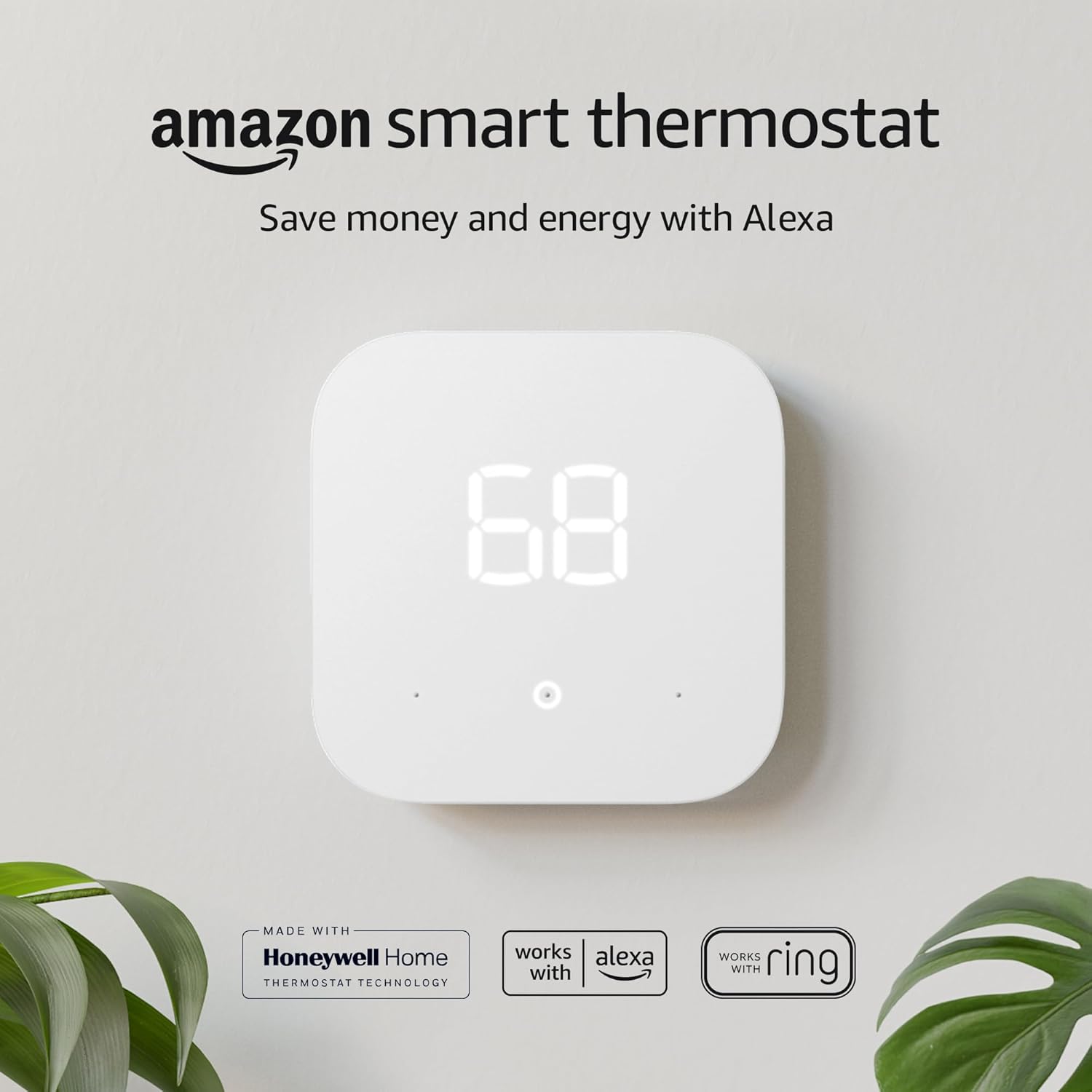
| Single-Stage | Amazon Smart Thermostat / Sensi Touch | $60–$130 | Best value smart upgrade |
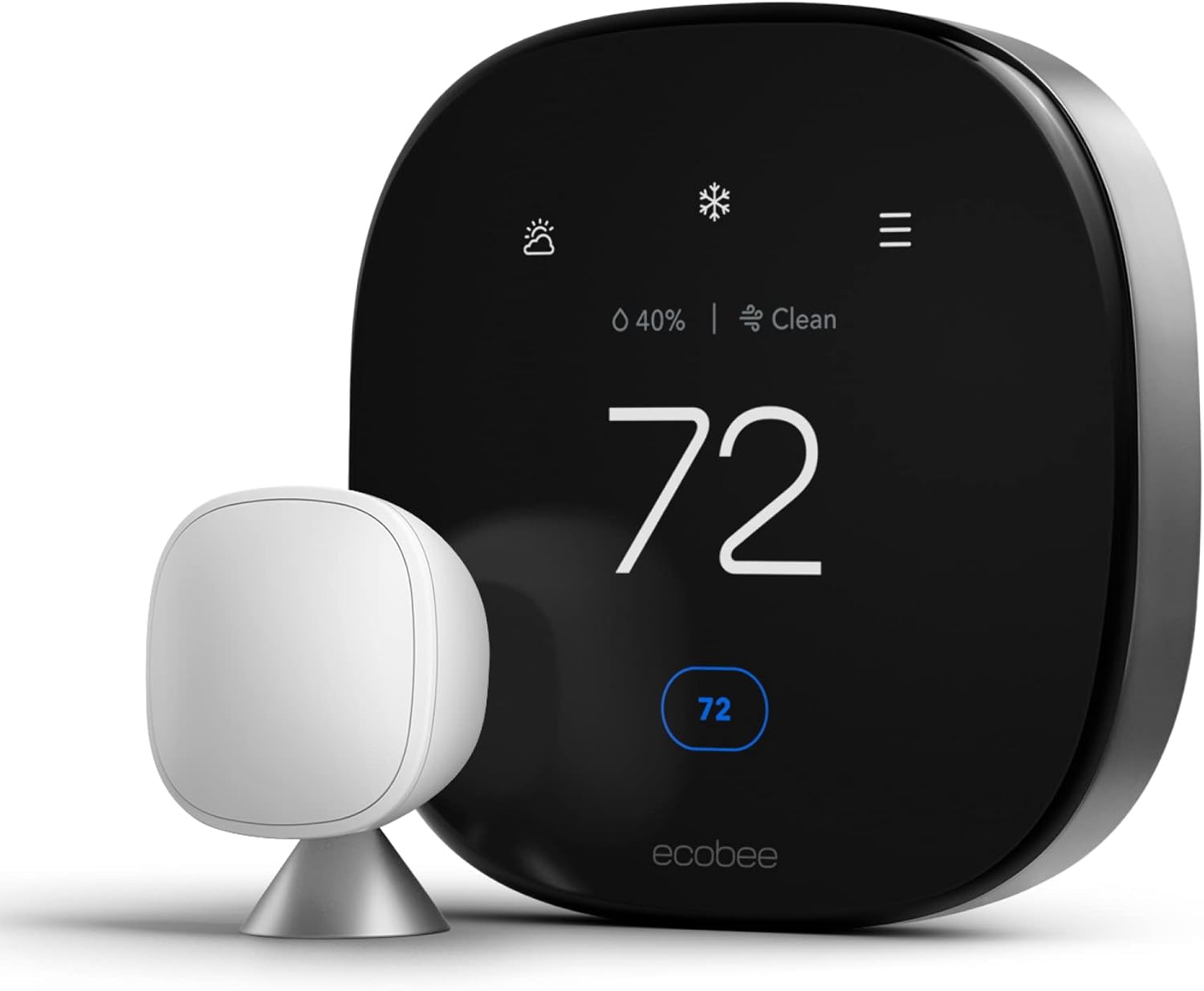
| Two-Stage | Ecobee Premium / Nest Learning (4th Gen) | $180–$250 | Full 2-stage support + sensors |
| Variable-Speed | Brand-matched controller + smart override | $200–$500 | Preserves full modulation |
| Mini-Split | Vendor app + Sensibo / Cielo integration | $100–$200 | Smart scheduling for IR-controlled units |
How to Get the Best Price on AC Installation
The single most effective thing you can do to reduce your AC installation cost is to be an informed buyer who gets multiple quotes. Everything else — negotiation, timing, rebate stacking — is secondary to that foundation. Here’s the full playbook:
1. Get At Least Three Quotes
One quote gives you no frame of reference. Two creates false confidence. Three gives you real market data. For a $6,000 AC installation, the difference between the highest and lowest legitimate quote from three local contractors is typically $800–$2,000. That’s real money that takes about 3 hours of your time to capture.
2. Schedule in the Off-Season
AC demand peaks in April–August in most markets. Contractors are busiest, waitlists are longest, and prices are highest. Schedule an installation in October–February (or November–March in warm climates) and you’ll find contractors more willing to negotiate and more attentive to the job. Off-season pricing discounts of 8–15% are common.
3. Specify Exactly What You Want
Don’t call and say “I need a new AC.” Call and say “I need quotes for a 3-ton, 16 SEER2 two-stage central air conditioner replacement — existing ductwork, no relocation.” Specific requests yield apples-to-apples comparison quotes rather than three completely different systems at completely different price points.
4. Never Accept a Phone-Only Quote
Any contractor who quotes you a price for a full AC installation over the phone without visiting your home is guessing — and that guess will change when they arrive and see the actual job conditions. Insist on an in-home estimate. Reputable HVAC companies provide these at no charge.
5. Verify License, Insurance, and Permit Practice
Before signing anything, ask every contractor for their contractor’s license number (verify it with your state licensing board), proof of liability and workers’ compensation insurance, and confirmation that they pull the required mechanical permit. A contractor who balks at any of these three things should be crossed off your list immediately.
6. Negotiate — It Works
HVAC installation is more negotiable than most homeowners realize. With competing quotes in hand, call your preferred contractor and say exactly that: “I have a competing quote that’s $800 lower for comparable equipment. Can you match it?” A yes saves you $800 with one phone call. Even a partial match ($400) was worth making.
- Research SEER2 minimums for your region and get the BTU range for your home size
- Call 3–4 HVAC companies; request in-home estimates only (no phone quotes)
- Ask each contractor to itemize equipment, labor, refrigerant, lineset, permits, and disposal separately
- Check utility rebates (call your electric company) and ENERGY STAR for federal credit qualification
- Compare quotes on identical equipment specs — brand, tons, SEER2, staging
- Negotiate with your top contractor using the best competing bid
- Confirm permits are included before signing; ask for the inspection process
- Plan your smart thermostat upgrade before installation day so wiring is checked simultaneously
- Quote provided over the phone without a home visit
- “Today only” pricing or high-pressure close tactics
- No mention of permits or inspection
- Recommendation for a much larger system with no load calculation
- No itemized breakdown of equipment vs. labor on the quote
- Cannot provide license number or insurance certificate on request
- Significantly lower than all other quotes (often signals unlicensed work or bait-and-switch)
Frequently Asked Questions
Ready to Move Forward with Your AC Installation?
You now have the full picture: what AC installation actually costs, which variables matter most, how to evaluate efficiency vs. upfront investment, which brands deserve the premium, and exactly how to negotiate a fair price. The next step is yours.
Get three in-home quotes from licensed contractors, stack every rebate available in your area, and pair your new system with a smart thermostat that lets you capture every bit of efficiency you paid for.
Find the Right Thermostat for Your New AC →How Geofencing Cuts Your AC Runtime Costs




 Home
Home
 Info
Info
 Compare
 Reviews
 Shop
Shop