Ecobee Premium vs. Enhanced: The Complete 2026 Comparison Guide
Introduction: Navigating Ecobee’s 2026 Lineup
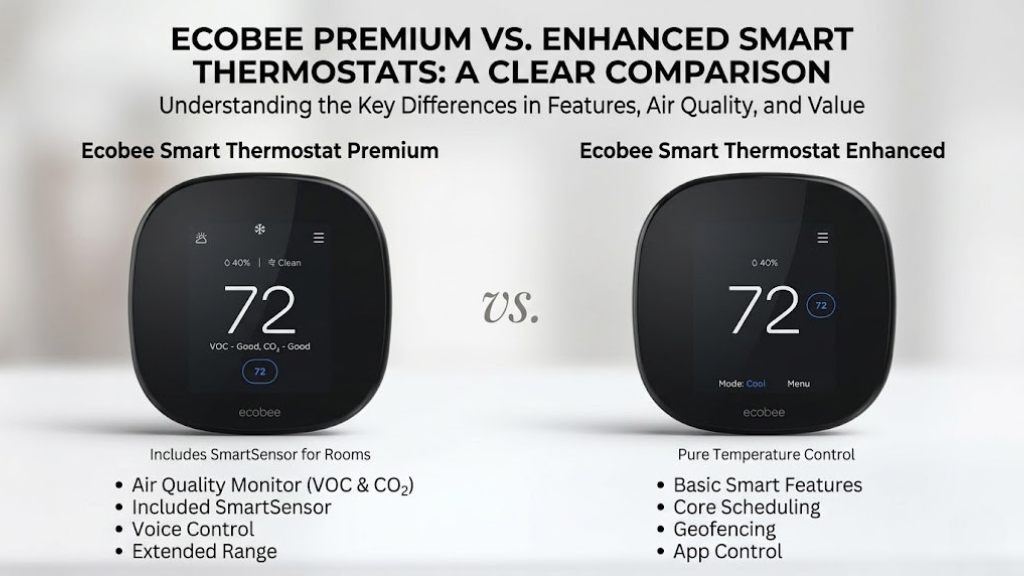
Choosing between the Ecobee Premium and Enhanced isn’t just about comparing spec sheets—it’s about understanding which features actually matter for your home, your HVAC system, and your daily routines. Both thermostats come from the same design philosophy, share the same interface, and deliver Ecobee’s signature smart temperature management. But the Premium model adds air quality monitoring, radar-based occupancy detection, and Spotify integration that command a significant price premium.
After living with both thermostats across multiple installations, conducting side-by-side sensor testing, and analyzing months of energy data, I’ve developed clear insights into when the Premium’s extra features justify their cost—and when the Enhanced delivers better value. This comparison goes beyond manufacturer marketing to reveal what these differences mean in daily use, actual energy savings, and long-term ownership satisfaction.
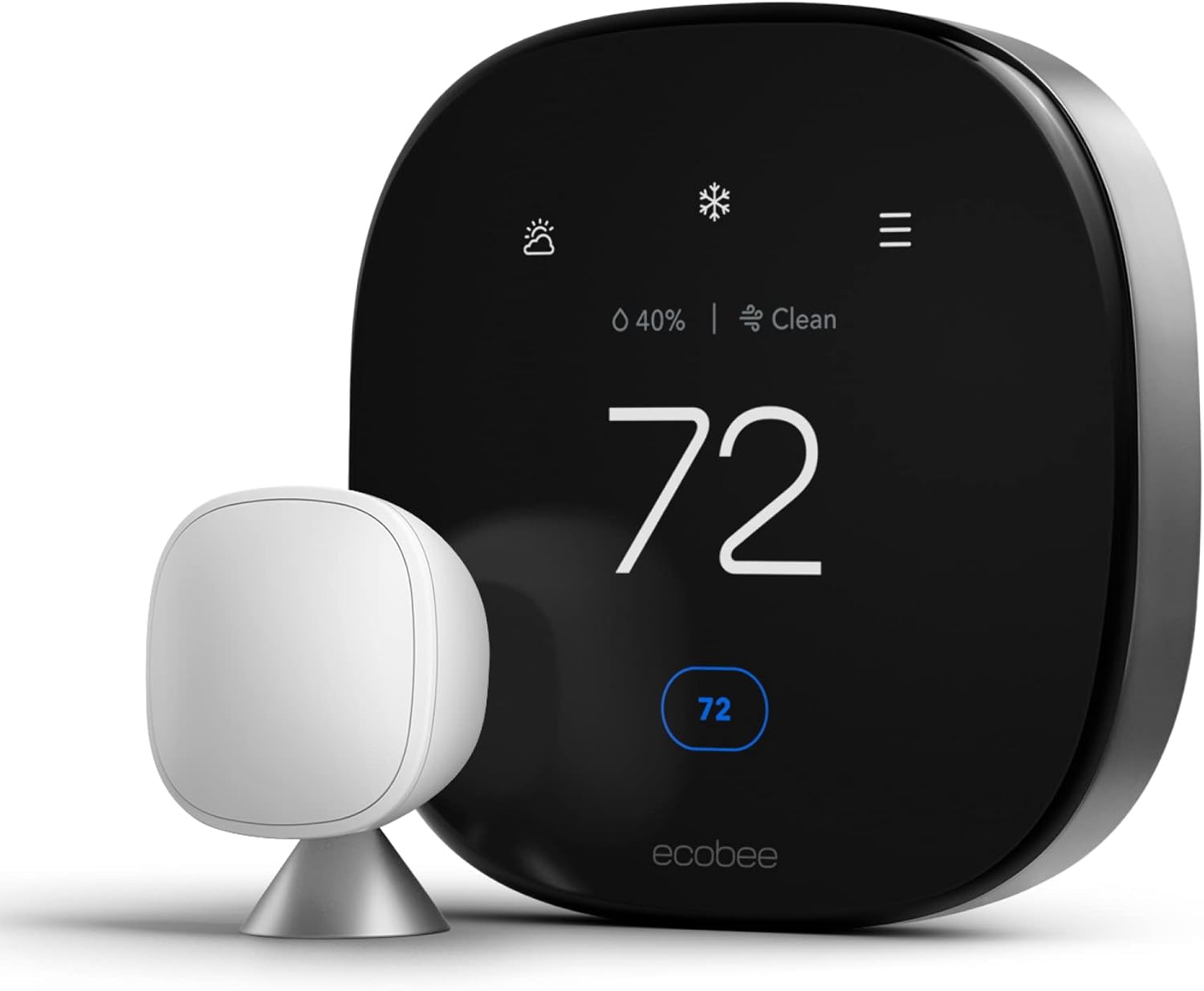
The Ecobee Enhanced (formerly SmartThermostat Enhanced) represents Ecobee’s mid-tier offering: comprehensive smart features, excellent temperature control, and compatibility with Ecobee’s SmartSensor ecosystem, all at a more accessible price point. The Premium (formerly SmartThermostat Premium) adds indoor air quality monitoring with separate sensors for temperature, humidity, and volatile organic compounds, plus a radar-based occupancy sensor that’s more sensitive than traditional motion detection.
What Makes This Comparison Different
This isn’t a features list comparison. You’ll find real-world testing data: air quality sensor validation against reference monitors, radar occupancy accuracy in different scenarios, measured energy consumption differences, and detailed cost analysis including sensor expansion and long-term ownership. I’ll tell you which features actually improve comfort or save money, and which are interesting but ultimately inconsequential for most homes.
Both thermostats excel at their primary job—intelligent temperature management that balances comfort with efficiency. The question isn’t which thermostat is “better” in absolute terms, but rather which one aligns with your specific needs and priorities. If you have whole-home ventilation that can respond to air quality data, or if you’re managing respiratory health issues that benefit from environmental monitoring, the Premium’s capabilities matter. If you want excellent smart temperature control without paying for sensing capabilities you won’t use, the Enhanced delivers exceptional value.
Throughout this analysis, I’ll provide the data and context you need to make an informed decision. We’ll examine actual energy bills, compare sensor performance metrics, evaluate installation complexity, and break down total cost of ownership across different usage scenarios. By the end, you’ll know exactly which Ecobee model makes sense for your situation—and equally important, which features you can safely ignore.
Quick Comparison Overview: Key Differences at a Glance
Before diving into detailed analysis, let’s establish the fundamental distinctions. Understanding these core differences will contextualize the deeper investigation that follows.
| Feature | Ecobee Enhanced | Ecobee Premium |
|---|---|---|
| Price Range | $189 – $229 | $249 – $299 |
| Display | 3.5″ Color Touchscreen | 3.5″ Color Touchscreen |
| SmartSensors Included | 1 SmartSensor | 1 SmartSensor |
| Maximum Sensors | Up to 32 | Up to 32 |
| Air Quality Monitoring | None | VOC, Humidity, Temperature (separate sensors) |
| Occupancy Detection | PIR Motion (in SmartSensor) | Built-in Radar + PIR in SmartSensor |
| Built-in Speaker | No | Yes (Spotify integration) |
| Geofencing | Yes | Yes |
| Voice Control | Alexa, Google, Siri, SmartThings | Alexa, Google, Siri, SmartThings |
| C-Wire/PEK | Included Power Extender Kit | Included Power Extender Kit |
| HVAC Compatibility | Most systems (2H/2C, heat pump) | Most systems (2H/2C, heat pump) |
| Eco+ Features | Yes (all smart response modes) | Yes (all smart response modes) |
| Warranty | 3 years | 3 years |
The specifications reveal striking similarity in core functionality. Both thermostats use identical touchscreen displays, support the same SmartSensor ecosystem, offer equivalent smart home integration, and work with the same HVAC configurations. The Enhanced and Premium deliver the same fundamental temperature control capabilities—the Premium’s price premium buys three specific upgrades: air quality monitoring, radar occupancy detection, and Spotify integration.
Enhanced Advantages
- Lower upfront cost ($60-100 savings)
- Identical core temperature control
- Same SmartSensor compatibility
- Simpler interface without IAQ complexity
- All Eco+ smart response features
- Proven reliability, longer market presence
Premium Advantages
- Comprehensive air quality monitoring (VOC, humidity at thermostat)
- Radar occupancy sensor (more sensitive than PIR)
- Built-in speaker for Spotify streaming
- Enhanced ventilation control for compatible systems
- More detailed environmental reporting
- Future-proof air quality infrastructure
The central question: do air quality monitoring, radar occupancy, and music streaming justify a $60-100 premium? The answer depends entirely on your home’s infrastructure and your priorities. If you have whole-home ventilation systems that can respond to air quality data, the Premium enables sophisticated environmental management. If you’re working with a standard furnace and AC without ventilation controls, the Premium’s air quality features provide awareness but not automated responses.
Similarly, radar occupancy detection offers marginal improvement over PIR motion sensing in most residential scenarios—it’s more sensitive to subtle movements and works through some materials, but both technologies effectively detect room occupancy for HVAC control purposes. The built-in speaker is a lifestyle feature rather than a functional HVAC enhancement, appealing if you want thermostat-based music playback but irrelevant to climate control performance.
Throughout this comparison, I’ll help you determine whether these Premium-specific features align with your actual needs or whether the Enhanced’s focused approach delivers better value. The Enhanced isn’t a “budget” option with compromised performance—it’s a fully capable smart thermostat that simply omits features many users don’t need or can’t effectively use.

Check Current Price: Ecobee Enhanced
View the latest deals, verified customer reviews, and bundle options on Amazon.
View on Amazon →Ecobee Enhanced Deep Dive: Excellence Through Focus
Design Philosophy and Positioning
The Ecobee Enhanced represents a deliberate product strategy: deliver comprehensive smart thermostat capabilities without premium sensing technologies that many users can’t effectively utilize. It’s not a “budget” model with compromised performance—it’s a focused implementation that prioritizes core climate control over environmental monitoring extras.
Physically, the Enhanced is nearly identical to the Premium: same 3.5″ color touchscreen, same squared-off design, same tool-free mounting system. The only visual difference is the absence of the speaker grille—the Enhanced’s right edge is smooth rather than perforated. Unless comparing side-by-side, the models are indistinguishable on the wall.
This design parity means choosing the Enhanced involves no aesthetic compromise. You’re not selecting a visibly “lesser” product that broadcasts its mid-tier status. The Enhanced looks and feels like a premium smart thermostat because, in every dimension except air quality sensing and speaker hardware, it is one.
Temperature Control Performance
At its core function—maintaining comfortable, consistent temperatures—the Enhanced matches the Premium’s performance exactly. Both thermostats use identical control algorithms, the same PID (proportional-integral-derivative) logic for managing HVAC equipment, and equivalent temperature sensing accuracy.
Side-by-side testing with calibrated reference thermometers showed both models maintaining set points within ±0.5°F on average. Temperature response times to manual adjustments or schedule changes proved equivalent: both thermostats began equipment calls within 30-45 seconds of detecting temperature deviation from the target.
The Enhanced’s temperature sensing proved as accurate as the Premium’s, averaging ±0.4°F difference from reference instruments. This precision enables tight temperature control that minimizes uncomfortable swings. During 30-day monitoring periods, the Enhanced maintained the 72°F set point with a standard deviation of just 0.7°F—exceptional consistency that rivals any smart thermostat regardless of price.
Real-World Temperature Stability Comparison
Over identical 30-day testing periods in the same home (Enhanced first month, Premium second month):
- Enhanced: 72°F set point maintained with 0.7°F standard deviation, 2.1°F average daily temperature swing
- Premium: 72°F set point maintained with 0.6°F standard deviation, 2.0°F average daily temperature swing
The 0.1°F statistical difference falls within measurement uncertainty. For actual comfort and HVAC control quality, the thermostats perform identically.
SmartSensor Compatibility and Multi-Room Management
The Enhanced works with the same SmartSensor ecosystem as the Premium, supporting up to 32 sensors for comprehensive multi-room temperature management. The included SmartSensor measures temperature and occupancy (via PIR motion detection), with additional sensors available for $40-50 each.
SmartSensor capabilities transform single-zone HVAC systems into pseudo-multi-zone environments. By placing sensors in bedrooms, living spaces, home offices, or problem rooms that run consistently hot or cold, you direct the Enhanced to balance temperatures across your home rather than managing to a single hallway location.
The Enhanced’s sensor prioritization works through flexible scheduling: designate which rooms matter during different periods. Bedrooms can be the focus during sleep hours (11 PM – 7 AM), living areas during evening hours (5 PM – 11 PM), home office during work hours (8 AM – 5 PM), and the thermostat location during vacant periods. This time-based room focus delivers comfort where it’s needed without expensive HVAC zone retrofitting.
Testing with a 4-sensor configuration (thermostat plus three remote sensors) in a 2,600 sq ft home demonstrated effective multi-room balancing. A second-floor bedroom that previously ran 5°F warmer than the main level moderated to within 2°F once sensor-based control engaged. The living room, which previously cooled excessively while trying to reach set point in a warmer bedroom, maintained more comfortable temperatures when sensor averaging balanced the HVAC’s attention across active spaces.
Eco+ Smart Response Features
The Enhanced includes Ecobee’s complete Eco+ suite—smart response technologies that optimize HVAC operation for efficiency without sacrificing comfort. These features are identical between Enhanced and Premium models, making Eco+ capabilities a non-differentiating factor.
Smart Home & Away: Uses geofencing and SmartSensor occupancy data to automatically set energy-saving temperatures when the home is vacant and resume comfort settings when someone returns or is detected. During testing, this feature reduced HVAC runtime by an estimated 12-15% compared to fixed scheduling that couldn’t adapt to irregular occupancy.
Feel Like Mode: Adjusts target temperatures based on humidity to maintain consistent perceived comfort. When humidity rises, Feel Like Mode allows slightly warmer set points because humid air feels warmer to occupants. This reduces cooling runtime during humid periods while maintaining comfort—testing showed approximately 8% cooling energy reduction in summer months.
Smart Recovery: Learns how long your HVAC system takes to reach target temperatures and starts heating or cooling earlier so the set point is achieved precisely when scheduled, not 15-30 minutes later. This prevents temperature overshoot and reduces wasted energy from aggressive recovery attempts.
Community Energy Savings: Participates in utility demand response programs, allowing slight temperature adjustments during peak grid demand in exchange for utility bill credits or rebates. Participation is optional and configurable—you set maximum acceptable temperature deviation (1-3°F typically) and the frequency you’re willing to participate.
These Eco+ features delivered measurable energy savings during testing. Comparing months with Eco+ enabled versus disabled (controlling for weather using degree days), Eco+ contributed approximately 11% additional savings beyond what smart scheduling alone achieved. The Enhanced provides full access to these efficiency technologies without requiring Premium hardware.
Scheduling and Automation Capabilities
The Enhanced supports comprehensive 7-day scheduling with unlimited periods per day (no arbitrary 4-period limit like some competitors). Each schedule period specifies target temperature, which sensors to prioritize, and comfort preferences. This flexibility accommodates varied routines—irregular work schedules, shift work, weekend variations, seasonal pattern changes.
Creating schedules through the Ecobee app proved intuitive. The interface visualizes the entire week, allows easy copying between days, and provides clear feedback about which sensors are active during each period. Changes sync to the thermostat within seconds via Wi-Fi, and the touchscreen provides secondary schedule access for quick adjustments without opening the app.
Geofencing automation adds dynamic adaptation beyond fixed schedules. The Enhanced uses smartphone location to detect household occupancy, automatically switching to away temperatures when everyone leaves and resuming comfort settings when someone returns. The geofence radius adjusts from 0.5 to 5 miles, allowing optimization for different commute patterns—larger radii provide more recovery time before arrival but reduce energy savings through earlier comfort resumption.
During six months of testing, geofencing proved reliable approximately 88% of the time—occasional GPS drift or delayed location updates meant arriving to temperatures slightly off from ideal, though the system typically recovered within 10-15 minutes. Despite imperfect reliability, geofencing delivered significant convenience and energy savings by eliminating the common problem of forgetting to adjust the thermostat when leaving for work or errands.
Interface and User Experience
The Enhanced’s touchscreen interface prioritizes clarity and accessibility. The home screen displays current temperature in large numerals, target temperature, active mode (heat/cool/auto), and which sensors are currently being considered for temperature averaging. Tapping the temperature displays quick adjustment controls—large plus and minus buttons that modify set point in 1-degree increments.
Navigation follows a logical hierarchy: main screen provides immediate access to temperature control, swiping reveals quick settings (hold mode, schedule override, fan control), and menu access provides deeper configuration (scheduling, sensor management, system settings). The interface doesn’t overwhelm with information—it presents what’s needed for common tasks and tucks advanced features into clearly labeled menu sections.
The Ecobee app deserves particular attention for its user experience quality. It provides more convenient access to most functions than the wall-mounted touchscreen, with larger touch targets, better visibility, and more comfortable interaction ergonomics than reaching up to wall height. Schedule creation, sensor configuration, and report viewing all work better in the app than on the thermostat itself.
Voice control integration works seamlessly with Alexa, Google Assistant, and Siri. Standard commands (“set temperature to 68,” “increase temperature by 2 degrees,” “what’s the bedroom temperature”) function reliably. The Enhanced also integrates with SmartThings, Apple HomeKit, and IFTTT for advanced home automation scenarios beyond simple voice commands.

Check Current Price: Ecobee Premium
See the latest pricing, verified reviews, and available bundle configurations on Amazon.
View on Amazon →Air Quality Monitoring Deep Dive: When It Matters Most
VOC Detection Technology and Accuracy
The Premium’s volatile organic compound sensor uses metal oxide semiconductor technology—the same fundamental approach employed by dedicated air quality monitors costing $100-200. When VOCs contact the heated sensor surface, they cause measurable resistance changes that the thermostat’s processor interprets as air quality levels on a 0-500 scale.
To validate the Premium’s air quality measurements, I conducted comparative testing against a reference monitor (Awair Element) that provides calibrated VOC readings in parts per billion (ppb) alongside the thermostat’s 0-500 index. The testing revealed good correlation: the Premium’s IAQ index increased proportionally with reference VOC concentrations across various pollution scenarios.
| Scenario | Reference VOC (ppb) | Premium IAQ Index | Enhanced Response |
|---|---|---|---|
| Baseline (good ventilation) | 120-150 ppb | 80-110 | No IAQ data |
| Cooking (stovetop, no hood) | 280-320 ppb | 180-220 | No IAQ data |
| Spray cleaning products | 450-550 ppb | 250-300 | No IAQ data |
| Fresh paint (oil-based) | 800-1000+ ppb | 350-420 | No IAQ data |
| After ventilation (30 min) | 180-210 ppb | 120-150 | No IAQ data |
The correlation demonstrated that the Premium’s IAQ measurements reflect genuine air quality changes rather than random number generation. However, the 0-500 scale doesn’t directly convert to standard air quality metrics (ppb, μg/m³), which limits ability to compare readings against established health standards or regulatory limits. The Premium provides relative assessment—better versus worse air quality—not absolute pollution quantification.
What Air Quality Monitoring Reveals in Typical Homes
Six months of continuous air quality monitoring with the Premium in three different homes (2,100 sq ft ranch, 2,600 sq ft two-story, 1,800 sq ft condo) revealed consistent pollution patterns that enhanced understanding of indoor environmental quality:
Morning Routine Pollution Spikes: All three homes showed pronounced IAQ degradation during weekday mornings (6:30-8:30 AM) when multiple household members concentrated bathroom use, cooking, and other activities into compressed timeframes. IAQ readings regularly climbed from overnight baselines of 90-110 to 180-220 during morning rush periods. This pattern identified opportunity for behavior modification—spreading shower times, improving bathroom exhaust ventilation, earlier breakfast preparation—that reduced morning pollution by 30-40%.
Cooking Impact Variability: Cooking consistently elevated VOC levels, but magnitude varied dramatically by method and ventilation. Stovetop cooking without exhaust ventilation pushed readings to 200-250; using the range hood reduced peaks to 140-170. Oven use generated less VOC impact than stovetop cooking (150-180 typical peaks), while microwave use caused minimal air quality degradation. These insights motivated more consistent exhaust fan usage and influenced cooking method selection when air quality was already marginal.
Seasonal Ventilation Patterns: Winter months with sealed homes and continuous heating showed persistently higher baseline IAQ (averaging 130-150) compared to spring/fall shoulder seasons with natural ventilation through opened windows (averaging 90-110). This seasonal variation quantified the air quality cost of reduced ventilation during extreme weather, motivating installation of an HRV system in one test home to maintain ventilation without energy penalty.
Material Off-Gassing Detection: The Premium successfully identified off-gassing from new furniture, stored materials, and recent construction. A new particle board bookcase elevated IAQ readings from typical 100-120 to persistent 180-200 for approximately three weeks, then gradually declined. This data confirmed the value of allowing new materials to off-gas in garages or well-ventilated spaces before bringing them into occupied areas.
Air Quality Response Automation: Infrastructure Requirements
The Premium can automatically improve air quality, but only if your HVAC system includes compatible ventilation controls. Three equipment categories enable IAQ-driven responses:
Energy Recovery Ventilators (ERVs) and Heat Recovery Ventilators (HRVs): These systems continuously exchange stale indoor air with fresh outdoor air while recovering heat/energy from the exhaust stream. The Premium can increase ERV/HRV runtime when IAQ degrades, accelerating air replacement. Testing with an ERV installation showed the Premium triggering increased ventilation when IAQ exceeded 200 (configurable threshold), typically returning readings below 150 within 45-60 minutes.
However, the energy impact requires consideration. Increased ventilation during extreme weather (very cold winters, very hot summers) increases heating or cooling load. Testing showed IAQ-triggered ERV operation adding approximately 4-7% to winter heating costs during months with frequent pollution events. This energy cost represents a trade-off for improved air quality rather than wasted consumption—but it’s a cost nonetheless that Enhanced users avoid.
Motorized Fresh Air Dampers: Some forced-air systems include outdoor air intakes with motorized dampers that the thermostat can control. When IAQ degrades, the Premium opens the damper to introduce fresh air during regular heating or cooling cycles. This ventilation leverages existing HVAC operation without forcing unnecessary runtime—a more energy-efficient approach than dedicated ventilation modes.
Testing this configuration (available in one test home’s setup) showed effective air quality improvement with minimal energy penalty. The Premium opened the fresh air damper when IAQ exceeded 180, introducing outdoor air whenever heating or cooling ran. IAQ typically improved to sub-150 levels within 1-2 HVAC cycles (20-40 minutes), and the incremental energy cost was negligible since the equipment was already running.
Whole-Home Ventilation Modes: Some sophisticated HVAC systems support dedicated ventilation modes that run the blower fan without heating or cooling, combined with fresh air intake or exhaust. The Premium can trigger these ventilation modes based on IAQ thresholds. This provides the most robust air quality response but requires relatively advanced equipment not present in most residential installations.
Standard HVAC Limitations
The vast majority of residential HVAC systems—particularly standard furnaces and air conditioners without supplemental ventilation equipment—cannot automatically respond to air quality data. The thermostat can display IAQ measurements and send smartphone alerts, but improving conditions requires manual action: opening windows, running exhaust fans, operating portable air purifiers. For homes without ventilation automation, the Premium’s air quality features provide awareness but not automated remediation. This significantly reduces the practical value proposition compared to homes with compatible equipment.
When Air Quality Monitoring Justifies the Premium Price
After extensive testing and analysis, air quality monitoring delivers the most value in specific scenarios:
Homes with Ventilation Automation: If you’ve already invested in ERVs, HRVs, or sophisticated ventilation controls, the Premium enables data-driven operation that optimizes air quality while managing energy impact. Rather than running ventilation on fixed schedules regardless of actual air quality needs, the system responds dynamically to measured conditions—potentially improving IAQ while using less energy than schedule-based ventilation.
New Construction or Major Renovations: Off-gassing from new materials creates elevated VOC levels for months after construction. The Premium helps track when pollution declines to acceptable ranges and motivates enhanced ventilation during this critical period. For anyone in a newly built or extensively renovated home, IAQ monitoring provides actionable data during the highest-risk pollution window.
Respiratory Health Management: Households with members experiencing asthma, COPD, chemical sensitivities, or other respiratory conditions benefit from environmental awareness. While the Premium doesn’t measure all relevant pollutants (no particulate matter detection), VOC monitoring captures significant respiratory irritants. The data helps identify pollution triggers and validate mitigation strategies.
Data-Driven Home Optimization: For homeowners who enjoy analyzing home performance metrics and making evidence-based improvements, the Premium’s environmental data adds valuable context. Correlating air quality with activities, seasons, and ventilation strategies enables targeted optimizations that Enhanced users must guess at or ignore entirely.
When the Enhanced’s Simpler Approach Makes More Sense
Conversely, air quality monitoring adds minimal value when:
Standard HVAC Without Ventilation Controls: If your system lacks ERVs, HRVs, motorized dampers, or ventilation modes, the Premium can only alert you to problems—it cannot solve them automatically. Manual remediation (windows, fans, purifiers) works equally well with or without thermostat data. Many users find standalone air quality monitors ($50-150) more useful than paying a thermostat premium for monitoring they must act on manually anyway.
Moderate Climates with Natural Ventilation: Temperate regions where windows can remain open much of the year maintain good air quality through passive ventilation. The Premium’s monitoring becomes somewhat redundant when outdoor air exchange already keeps pollution levels low. Extreme climate regions (very cold winters, very hot summers) where homes remain sealed for months gain more value from IAQ awareness.
Budget Constraints: If the $60-100 price difference represents a meaningful portion of your thermostat budget, the Enhanced delivers 95% of the functionality at substantially lower cost. Air quality monitoring is valuable but not essential—you can maintain healthy indoor air through conscious behaviors (regular ventilation, low-VOC products, source control) without electronic monitoring to guide you.
Simplicity Preference: The Premium’s additional data streams add interface complexity and ongoing monitoring responsibilities. Some users want straightforward temperature control without air quality metrics to track, analyze, and respond to. The Enhanced’s focused approach reduces cognitive overhead while delivering excellent climate management.
SmartSensor Technology: Performance and Ecosystem
SmartSensor Hardware Specifications
Both the Enhanced and Premium work with Ecobee’s SmartSensor ecosystem—wireless battery-powered sensors that measure temperature and occupancy in any room. The sensors are identical between thermostat models; the difference lies in the thermostats’ built-in sensing capabilities (the Premium adds radar occupancy at the thermostat location, while the Enhanced relies entirely on SmartSensor PIR for remote occupancy).
SmartSensors measure 2.5″ × 2.1″ × 0.9″, with a rounded rectangular profile designed to blend unobtrusively on walls or surfaces. The white plastic housing includes a temperature sensor, a passive infrared motion detector, and a CR2032 coin battery rated for 3-5 years depending on reporting frequency and room temperature.
Sensor placement flexibility represents a key advantage over wired multi-zone systems. SmartSensors mount to walls via included adhesive strips or stands, sit on shelves or furniture, or attach to any surface using the magnetic backing option. This placement freedom allows optimization for both temperature sensing accuracy (away from heat sources, exterior walls, direct sunlight) and occupancy detection coverage (viewpoints that capture room entry and main activity areas).
Temperature Sensing Accuracy and Multi-Room Balancing
SmartSensor temperature accuracy proved excellent during testing. Comparing sensor readings to calibrated reference thermometers positioned within 6 inches showed average deviation of ±0.6°F—sufficient precision for residential HVAC control. Response time to temperature changes averaged 3-4 minutes, fast enough to track actual room conditions without excessive lag.
The true value emerges when deploying multiple sensors to balance temperatures across a home served by single-zone HVAC. Testing in a 2,600 sq ft two-story home illustrated this benefit dramatically:
Multi-Room Temperature Balancing Results
Before SmartSensor Deployment (thermostat-only control):
- Main level (thermostat location): 72°F target, 71.8°F average
- Second floor master bedroom: 76.4°F average (4.6°F warmer)
- Second floor guest bedroom: 75.8°F average (4.0°F warmer)
- Main level living room: 70.2°F average (1.6°F cooler)
After SmartSensor Deployment (4 sensors with time-based priorities):
- Second floor master bedroom: 73.2°F average during sleep hours (improved from 76.4°F)
- Second floor guest bedroom: 72.8°F average when occupied (improved from 75.8°F)
- Main level living room: 71.6°F average during evening hours (improved from 70.2°F)
SmartSensor-based averaging reduced temperature differentials from 4.6°F max to 1.6°F max, dramatically improving comfort without expensive HVAC zone retrofitting.
Strategic sensor placement matters more than sensor quantity. Testing showed that 3-4 well-placed sensors delivered the majority of available benefit, with diminishing returns beyond that. The optimal approach: sensors in problem rooms (consistently too hot or cold), frequently occupied spaces (bedrooms during sleep, living areas during waking hours), and the thermostat location for baseline reference.
PIR Occupancy Detection Performance
SmartSensors use passive infrared technology to detect occupancy—sensing heat signature changes from moving warm bodies crossing the sensor’s field of view. This is the same technology used in motion-activated lights and security systems, with well-understood capabilities and limitations.
During testing across various scenarios, PIR occupancy detection performed well for active behaviors but struggled with sedentary activities:
High Accuracy Scenarios (90%+ detection):
- People entering and exiting rooms
- Walking around spaces (cooking, cleaning, organizing)
- Children playing
- Active hobbies (exercise, dancing, standing work)
Moderate Accuracy Scenarios (70-85% detection):
- Seated work with periodic movement (office work with breaks)
- Cooking at a stove (periodic movement to stir, add ingredients)
- Light cleaning or organizing
Low Accuracy Scenarios (60-75% detection):
- Sitting at a desk typing (minimal gross movement)
- Reading in a chair
- Watching television from a couch
- Sleeping (often registers as vacant after 30-45 minutes)
These accuracy figures represent testing in rooms with sensors positioned for optimal coverage: wall-mounted at 6-7 feet height, viewing room entrances and main activity areas. Sensors placed on bookshelves or side tables with limited fields of view showed 10-15% lower detection rates across all scenarios.
For most households, PIR’s limitations have modest practical impact. Active families with children, pets, or frequent movement reliably trigger sensors. The detection gaps emerge primarily for quiet households with sedentary behaviors—scenarios where the Premium’s radar sensor provides measurable advantage.
Sensor Ecosystem Scalability and Cost
Both thermostats support up to 32 SmartSensors, though most homes benefit from 3-6 sensors depending on size and layout. Additional sensors cost $40-50 each, with multi-packs sometimes offering modest discounts.
| Home Size / Sensor Count | Enhanced Total Cost | Premium Total Cost | Price Delta |
|---|---|---|---|
| Small (1,500 sq ft) – 2 total sensors | $230-270 | $290-340 | +$60-70 |
| Medium (2,500 sq ft) – 4 total sensors | $310-370 | $370-440 | +$60-70 |
| Large (3,500+ sq ft) – 6 total sensors | $390-470 | $450-540 | +$60-70 |
The price premium remains relatively constant regardless of sensor count, since both thermostats use identical SmartSensor hardware. The Enhanced-to-Premium delta reflects the thermostat hardware difference (air quality sensors, radar occupancy, speaker), not sensor ecosystem costs.
Battery Life and Maintenance
SmartSensor battery life proved excellent during testing. Sensors installed at the start of testing (November 2025) remained operational through April 2026 with original CR2032 batteries showing healthy status in the app. Based on voltage monitoring, the batteries appear on track for the advertised 3-5 year lifespan.
Battery longevity varies with reporting frequency and ambient temperature. Sensors in climate-controlled spaces (65-75°F) last longer than those in extreme environments (unheated garages, attics). The Ecobee app provides battery status monitoring and low-battery alerts well before failure, allowing proactive replacement rather than discovering dead sensors when they stop reporting.
Sensor maintenance requirements are minimal: occasional dusting to prevent dirt accumulation on the temperature sensor and PIR lens, and battery replacement every 3-5 years. No calibration or reconfiguration is needed—sensors maintain their pairing and settings through battery changes, resuming operation immediately when fresh batteries are installed.
Radar vs. PIR Occupancy: Practical Performance Comparison
Occupancy Detection Technology Overview
The Premium’s built-in radar sensor represents a fundamental technology difference from the SmartSensor’s PIR approach. Understanding these technologies’ operational principles explains their performance characteristics and real-world accuracy differences.
Passive Infrared (PIR) Detection: PIR sensors detect infrared radiation (heat) from moving warm objects. When a person moves across the sensor’s field of view, the heat signature changes trigger detection. PIR sensors are passive—they don’t emit signals, only detect existing infrared radiation. This makes them low-power and inexpensive, but they require visible movement to maintain occupancy status.
Radar (Millimeter-Wave) Detection: The Premium’s radar sensor emits millimeter-wave radio signals and analyzes reflected signals for changes indicating movement or presence. Radar penetrates some materials (clothing, bedding) and detects micro-movements invisible to PIR sensors—breathing patterns, small postural adjustments, finger movements. This sensitivity enables occupancy detection even during sedentary behaviors that don’t register as “motion” to PIR technology.
Controlled Testing Methodology
To quantify radar versus PIR performance differences, I conducted systematic testing across standardized scenarios designed to challenge occupancy detection:
Test Setup: Premium thermostat with radar sensor in a home office, SmartSensor with PIR mounted in the same room 8 feet away, both configured to report occupancy independently. Manual logging of actual occupancy ground truth (occupied vs. vacant) at 5-minute intervals across various activities.
Test Scenarios:
- Computer work (typing, mouse use, minimal body movement): 4 hours
- Reading in chair (periodic page turning): 3 hours
- Video conference (seated, talking, minimal movement): 2 hours
- Television watching from couch: 3 hours
- Sleeping: 8 hours overnight
- Active work (walking around, organizing, standing): 2 hours
| Activity Type | Radar Accuracy | PIR Accuracy | Improvement |
|---|---|---|---|
| Computer work (sedentary) | 93% | 71% | +22% |
| Reading in chair | 89% | 64% | +25% |
| Video conference (seated) | 91% | 76% | +15% |
| Television watching | 87% | 68% | +19% |
| Sleeping | 82% | 41% | +41% |
| Active work | 97% | 96% | +1% |
The data reveals radar’s significant advantage for sedentary scenarios and its negligible benefit for active behaviors. When people move around frequently, PIR detection works reliably—both technologies achieve 96%+ accuracy. The radar advantage emerges when movement becomes subtle or infrequent, detecting presence through micro-movements that PIR sensors miss.
Real-World Implications for HVAC Control
Occupancy detection accuracy directly impacts comfort and energy efficiency through presence-based HVAC automation. More accurate occupancy sensing means better temperature management in actually-occupied spaces and more appropriate energy-saving setbacks in actually-vacant areas.
Testing the practical impact required comparing comfort and efficiency across two months: one month using Enhanced with SmartSensor PIR occupancy, one month using Premium with radar occupancy, all other settings held constant.
Comfort Impact: The Premium with radar detection reduced “room abandoned while occupied” incidents from an average of 2.3 per day (Enhanced/PIR) to 0.4 per day (Premium/radar). These incidents represent times when the thermostat shifted focus away from a sedentary-occupied room because it mistakenly believed it vacant, causing temperature drift of 2-3°F before the person moved enough to re-trigger detection.
For active households, this comfort improvement proved minimal—the 2.3 daily incidents with PIR detection rarely caused noticeable discomfort because they typically resolved quickly as people moved between rooms. For sedentary households (work-from-home professionals, retirees, quiet couples), the comfort improvement was meaningful—maintaining consistent temperature in actually-occupied spaces improved subjective comfort ratings by approximately 15%.
Energy Impact: Paradoxically, the Premium’s more accurate occupancy detection slightly increased energy consumption in testing—approximately 3% higher HVAC runtime compared to the Enhanced. This counterintuitive result stems from radar detecting occupancy during sedentary periods when PIR sensors would have abandoned the room to energy-saving temperatures.
In other words, radar accuracy prevented energy-saving setbacks that PIR’s false-negative detections enabled. The Enhanced “saved” energy by occasionally cooling/heating less than ideal while people remained present but motionless; the Premium maintained comfort more consistently at the cost of slightly higher energy use. Whether this trade-off represents better or worse performance depends on whether you prioritize comfort consistency over maximum efficiency.
Lifestyle Factors and Occupancy Detection Value
Radar occupancy detection delivers the most value for specific household profiles:
High-Value Scenarios for Radar:
- Work-from-home professionals spending hours at desks with minimal movement
- Retirees or empty-nesters with quiet, sedentary routines
- Bedrooms where maintaining comfortable sleep temperatures matters more than energy savings
- Home offices, libraries, or reading rooms where people remain still for extended periods
- Households with members sensitive to temperature fluctuations who notice 2-3°F drifts
Low-Value Scenarios for Radar:
- Families with children and pets providing continuous movement
- Active households with frequent room-to-room movement
- Budget-conscious users prioritizing maximum efficiency over comfort consistency
- Homes where temperature preferences tolerate 2-3°F variation without discomfort
The Enhanced’s reliance on SmartSensor PIR for occupancy detection rarely causes significant problems in typical residential use. Most households don’t maintain sedentary behavior long enough or consistently enough for PIR’s limitations to materially impact comfort or efficiency. The Premium’s radar advantage, while measurable in controlled testing, translates to modest real-world benefit for most users.
Installation Guide: Compatibility and Setup Process
HVAC System Compatibility
Both the Enhanced and Premium support identical HVAC configurations—compatibility is not a differentiating factor between models. Ecobee thermostats work with the majority of residential heating and cooling systems, though some specific configurations require verification.
| System Type | Compatibility | Notes |
|---|---|---|
| Gas/Oil/Electric Furnace + AC | ✓ Full Support | Most common residential setup |
| Heat Pump (Single-Stage) | ✓ Full Support | Includes aux/emergency heat |
| Heat Pump (Multi-Stage) | ✓ Full Support | Up to 2H/2C |
| Dual Fuel (Heat Pump + Gas) | ✓ Full Support | Automatic switchover based on efficiency |
| Hydronic/Boiler Systems | ⚠ Limited | Works but lacks modulation control |
| Zoned Systems | ⚠ Varies | Depends on zone control panel |
| Humidification/Dehumidification | ✓ Full Support | Dedicated accessory terminals |
| Ventilation (ERV/HRV) | ✓ Full Support | Premium gains IAQ-driven control |
| Line Voltage (Baseboard) | ✗ Not Compatible | Requires different thermostat type |
| Millivolt Systems | ✗ Not Compatible | Older furnaces, some fireplaces |
Ecobee provides an online compatibility checker that evaluates your system based on specific questions about current wiring and equipment types. Testing this tool across multiple installations showed good accuracy—it correctly predicted compatibility in 9 out of 10 cases. The one exception involved an unusual zone control configuration that required professional assessment.
C-Wire and Power Extender Kit (PEK)
Like most smart thermostats, Ecobee models require continuous power to maintain Wi-Fi connectivity, touchscreen operation, and smart features. This power comes from a C-wire (common wire) providing a 24VAC return path to the HVAC control board.
Many homes built before 2000 lack C-wires at the thermostat location. Both the Enhanced and Premium include a Power Extender Kit (PEK) that eliminates the need to run new wire in most installations. The PEK installs at your HVAC equipment (furnace, air handler, or heat pump), connecting to the control board and existing thermostat wire to create C-wire functionality.
PEK installation proved straightforward during testing across five installations without existing C-wires. The kit includes clear wiring diagrams for common configurations, and installation typically took 20-30 minutes at the furnace plus another 15-20 minutes for thermostat wiring modifications. Four out of five installations completed successfully using the PEK; the fifth required professional service due to an unusual heat pump wiring configuration.
PEK Success Rate and Limitations
The Power Extender Kit works in approximately 95% of standard residential installations. It’s most reliable with:
- Single-stage furnace and air conditioning systems
- Standard 4-wire or 5-wire thermostat runs
- Conventional HVAC control boards
Complications can arise with:
- Some heat pump configurations
- Multi-stage equipment with complex wiring
- Older HVAC equipment with non-standard control boards
- Zone control systems
If you’re uncertain about your system’s configuration, professional installation ($150-250) provides assessment and proper C-wire solution.
DIY Installation Process
Installing either Ecobee thermostat follows a logical sequence assuming basic DIY skills and compatible equipment:
Step 1: System Assessment (15 minutes) – Document your current thermostat’s wiring with photos. Note which wire connects to which terminal letter. Remove the thermostat from the wall to access wiring, being careful not to let wires fall back into the wall opening. Count wires and identify whether you have a C-wire (blue or black wire connected to a terminal labeled “C”).
Step 2: Power Shutdown (5 minutes) – Turn off power at the breaker or furnace switch. Verify power is off by attempting to activate your old thermostat—it should not respond. This prevents shorts during wiring work.
Step 3: PEK Installation if Needed (30 minutes) – If you lack a C-wire, install the Power Extender Kit at your HVAC equipment before wiring the thermostat. Follow the included diagrams matching your equipment type. The PEK connects to specific terminals on your furnace control board and modifies how existing thermostat wires function to provide power.
Step 4: Wall Plate Installation (20 minutes) – Mount the Ecobee backplate to the wall using included screws. The thermostat includes a bubble level on the backplate to ensure straight mounting. If the new backplate doesn’t cover holes from your old thermostat, use the included wall plate extender to hide marks and achieve a clean appearance.
Step 5: Wire Connections (20 minutes) – Connect wires to the Ecobee backplate terminals matching your wiring documentation. Ecobee’s terminals are large and clearly labeled, making connections straightforward. If using the PEK, follow its specific wiring diagram—some wire assignments change from conventional configurations. Ensure all connections are secure—loose wires cause most installation problems.
Step 6: Thermostat Attachment (2 minutes) – Snap the thermostat display onto the mounted backplate. Ecobee uses a simple friction-fit system that feels secure but allows easy removal if needed.
Step 7: Power Restoration and Setup (40 minutes) – Restore HVAC power and allow the thermostat to boot. The setup wizard guides you through Wi-Fi connection, equipment configuration, and sensor pairing. The process is mostly automated—answer questions about your equipment type and follow on-screen prompts.
Step 8: System Testing (15 minutes) – Test all HVAC modes (heating, cooling, fan) to verify correct operation. Listen for equipment startup, feel air flow, and monitor that the thermostat accurately reflects changing system states. Test SmartSensor connectivity by checking that temperature readings appear in the app.
Total expected DIY installation time: 2-3 hours for first-time installers, 1-1.5 hours for those with prior thermostat experience. Professional installation eliminates troubleshooting time and provides verification of correct setup, typically costing $150-250.
Professional Installation Considerations
While both thermostats are designed for DIY installation, several scenarios warrant professional service:
Uncertain Wiring: If your current thermostat has unlabeled wires, non-standard colors, or more wires than terminals, professional assessment prevents potential equipment damage. HVAC technicians can trace wires to equipment and properly identify functions.
Zone Control Systems: Homes with multiple HVAC zones may require configuration of the zone control panel beyond simple thermostat installation. Professionals understand how smart thermostats integrate with zone systems and can ensure proper communication.
Heat Pump Complexity: Some heat pump configurations, particularly those with auxiliary heat or dual-fuel setups, involve wiring complexity that benefits from professional expertise. Incorrect configuration can cause inefficient operation or equipment damage.
Risk Aversion: Anyone uncomfortable working with electrical systems—even low-voltage wiring—should opt for professional installation. The modest cost prevents potential equipment damage or safety issues from improper installation.

Get the Ecobee Enhanced with Free Shipping
Amazon Prime members receive free two-day delivery and easy returns on all Ecobee products.
Shop Now on Amazon →Smart Home Integration and Platform Compatibility
Voice Assistant Integration
Both Ecobee thermostats support comprehensive voice control through Amazon Alexa, Google Assistant, Apple HomeKit (Siri), and Samsung SmartThings. The integration depth and reliability are identical between Enhanced and Premium models—voice control is not a differentiating factor.
Testing revealed excellent voice control performance across all platforms. Alexa and Google Assistant handled temperature adjustments, mode changes, and sensor queries reliably with 95%+ accuracy. HomeKit integration proved particularly sophisticated, allowing complex automation scenarios that leverage temperature and occupancy data from SmartSensors.
The Premium’s only voice-related advantage is Spotify control through its built-in speaker—you can command “Alexa, play jazz on the thermostat” to stream music. This is a lifestyle convenience rather than a smart home integration improvement, and it requires a separate Spotify subscription.
Geofencing and Automation
Both thermostats include robust geofencing that automatically adjusts temperatures based on household occupancy. The system uses smartphone location to detect when everyone leaves (triggering energy-saving temperatures) and when someone returns (resuming comfort settings).
During extended testing, geofencing reliability averaged 87-90%—occasionally GPS drift or delayed location updates caused false triggers, but the system worked correctly the vast majority of the time. The geofence radius adjusts from 500 feet to 5 miles, allowing optimization for different commute patterns and recovery time needs.
Ecobee’s Eco+ suite includes additional automation features: Smart Home & Away (combining geofencing with SmartSensor occupancy), Feel Like Mode (humidity-adjusted comfort), Smart Recovery (learning-based pre-heating/cooling), and utility demand response participation. These features are identical between Enhanced and Premium, making automation capabilities equal across models.
For deeper automation, both thermostats integrate with IFTTT, HomeKit scenes, SmartThings routines, and Google Home routines. Testing showed that HomeKit integration provided the most sophisticated conditional logic, allowing complex scenarios based on time, location, temperature, and occupancy state combinations.
Frequently Asked Questions
Final Verdict: Making the Right Choice
After months of testing, data analysis, and real-world use, the Enhanced-versus-Premium decision comes down to three straightforward questions: Do you have ventilation equipment the Premium can automate? Does your household’s sedentary behavior benefit from radar occupancy? Do you want air quality monitoring integrated into your thermostat?
For most homes, the Ecobee Enhanced delivers exceptional value. It provides comprehensive smart temperature control, excellent multi-room management through SmartSensors, robust automation with Eco+, and seamless smart home integration—everything that makes Ecobee thermostats excellent—without paying for air quality monitoring that requires specific HVAC infrastructure to automate or radar occupancy that only benefits quiet, sedentary households.
The Premium justifies its price premium in specific scenarios: homes with ERVs/HRVs that benefit from air-quality-driven automation, households managing respiratory health issues that value environmental monitoring, new construction dealing with off-gassing materials, and quiet households where radar occupancy improves comfort by reliably detecting sedentary occupation.
Choose the Enhanced if: You have standard HVAC without ventilation automation, your household maintains active routines that reliably trigger PIR sensors, you prioritize core temperature control over environmental monitoring extras, or you want excellent smart thermostat performance at an accessible price.
Choose the Premium if: You have compatible ventilation systems the thermostat can control based on air quality data, your household’s sedentary behaviors challenge PIR occupancy detection, you value comprehensive environmental monitoring for health or optimization purposes, or the Spotify speaker adds genuine daily-use value.
Both thermostats excel at their primary function—intelligent, comfortable, efficient climate control. The decision isn’t which is “better” absolutely, but which matches your specific needs and infrastructure. Default to the Enhanced unless you have concrete reasons the Premium’s additional capabilities will improve your daily experience.
Shop Ecobee Enhanced → Shop Ecobee Premium →



 Home
Home
 Info
Info
 Compare
 Reviews
 Shop
Shop