
Line Voltage vs. Low Voltage Thermostats
Installing the wrong one can destroy your HVAC system or start a fire. Here is the definitive guide to identifying your wiring in 2 minutes — plus millivolt systems, radiant floor thermostats, NEC code, energy costs, and the full smart thermostat upgrade path for every system type.
One of the most common—and dangerous—mistakes homeowners make when upgrading their home heating is buying the wrong type of thermostat. While they look similar on the store shelf, line voltage and low voltage thermostats operate on entirely different electrical principles.
Confusing the two isn’t just about the thermostat not working; it can lead to blown transformers, fried circuit boards, or even electrical fires. Whether you are installing a thermostat for baseboard heaters or a central furnace, understanding this distinction is step one. And as this expanded guide covers, there is actually a third type — the millivolt system — that most buyer’s guides skip entirely, plus radiant floor thermostats, NEC electrical code requirements, operating cost comparisons, and the full upgrade path for every system type.
The “Pasta Test”: Identify Your Voltage in 2 Minutes
You don’t need a multimeter to tell the difference. You just need to look at the wires coming out of the wall.
Line Voltage (High)
The Linguini Test
Wires are thick, stiff, and usually Black, Red, or White. They look like the wires connected to a wall outlet.
Voltage: 120V – 240VLow Voltage
The Angel Hair Test
Wires are very thin, flexible, and multicolored (Red, White, Green, Yellow, Blue). They look like doorbell or phone wires.
Voltage: 24VMillivolt
The Fishing Line Test
Two very thin wires, often unlabeled. The thermostat has no batteries and no C-wire. The system has no external power source at all.
Voltage: 0.5–2VConfirming with a Multimeter: The Definitive Method
The visual test is reliable in 90% of cases, but the only way to be completely certain of your system voltage is to measure it with a multimeter (also called a voltmeter or DMM). This is a $15–$25 tool available at any hardware store and is the same device a licensed electrician would use. If you have any doubt after the visual test — particularly if you have unusual wiring, an older home, or wires that have been painted over — take the two minutes to confirm electrically.
- Set your multimeter to AC Voltage (VAC). Select the 200V or 600V range — never the DC range for thermostat wiring.
- Do not turn off the breaker yet — you need power on to take a live reading. But do not touch any bare wire with your hands.
- Remove the thermostat faceplate carefully, touching only the plastic housing. Insert the two multimeter probes into the wiring block or touch them to the wire terminals.
- Read the display. A reading of 110–130V indicates a 120V line voltage system. A reading of 220–250V indicates a 240V line voltage system. A reading of 22–28V indicates a low voltage system. A reading of less than 5V indicates a millivolt system.
- After taking your reading, turn off the breaker before doing any further work.
Deep Dive: Line Voltage Thermostats
Also known as: High Voltage, 120V/240V, Direct Wire.
Line voltage thermostats act as a “dam” for electricity. The full power that runs your heater flows through the thermostat itself. When the room is cold, the thermostat opens the gate, and high-voltage electricity rushes to the heater.
Where You’ll Find Them:
- Electric Baseboard Heaters
- Wall Heaters (Fan Forced)
- Cove Heaters
- In-ceiling Radiant Heat
Pros & Cons:
- Pros: Simple design, no transformer needed, robust.
- Cons: “Temperature Swing” (rooms can get too hot/cold before it clicks on/off), safety risk if handled improperly, limited smart features historically.
If you have this system and want smart control, you cannot use a standard Nest or Ecobee. You need a dedicated line-voltage smart thermostat. Read our Mysa Smart Thermostat review for the best option in this category.

Best for Line Voltage: Mysa Smart Thermostat
Designed specifically for high-voltage electric heating (120V-240V). Works with Apple HomeKit, Alexa, and Google Assistant. No additional relays required.
Check Price on AmazonDeep Dive: Low Voltage Thermostats
Also known as: 24V, Central Control.
Low voltage thermostats are the “brain” of the operation, not the muscle. They run on a safe 24 volts provided by a transformer on your furnace. They send gentle signals to tell the HVAC equipment to turn on or off.
Where You’ll Find Them:
- Central Gas/Oil Furnaces
- Central Air Conditioning
- Heat Pumps
- Boilers
Pros & Cons:
- Pros: Extremely precise temperature control, vast selection of smart models, safe to handle wires.
- Cons: Requires a C-wire for modern smart features (power), more complex wiring logic (R, W, Y, G, C).
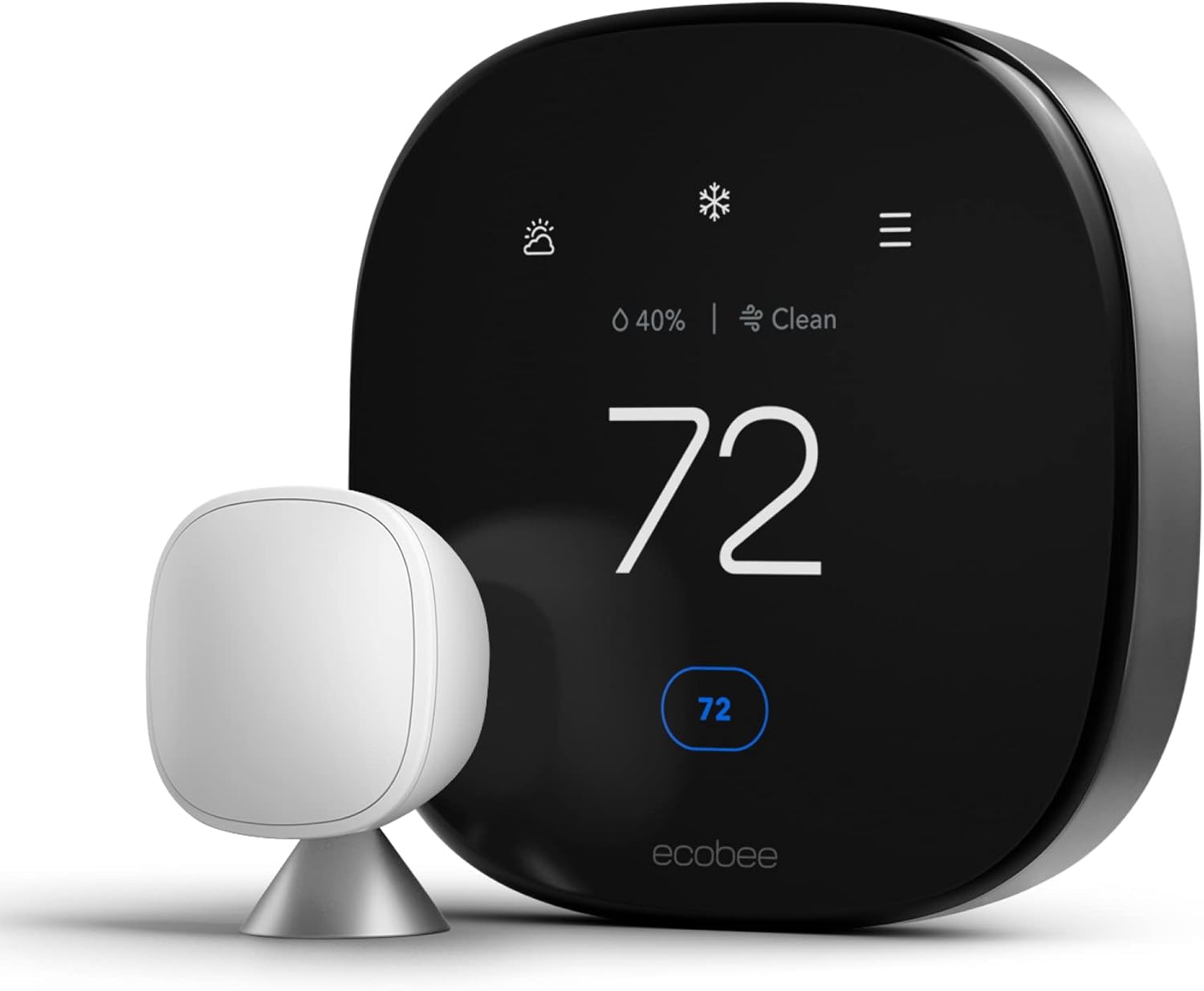
For these systems, you are spoiled for choice. To help you decide, check out our comparison of Nest vs. Ecobee or learn about smart vs. programmable thermostats.

Best for Low Voltage: Ecobee Smart Thermostat Premium
The gold standard for central HVAC systems. Includes a remote room sensor and advanced occupancy detection to save money automatically.
Check Price on AmazonComparison Matrix
| Feature | Line Voltage (High) | Low Voltage |
|---|---|---|
| Voltage | 120V or 240V | 24V (usually) |
| Wire Thickness | Thick (12-14 Gauge) | Thin (18 Gauge) |
| Wire Count | 2 or 4 wires | 2 to 8+ colored wires |
| Primary Use | Electric Baseboards, Wall Heaters | Furnaces, AC, Heat Pumps |
| Shock Hazard | High (Dangerous) | Low (Safe) |
| Nest/Ecobee Compatible? | NO (Requires adapter) | YES |
Can I Convert Line to Low Voltage?
Technically, yes, using a transformer and a relay switch (like an Aube relay), you can force a Nest to control a baseboard heater. However, we rarely recommend this.
It involves stuffing bulky electronics into a junction box, which can violate electrical codes and create heat buildup issues. In 2025, it is much smarter to simply buy a purpose-built line voltage smart thermostat like Mysa or Sinope. They offer the same app control and scheduling features without the messy hacking of your electrical system.
The Third Type Most Guides Ignore: Millivolt Systems
The majority of thermostat guides discuss two types of systems — line voltage and low voltage. But there is a third category that affects millions of homes and is the source of enormous confusion when homeowners try to upgrade to a smart thermostat: the millivolt system.
What Is a Millivolt System?
Millivolt thermostats operate on an extremely small voltage — typically between 0.5 and 2 volts — generated by a device called a thermopile or thermocouple built directly into the heating appliance. A thermopile is essentially a set of metal junctions that generate a tiny electrical current when heated by the appliance’s pilot light. This current is what powers the thermostat and controls the gas valve — the entire system requires no external electricity at all.
This self-powered characteristic is the defining feature of millivolt systems. If your power goes out on the coldest night of the year, a millivolt heating system will continue to function because it generates its own operating current from the pilot light. This is why millivolt systems were popular in mountain cabins, remote properties, and areas with unreliable electrical supply.
Where You’ll Find Millivolt Systems
Millivolt heating is most commonly found in: gravity-fed wall furnaces (the large vented units often found in older apartments and small homes), direct-vent or top-vent gas fireplace inserts and standalone gas fireplaces, floor furnaces (gas heating units installed beneath the floor), and some older mobile home heating systems. If you have a gas fireplace with a standing pilot light and it appears to have its own small thermostat, there is a strong likelihood you have a millivolt system.
How to Confirm You Have a Millivolt System
The most reliable confirmation method: remove your current thermostat from the wall and look for batteries. A millivolt thermostat has no batteries — it draws power from the thermocouple. With the thermostat removed, use your multimeter set to DC millivolts (mV) — note that millivolt systems use DC, not AC — and probe the two thermostat wires. A reading of 100–750 mV (0.1 to 0.75 volts) confirms a millivolt system. Another telltale sign: your thermostat has only two wires with no color coding or labeling system, and your heating appliance has a standing pilot light (a small continuously burning flame).
Millivolt Smart Thermostat Options
The options for adding smart scheduling to a millivolt system are more limited than for line or low voltage systems. The most straightforward approach is a millivolt-compatible programmable thermostat such as the Lux TX500E or Honeywell’s TH2110DV1008, which add 7-day scheduling without requiring external power. For genuine Wi-Fi smart control, a Nest or Ecobee can be made to work using a 24V power adapter and a relay (the EI Electronics R8285A relay is commonly used for this), but this requires adding external power to a system that previously needed none — a project best left to a licensed electrician in most cases.
Single Pole vs. Double Pole Thermostats: A Complete Explanation
Within the line voltage category, one of the most frequently misunderstood distinctions is between single pole and double pole thermostats. This difference has significant implications for both safety and functionality, and it determines which replacement thermostat you can use — you cannot simply swap one type for the other without checking your existing wiring.
What Is a “Pole” in Electrical Terms?
A “pole” refers to the number of separate electrical conductors that a switch simultaneously interrupts. In a single-phase 120V circuit, there is one hot conductor and one neutral conductor — a single pole switch opens the hot conductor only, leaving the neutral intact. In a 240V circuit, there are typically two hot conductors (no neutral in most baseboard heater circuits) — a double pole switch opens both hot conductors simultaneously.
Single Pole Thermostats
A single pole thermostat uses 2 wires and interrupts only one side of the circuit. When the thermostat reaches setpoint and “turns off,” it opens only one conductor — the other conductor remains live at full voltage. This means:
- There is no true OFF position — the lowest setting is typically 45–50°F, not an actual off. Even at the lowest position, the heater is still connected to live voltage.
- Even with the thermostat set to minimum, the heater wiring remains energized and potentially hazardous.
- Single pole units are slightly less expensive and simpler than double pole models.
- They are primarily used on 120V baseboard heater circuits where a single hot conductor controls the heater.
Double Pole Thermostats
A double pole thermostat uses 4 wires and simultaneously interrupts both sides of the circuit. This provides:
- A true OFF position — when set to OFF, both conductors are broken and the heater wiring is completely de-energized.
- Significantly better safety — the heater cannot energize accidentally if the bimetal strip malfunctions.
- Compatibility with 240V two-wire circuits (where both conductors are hot at 120V each).
- Required by code in many jurisdictions for 240V baseboard installations.
How to Tell Which Type You Currently Have
Count the wires at your thermostat. Two wires = single pole. Four wires = double pole. If you have a 240V system, you almost certainly have double pole — 240V baseboard installations require interrupting both legs of the circuit. On 120V systems, you may have either type. The label on your current thermostat will also specify “SPST” (single pole, single throw = single pole) or “DPST” (double pole, single throw = double pole).
120V vs. 240V Line Voltage Systems: Which Do You Have and Why It Matters
Not all line voltage heating systems operate at the same voltage. In North America, residential electric heating runs on either 120V or 240V, and these are not interchangeable. Installing a 120V thermostat on a 240V circuit will cause immediate failure. Installing a 240V-rated thermostat on a 120V circuit is usually harmless (the thermostat is rated for more than it receives) but verify the manufacturer’s specifications to be sure.
How to Tell Which Voltage Your System Uses
The most reliable visual indicator is the circuit breaker in your electrical panel. A 120V circuit is controlled by a single-slot breaker — one breaker slot. A 240V circuit is controlled by a double-slot breaker — a breaker that takes up two slots in the panel, typically called a “double pole breaker” or “tandem breaker.” Look at the breaker for the circuit that powers your baseboard heater. If it fills two slots and is rated 15–30 amps, you have a 240V system. If it fills one slot, you have 120V.
You can also check the label on the heater itself — most electric baseboard heaters have a nameplate on the end cap listing the voltage (120V or 240V or 208V), wattage, and amperage. A 240V label on the heater means you need a 240V rated thermostat. A 120V label means a 120V thermostat.
Why 240V Is More Common for Baseboard Heating
240V baseboard systems are far more common than 120V for whole-home electric heating, for an important practical reason: amperage efficiency. A 1,500-watt baseboard heater running on 120V draws 12.5 amps (watts ÷ volts = amps). The same 1,500-watt heater on 240V draws only 6.25 amps. Lower amperage means thinner wire, smaller breakers, and the ability to run more heaters on a single circuit. Under the National Electrical Code, a 20-amp 240V circuit can support up to 3,840 watts of continuous load (at 80% capacity), while a 20-amp 120V circuit supports only 1,920 watts. This makes 240V systems roughly twice as cost-effective from an electrical installation standpoint in larger homes.
The 120V vs. 240V Decision for New Installations
If you are selecting between 120V and 240V for a new installation, the practical guidance is: for small supplemental heaters (under 1,000 watts in a single room), 120V is convenient because it uses an existing standard outlet circuit and does not require a dedicated double-pole breaker. For primary heating in a room over 150 square feet, or any installation of 1,500 watts or more, 240V is the correct choice — better efficiency, lower operating costs per watt, and compatibility with the widest range of smart thermostat options.
| Factor | 120V System | 240V System |
|---|---|---|
| Breaker type | Single pole (1 slot) | Double pole (2 slots) |
| Wire color (hot) | Black + White (or Black) | Black + Red (both hot) |
| Amps at 1,500W | 12.5 amps | 6.25 amps |
| Max load on 20A circuit (NEC 80%) | 1,920 watts | 3,840 watts |
| Best thermostat type | Single or double pole, 120V rated | Double pole, 240V rated (required) |
| Common smart thermostat | Mysa (120V model), Cadet SmartStat | Mysa (240V model), Stelpro MAESTRO, Sinopé |
The Temperature Swing Problem: Why Line Voltage Heaters Feel Less Comfortable
One of the most frequently experienced but least explained disadvantages of line voltage baseboard heating is the phenomenon known as temperature swing, overshoot, or deadband — the tendency of the room to feel either too hot or too cold before the thermostat responds. Understanding why this happens explains why smart thermostats specifically designed for line voltage systems can dramatically improve comfort, not just convenience.
Why Mechanical Line Voltage Thermostats Swing
Traditional mechanical line voltage thermostats use a bimetal strip — two metals bonded together that bend as temperature changes — to make and break the electrical connection. The problem is thermal lag: the bimetal strip is at the thermostat, not at the room’s center. It responds to the temperature immediately around the thermostat, which may be affected by drafts, nearby heat sources, or simply because it is mounted on an exterior wall that is cooler than the room’s interior. Additionally, mechanical bimetal contacts require a meaningful temperature differential to snap cleanly open or closed — this “differential” is often 3–7°F on basic thermostats, meaning the heater runs until the room is 3–7 degrees above setpoint before shutting off.
The result: rooms controlled by basic line voltage thermostats cycle through a wider temperature band than rooms controlled by modern digital or smart line voltage thermostats. A room set to 70°F may actually swing between 66°F and 74°F in a cycle — an 8-degree swing that is clearly perceptible and causes occupants to continually adjust the thermostat dial.
How Digital and Smart Line Voltage Thermostats Fix This
Digital line voltage thermostats — even non-smart ones — use a thermistor (electronic temperature sensor) rather than a bimetal strip. Thermistors respond faster and more accurately to room temperature, and digital controllers can maintain a differential of 0.5–1°F rather than the 3–7°F of mechanical models. The temperature swing improvement alone is often cited by homeowners as the most noticeable comfort upgrade from replacing an old mechanical line voltage thermostat with even a basic digital replacement.
Smart line voltage thermostats (Mysa, Stelpro MAESTRO) go further by using adaptive algorithms that anticipate thermal mass and begin cycling down the heating before the setpoint is reached, further reducing overshoot. Mysa’s app allows adjustment of the differential setting, giving users direct control over the precision-versus-efficiency trade-off.
Radiant In-Floor Heating Thermostats: A Special Category
Electric radiant in-floor heating — heating elements or cables embedded beneath floor tile, stone, or hardwood — represents one of the most popular and fastest-growing applications of line voltage heating. Its thermostats have unique requirements that are different from standard baseboard thermostats, making this a category that deserves separate treatment.
What Makes Radiant Floor Thermostats Different
Standard thermostat operation — measuring air temperature and cycling the heating on and off to maintain setpoint — is poorly suited to radiant floor heating for two reasons. First, floor heating has significant thermal mass: the floor itself stores heat and releases it slowly, creating a lag between when the heater switches on and when the room feels warmer. A thermostat that only measures air temperature will over-run the system, resulting in a floor that becomes uncomfortably hot. Second, radiant floor heating manufacturers have strict temperature limits for protecting the floor material itself — tile can handle high temperatures, but hardwood and engineered wood flooring typically cannot exceed 85°F without risk of warping or adhesive failure.
For these reasons, proper radiant floor thermostats include a floor temperature sensor — a thin probe installed in a conduit beneath the floor during installation — in addition to the standard air temperature sensor. The thermostat uses both readings: the air sensor for comfort control and the floor sensor for limit protection. If the floor temperature exceeds the programmed limit (typically set at 80–85°F for wood floors), the thermostat cuts power regardless of the air temperature reading.
Types of Radiant Floor Thermostat Operation Modes
Most radiant floor thermostats offer three operational modes. Air sensor mode controls entirely based on air temperature — suitable for tile floors with no temperature limit concerns. Floor sensor mode controls based only on the floor temperature — typically used in bathroom installations where maintaining a specific floor surface temperature is the goal (“warm tiles at 75°F when I get up”). Dual sensor mode uses air temperature for the primary setpoint but limits the floor temperature to a programmed maximum — the correct mode for wood or engineered wood floor installations.
Smart Radiant Floor Thermostat Options
The Mysa Smart Thermostat for In-Floor Heating handles both 120V and 240V radiant floor systems and supports all three operating modes including dual sensor mode with a configurable floor temperature limit. The nUheat ELEMENT Wi-Fi thermostat is another strong option designed specifically for radiant floor, with a large color display showing both air and floor temperatures simultaneously. Both include scheduling, geofencing, and voice assistant integration. The Schluter DITRA-HEAT-E-WiFi is built specifically to integrate with Schluter’s heated floor mat system and includes 7-day scheduling with touchscreen programming.
Amperage, Wattage & NEC Code: What You Must Know Before Buying
Every line voltage thermostat has a maximum amperage and wattage rating — the total electrical load it can safely switch. Exceeding this rating is a fire hazard. Understanding these ratings and how the National Electrical Code (NEC) governs heating circuits is essential for safe thermostat selection, especially if you are connecting more than one heater to a single thermostat.
Thermostat Amperage and Wattage Ratings
Basic mechanical line voltage thermostats are typically rated for 15 amps at 120V (1,800 watts) or 15–22 amps at 240V (3,600–5,280 watts). Digital and smart line voltage thermostats have specific ratings that vary by model — Mysa’s baseboard thermostat is rated for 16 amps at 120V and 240V, covering heaters up to 3,840 watts (at 240V). Stelpro’s MAESTRO is rated for 12.5 amps, covering up to 3,000 watts at 240V.
If you are connecting a single heater to a thermostat, simply confirm that the heater’s wattage does not exceed the thermostat’s wattage rating at your voltage. If you are connecting multiple heaters on one circuit through a single thermostat (common in older homes where a single thermostat controls a series of baseboard heaters), add the wattages of all heaters together and confirm the total is below the thermostat’s rating.
The NEC 80% Continuous Load Rule
This is the single most important electrical code rule for baseboard heating installations, and it is violated more frequently than almost any other residential wiring requirement. The National Electrical Code classifies electric heaters as a “continuous load” — a load that operates for 3 hours or more at a time. For continuous loads, the NEC requires that the circuit breaker be sized at 125% of the connected load, which equivalently means that the heater load should not exceed 80% of the breaker’s rated capacity.
In practice: a 20-amp 240V circuit breaker should not supply more than 16 amps of heating load (20A × 80% = 16A), which at 240V equals 3,840 watts. A common mistake is installing 4,000 or 4,500 watts of baseboard heaters on a 20-amp circuit — this violates NEC and presents a fire risk from chronic overloading of the breaker. If your heater load calculation exceeds 80% of your breaker rating, you must either reduce the heater wattage or install a higher-rated circuit.
Wire Gauge Requirements
Thermostat replacement does not change the wire gauge in the walls, but understanding wire gauge is necessary for confirming your circuit is correctly configured. For 120V circuits: 14-gauge wire (the thinner, common type) is rated for 15 amps; 12-gauge wire is rated for 20 amps. For 240V circuits: 14-gauge is rated for 15 amps at 240V (3,600 watts maximum, 2,880 watts at NEC 80%); 12-gauge is rated for 20 amps (4,800 watts maximum, 3,840 watts at NEC 80%); 10-gauge wire is rated for 30 amps (7,200 watts maximum, 5,760 watts at NEC 80%). Wire gauge is stamped on the wire jacket — look for “14 AWG,” “12 AWG,” or “10 AWG.”
Smart Line Voltage Thermostats: The Complete Brand Guide
The smart thermostat market for line voltage systems has expanded significantly since 2020. Line voltage homeowners are no longer limited to basic dial or digital programmable models — several well-supported Wi-Fi connected smart thermostats now offer full app control, scheduling, geofencing, voice assistant integration, and energy reporting, purpose-built for 120V and 240V systems.
Mysa Smart Thermostat
Best Overall- Separate models for 120V baseboard, 240V baseboard, and in-floor heating
- Apple HomeKit, Alexa, Google Home integration
- Per-room energy monitoring with kWh tracking
- Geofencing and 7-day scheduling
- Double pole on all models
- Rated to 16A / 3,840W at 240V
Stelpro MAESTRO
Best for 240V- Designed specifically for 240V baseboard and convectors
- Zigbee connectivity — integrates with SmartThings and other hubs
- Alexa and Google Home via hub
- Large clear display with floor/air dual sensor support
- Rated to 12.5A / 3,000W at 240V
- Made in Canada — strong utility rebate record in Quebec
Cadet SmartStat
Best for 120V & Dual Voltage- Dual voltage model handles both 120V and 240V
- Wi-Fi connected with Cadet app
- Alexa and Google Home integration
- 7-day scheduling and geofencing
- Energy monitoring via app
- Budget-friendly entry point for smart line voltage control
Sinopé TH1300ZB / TH1400ZB
Best for Zigbee Ecosystems- Zigbee-based smart thermostat for 240V baseboard
- Compatible with Hubitat, SmartThings, Home Assistant
- Neviweb platform for multi-room energy dashboard
- Strong option for tech-savvy homeowners using hub-based smart home
- Especially popular in Canada (Quebec/Ontario utility rebates)
- Floor heating model (TH1400ZB) includes floor sensor support
A Note for Canadian Homeowners
Canada has a higher proportion of electric baseboard heating than the United States, particularly in Quebec, Atlantic Canada, and British Columbia where hydroelectric power makes electric heating cost-competitive. The Canadian smart line voltage thermostat market is accordingly more developed, with Stelpro and Sinopé both headquartered in Quebec and deeply integrated with utility programs from Hydro-Québec and other provincial utilities. If you are in Canada, these brands are worth prioritizing both for product compatibility and for utility rebate accessibility. Hydro-Québec’s RPCE program has historically offered rebates of $50–$100 on qualifying smart thermostats including Sinopé and Stelpro models.
The Relay Adapter Method: Using a Low Voltage Smart Thermostat on a Line Voltage System
The original article correctly noted that an Aube relay can theoretically allow a low-voltage smart thermostat (like a Nest) to control a line-voltage baseboard heater. This section provides the complete technical explanation of how this works, its legitimate use cases, and why the dedicated smart line-voltage thermostat is almost always the better choice in residential installations.
How the Relay Method Works
The relay method uses two components: a step-down transformer that converts your 120V or 240V line voltage to 24V AC (the voltage a Nest or Honeywell T-series thermostat expects), and a switching relay (the Aube RC840T-240V is the most commonly cited example) that uses the 24V signal from the thermostat to operate a set of high-voltage contacts that actually switch the line voltage to the heater. The thermostat sends a 24V “call for heat” signal to the relay; the relay’s internal coil activates and closes its high-voltage contacts; the heater receives full line voltage and runs. When the thermostat ends the call for heat, the relay opens its contacts and the heater stops.
When the Relay Method Is Legitimately Used
There are specific situations where the relay method is the correct technical choice. In commercial buildings where a building management system (BMS) controls many zones from a central controller, all communicating in 24V signals, a relay is required to interface the BMS with line-voltage heaters. In retrofit situations where a homeowner has an existing low-voltage smart thermostat system controlling other devices and wants to add line-voltage zone control without learning a second app. And in some DIY home automation setups using Home Assistant or similar platforms where Zigbee-based low-voltage thermostats are being used to control multiple zone types through a single interface.
Why We Don’t Recommend It for Residential Baseboard
Despite being technically workable, the relay method has several meaningful disadvantages for typical residential baseboard thermostat replacement. The relay and transformer together typically cost $60–$100, often matching or exceeding the cost of a Mysa smart thermostat that handles everything natively. The relay must be installed in an accessible junction box, properly rated for the current load, and wired correctly — a project that requires comfort with both line and low-voltage wiring. If the installation is done incorrectly or the components are undersized, the relay can overheat, creating a fire risk. And the end result — a Nest controlling your baseboard — provides no advantage over a Mysa or Stelpro in terms of features, while being significantly more complex and potentially code-problematic due to junction box fill calculations.
Mixed Systems: Homes With Both Line and Low Voltage Heating
Many homes — particularly older houses that have been modified over the years, or homes in cold climates with a central furnace plus supplemental electric baseboard in specific rooms — have both low voltage and line voltage heating systems operating simultaneously. Managing a mixed system requires understanding that the two types cannot share thermostats, but they can coexist comfortably with the right approach.
Common Mixed System Configurations
The most common mixed system configuration is a central gas or oil furnace (low voltage) as the primary whole-home heating system, with electric baseboard heaters (line voltage) as supplemental heating in rooms that the central system struggles to adequately heat — a basement room, a room addition over a garage, or a finished attic space. In this configuration, the central system handles the main heating load while the baseboard fills in for comfort in problem areas.
Another common configuration: a home that was originally all-electric baseboard (line voltage throughout) where the owner added a central heat pump or mini-split system (low voltage control) but retained the baseboard heaters for backup heating during extreme cold when heat pump efficiency drops. In this case, the low voltage thermostat controls the primary system and the line voltage thermostats remain active for their respective rooms as needed.
Managing a Mixed System Smartly
The practical approach is to treat each thermostat type as its own independent system and choose the best smart thermostat for each. Use an Ecobee or Nest for the low-voltage central system. Use Mysa or Stelpro for the line-voltage supplemental heaters. Run them in separate apps, or — if you want unified control — check whether your preferred smart home platform (Google Home, Apple Home, SmartThings, or Home Assistant) can aggregate both. Mysa integrates with Google Home, Apple Home, and Alexa; Ecobee integrates with the same platforms. In Google Home, for example, you can view and control both your Ecobee and your Mysa thermostats in the same interface and create routines that coordinate their behavior.
Utility Rebates for Line Voltage Smart Thermostats
One of the most underutilized financial resources for homeowners with electric baseboard heating is the utility rebate programs that specifically cover smart line voltage thermostats. These rebates are available in many territories and can significantly reduce the upfront cost of upgrading from a mechanical dial thermostat to a smart model.
Why Utilities Offer Rebates for Line Voltage Thermostats
Electric utilities, particularly those serving areas with significant electric baseboard heating penetration, have strong financial incentives to reduce peak demand from electric heating. An uncontrolled baseboard heater running at full power on a cold winter evening contributes to peak demand that the utility must serve with expensive generation capacity. A smart thermostat with geofencing turns the heater down when nobody is home and pre-heats the space before occupants return — the exact behavior that reduces utility peak demand. This is why Hydro-Québec, BC Hydro, various New England utilities, and others actively fund smart thermostat adoption for electric baseboard customers specifically.
How to Find Rebates in Your Territory
The DSIRE database (dsireusa.org) is the most comprehensive source for US energy incentives searchable by state. For Canadian customers, the respective provincial utility website is the primary resource. Key steps: look up your electric utility provider’s website and search for “smart thermostat rebate” or “energy efficiency program.” Confirm that the specific thermostat model you are considering appears on the utility’s qualified product list — rebates are model-specific. Mysa explicitly maintains a rebate finder tool on their website that maps available rebates by utility territory and links to application forms.
Operating Cost Comparison: Line Voltage vs. Low Voltage Heating
A common question when evaluating line voltage electric baseboard heating versus low voltage central heating systems is the operating cost comparison. The answer involves the cost of the energy source, the efficiency of the heating method, and the degree to which smart thermostat control can reduce consumption in each case.
Electric Resistance Heating: 100% Efficient but Expensive per BTU
Electric baseboard heaters (line voltage) are 100% efficient at converting electricity to heat — every watt of electricity becomes a watt of heat in the room. There is no flue loss, no combustion inefficiency, no ductwork loss. However, electricity is typically two to four times more expensive per BTU than natural gas in most North American markets. The result is that electric resistance heating is operationally more expensive than gas heating in most climates and rate environments, even though the heater itself is perfectly efficient.
The operating cost of a 240V baseboard system depends entirely on your local electricity rate. At the US average residential electricity rate of approximately $0.13 per kWh, a 1,500-watt baseboard heater running for 8 hours costs about $1.56. Run that same heater for 8 hours per day for 5 months of heating season and you are looking at approximately $234 per room per season — and that is before accounting for unoccupied periods where a smart thermostat’s setback capability provides meaningful savings.
How Much Can a Smart Line Voltage Thermostat Save?
Smart thermostat savings on electric baseboard systems are consistently reported as larger than the 8–10% EPA average for central HVAC systems. The reason is that most line voltage baseboard thermostats are currently simple dial models with no scheduling, no geofencing, and no setback capability — the “before” baseline is extremely inefficient because the heater runs continuously at setpoint whether or not the room is occupied. Mysa has published internal data showing average savings of 26% among their installed base compared to the mechanical dial thermostat baseline. Studies in Quebec by Hydro-Québec have shown savings of 10–20% from smart thermostat adoption in baseboard-heated homes. The savings are most pronounced in homes where occupancy is irregular or people frequently forget to turn down thermostats when leaving.
Low Voltage Central System Efficiency: The Heat Pump Advantage
The comparison changes dramatically if the low voltage system is a heat pump rather than a gas furnace. Heat pumps move heat rather than generating it, achieving efficiencies of 200–400% (expressed as a Coefficient of Performance, or COP, of 2.0–4.0). A heat pump COP of 3.0 means that for every 1 kWh of electricity consumed, 3 kWh of heat is delivered. At that efficiency ratio, heat pump heating can be cost-competitive with or cheaper than natural gas heating even in areas where electricity rates are higher than the national average — and it is significantly cheaper to operate than electric resistance baseboard heating.
| System Type | Efficiency | Approx. Annual Cost (1,500 sq ft) | Smart Thermostat Savings |
|---|---|---|---|
| Electric baseboard (line voltage) | 100% (resistance) | $1,200–$2,400 | 15–25% with setbacks |
| Gas furnace (low voltage) | 80–98% AFUE | $600–$1,200 | 8–12% |
| Air-source heat pump (low voltage) | 200–400% (COP 2–4) | $400–$900 | 8–15% |
| Radiant in-floor electric (line voltage) | 100% (resistance) | Varies — typically supplemental use | 25–40% with scheduling |
Complete DIY Installation Guide: Line Voltage vs. Low Voltage
Thermostat replacement is one of the most frequently undertaken DIY home projects — but the safety requirements and skill level differ significantly between line voltage and low voltage installations. Understanding these differences before starting helps you decide whether to proceed yourself or hire a licensed electrician.
Low Voltage Thermostat Replacement: Safe for Confident DIYers
Installing a low voltage smart thermostat (Nest, Ecobee, Honeywell T-series) is a DIY project accessible to most homeowners who are comfortable with basic tool use. The 24V wiring carries minimal electrical risk — even if you accidentally touch a live 24V wire, the shock is negligible and not dangerous. The main risks are making incorrect wire connections (which can cause HVAC equipment to malfunction but not create a fire hazard) and, in rare cases, shorting 24V wires together which can blow the fuse on the furnace control board (a $5 replacement).
- Turn off power at the thermostat’s circuit breaker (not strictly required for safety at 24V, but best practice and required by most manufacturers).
- Photograph all wire connections on the existing thermostat before disconnecting anything.
- Label each wire with the included stickers using the terminal letter it was connected to (R, W, Y, G, C, etc.).
- Remove the old thermostat backplate and mount the new backplate to the wall, using a level.
- Connect wires to the corresponding terminals on the new thermostat following the manufacturer’s wiring guide.
- Restore power and follow the in-app setup wizard, which will test each HVAC function to confirm correct wiring.
Line Voltage Thermostat Replacement: Requires More Caution
Line voltage thermostat replacement involves working with 120V or 240V wiring that carries potentially lethal current. While many competent DIYers do successfully replace line voltage thermostats, the margin for error is lower and the consequences of mistakes are more serious. The key rule: the breaker must be OFF and confirmed OFF before touching any line voltage wiring.
- Turn off the circuit breaker for the heater circuit — this is non-negotiable. Find the breaker in your electrical panel labeled for the heater or the room, and switch it OFF.
- Confirm the power is OFF by switching on the heater and confirming it does not heat, or use a non-contact voltage tester on the wires before touching them.
- Remove the old thermostat. Take clear photographs of all wire connections and note the wire colors at each terminal.
- For 240V systems: note that both wires may be black, or one black and one red — neither is a neutral in a baseboard heating circuit. Both carry 120V to ground and must be treated as hot at all times.
- Match the wire connections to the new thermostat’s wiring diagram. For a single-pole replacement, connect Line (incoming power) to the L terminal and Load (to heater) to the T terminal. For double-pole, connect both incoming power wires to the Line terminals and both heater wires to the Load terminals.
- Mount the thermostat, restore power at the breaker, and confirm the heater operates correctly by turning the thermostat up and feeling the heater warm up.
Critical Safety Considerations by System Type
Electrical safety is the non-negotiable foundation of any thermostat work. The specific hazards differ between line and low voltage systems, and understanding them is more useful than a generic “be careful” warning.
Line Voltage Safety: The Real Risks
At 120V, the human body’s typical resistance of 1,000–10,000 ohms means contact with two 120V conductors can produce 12–120 milliamps of current — enough to cause cardiac arrest (the threshold for cardiac fibrillation is approximately 100 milliamps at power line frequency). At 240V, the same body resistance produces 24–240 milliamps — nearly certain death upon full contact. These are not theoretical risks; household electrical systems kill approximately 400 people per year in the United States. The primary protection is the circuit breaker, which is why confirming the breaker is OFF and the circuit is de-energized before touching any conductor is not optional.
Beyond personal safety, line voltage wiring poses fire risk if connections are made incorrectly or if thermostat ratings are exceeded. Undersized connections create resistance that generates heat, which can ignite surrounding materials over time — a common cause of residential electrical fires that may not manifest immediately after installation but develop over months of operation.
Low Voltage Safety: Less Dangerous, Not Risk-Free
The 24V signal carried by thermostat wires in a low voltage system is below the threshold for lethal electric shock in healthy adults. However, it is not completely risk-free. Shorting the R (24V hot) wire to the C (common) wire or to the HVAC chassis creates a short circuit through the furnace’s control transformer, which can burn out the transformer (a $50–$200 repair) and potentially trip the furnace’s internal fuse or breaker. The more serious risk with low voltage work is incorrect wiring that causes HVAC equipment to malfunction — sending continuous Y (cooling) calls to a heat pump in the wrong O/B configuration, for example, can cause equipment damage over time.
Frequently Asked Questions
How do I know if my thermostat is line voltage?
Look for thick wires (usually black and red) secured with wire nuts. Also, check the back of the old thermostat; if it says “120V” or “240V” or lists high wattage (e.g., 2000W), it is line voltage. For a definitive answer, use a multimeter set to AC voltage — a reading of 110–130V confirms 120V and 220–250V confirms 240V line voltage.
Can I use a Nest thermostat on a 240V system?
No, not directly. Connecting a Nest (designed for 24V) to a 240V system will instantly destroy the thermostat and potentially cause a fire. You must use a relay adapter if you insist on using Nest, or simply buy a Mysa thermostat instead.
What is a double pole vs. single pole thermostat?
These are types of line voltage thermostats. A single pole (2 wires) breaks one side of the circuit, meaning the heater is effectively “off” but still has live voltage running to it. A double pole (4 wires) breaks both sides, killing power completely to the heater for added safety. Double pole units actually have a true “OFF” setting.
Are low voltage thermostats safer?
Yes. Because they carry very little current (24V), the risk of lethal electric shock is minimal compared to line voltage systems. However, shorting the wires can still blow the fuse on your furnace control board.
What is a millivolt thermostat and how do I know if I have one?
A millivolt thermostat operates on a tiny voltage (0.5–2V) generated by a thermocouple in the heating appliance itself — no external power source is required. You typically find millivolt systems on gas wall furnaces, gas fireplace inserts, and floor furnaces with standing pilot lights.
To identify: remove your thermostat from the wall and check for batteries. Millivolt thermostats have none — they draw power from the thermocouple. With a multimeter set to DC millivolts, probe the two thermostat wires. A reading under 1,000 mV (1 volt) confirms a millivolt system. Standard smart thermostats (Nest, Ecobee, Honeywell) do not work on millivolt systems without a 24V adapter and relay.
Do radiant in-floor heating systems need a special thermostat?
Yes. Electric radiant floor heating systems benefit from thermostats with a floor temperature sensor probe — a thin cable installed in a conduit beneath the floor — in addition to a standard air temperature sensor. This dual sensor approach serves two purposes: comfort control (using air temperature) and floor protection (limiting the floor surface temperature to prevent damage to hardwood or engineered wood flooring).
Standard line voltage thermostats without a floor sensor can be used for tile or stone floors where there is no temperature limit concern. For hardwood or engineered wood floors, a dual-sensor thermostat with a configurable floor temperature limit is essential. Mysa’s in-floor heating thermostat and the nUheat ELEMENT both support dual sensor mode and are compatible with 120V and 240V systems.
How many watts can I connect to one baseboard thermostat?
The thermostat’s maximum wattage rating depends on the model and voltage. Mysa’s baseboard thermostat handles up to 3,840 watts at 240V (16 amps × 240V). The Stelpro MAESTRO handles up to 3,000 watts at 240V (12.5 amps × 240V).
More importantly, the NEC 80% continuous load rule requires that the total heater wattage connected to a circuit not exceed 80% of the circuit breaker’s rated capacity. A 20-amp 240V breaker: maximum continuous load of 3,840 watts (20A × 80% × 240V). Always add up the wattage of all heaters connected to a single thermostat and circuit to confirm you are within both the thermostat’s rating and the NEC limit.
Can I get a rebate on a smart line voltage thermostat?
Yes — in many utility territories, particularly those with significant electric baseboard heating. Utilities offer these rebates because smart thermostats reduce peak demand from electric heating. Rebates typically range from $25–$100 per thermostat. In Canada, Hydro-Québec and BC Hydro both have established programs covering smart baseboard thermostats including Sinopé and Stelpro models.
To find rebates: check your electric utility’s website for “smart thermostat rebate,” use the DSIRE database (dsireusa.org) for US programs, or use Mysa’s built-in rebate finder at getmysa.com. Confirm the specific model you are purchasing is on your utility’s qualified product list before buying.
Is electric baseboard heating more expensive to run than gas?
In most North American markets, yes — electric resistance baseboard heating is more expensive per BTU than natural gas heating. Even though baseboard heaters are 100% efficient (every watt of electricity becomes heat), electricity typically costs 2–4 times more per BTU than natural gas at current utility rates. A home heated entirely by electric baseboard can expect heating bills significantly higher than the same home with a high-efficiency gas furnace.
The comparison is more favorable if your electricity rate is very low (some hydro-electric regions), if you have a heat pump instead of resistance heating (heat pumps achieve 200–400% efficiency), or if you use aggressive setback scheduling with a smart thermostat to reduce runtime in unoccupied periods. Smart thermostats for electric baseboard can save 15–25% compared to uncontrolled baseboard, partially offsetting the rate disadvantage.
What is the NEC rule about baseboard heater circuits?
The most important NEC requirement for baseboard heater circuits is the 80% continuous load rule. Electric heaters are classified as a “continuous load” (operating for 3+ hours), and the NEC requires that circuit breakers be rated at 125% of the continuous load — equivalently, the heater load must not exceed 80% of the breaker’s capacity.
In practice: a 20-amp 240V circuit breaker should not supply more than 3,840 watts of baseboard heaters (20A × 80% × 240V). A 15-amp 240V circuit is limited to 2,880 watts. Exceeding these limits can result in chronic nuisance tripping of breakers, fire risk from sustained overloading, and code violations that can affect insurance coverage. When installing new heaters or adding to an existing circuit, always verify the total wattage against this 80% limit.




 Home
Home
 Info
Info
 Compare
 Reviews
 Shop
Shop