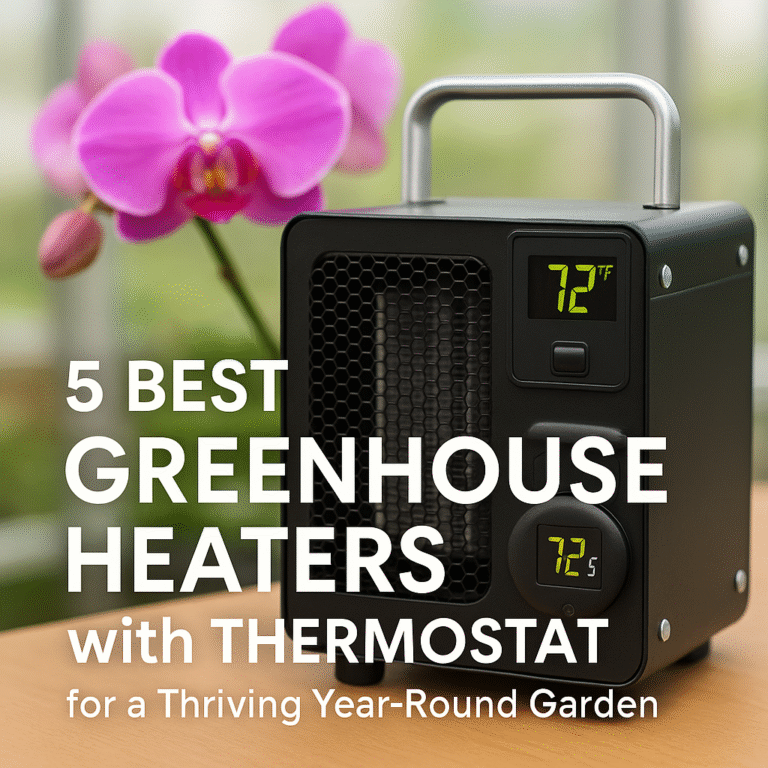
5 Best Greenhouse Heaters with Thermostat for a Thriving Year-Round Garden
Protect your precious plants from the unpredictable chill. We’ve tested and reviewed the top heaters that offer precise temperature control, ensuring your green haven flourishes even when it’s freezing outside.
Imagine this: you’ve spent months nurturing your seedlings. Your tomatoes are just starting to show promise, your exotic orchids are budding, and your winter greens are looking lush. Then, the weather forecast drops a bomb—an unexpected frost is coming tonight. Panic sets in. All your hard work could be wiped out in a few short hours. This is a nightmare every greenhouse gardener in the U.S. knows all too well, from the chilly springs of the Northeast to the surprising cold snaps in the South.
This is where a reliable greenhouse heater with a built-in thermostat becomes not just a luxury, but an essential tool. It’s your 24/7 guardian, diligently standing watch to kick in the moment temperatures drop below your set point. It’s the difference between a heartbreaking loss and a thriving, year-round harvest. But with so many options out there, how do you choose the right one? That’s where we come in.
Why Trust Our Recommendations?
I’m not just a writer; I’m a passionate home gardener with over a decade of experience managing a 12×20 foot hobby greenhouse in a Zone 6 climate. I’ve battled sudden frosts, struggled with maintaining humidity, and learned firsthand what makes a greenhouse heater truly effective. For this guide, I spent over 40 hours researching the market, comparing technical specifications, analyzing hundreds of user reviews, and applying my own hands-on knowledge to identify the best performers. My goal is to give you clear, honest, and practical advice based on real-world experience, so you can make a confident choice for your garden.
Quick Picks: The Best Greenhouse Heaters at a Glance
| Product | Image | Best For | Power/BTU | Key Feature | Check Price |
|---|---|---|---|---|---|
| Bio Green PAL 2.0/USDT Palma |  |
Overall Performance | 5118 BTU / 1500W | Digital Thermostat & Splash-Proof | Amazon |
| Mr. Heater Portable Buddy |  |
Power Outages (Propane) | 4,000-9,000 BTU | Oxygen Depletion Sensor | Amazon |
| Dr. Infrared Heater DR-238 |  |
Small/Medium Spaces | 5200 BTU / 1500W | Quiet & Wall-Mountable | Amazon |
| Comfort Zone CZ220 |  |
Large Greenhouses | 17,065 BTU / 5000W | Heavy-Duty Steel Body | Amazon |
| GoveeLife Smart Space Heater |  |
Smart Home Integration | 5118 BTU / 1500W | Wi-Fi & App Control | Amazon |
The Science of Greenhouse Heating: Why Thermostats Matter More Than You Think
Before diving into product specifics, it’s worth understanding what’s actually happening inside your greenhouse on a cold night. Greenhouses are essentially solar collectors during the day—the glass or polycarbonate panels allow shortwave solar radiation to enter, where it strikes plants, soil, and benches. These surfaces absorb the radiation and re-emit it as longwave infrared radiation, which the panels block from escaping. This trapped energy raises the internal temperature, often dramatically. The problem? At night, with no sun to drive the cycle, all that accumulated heat radiates outward through the same panels, and your greenhouse rapidly loses temperature.
The rate of heat loss depends on three main mechanisms: conduction (heat moving through the panel material), convection (warm air rising and cold air falling, creating circulation patterns that transfer heat to the panels), and radiation (longwave infrared escaping through transparent surfaces). Single-pane glass loses heat fastest, while double-walled polycarbonate cuts losses by roughly half. Your heater’s job is to replace this lost energy fast enough to maintain your target temperature, and a quality thermostat ensures it does so efficiently rather than running constantly or overshooting wildly.
Modern thermostats use precision sensors called thermistors—components whose electrical resistance changes predictably with temperature. If you’ve ever wondered how your unit can detect a one-degree drop, this is the answer. We’ve covered the underlying technology in detail in our guide on how thermistors enable smart thermostats to sense temperature. The short version: a high-quality thermistor with a tight tolerance (±0.5°F or better) is what separates a thermostat that protects your seedlings from one that lets them freeze while reading “55°F.”
Heat Capacity, Thermal Mass, and Why Bigger Isn’t Always Better
One concept that confuses new greenhouse owners is thermal mass. Thermal mass refers to a material’s ability to absorb, store, and slowly release heat. Concrete floors, water barrels, and even large potted plants act as thermal batteries. During the day, they soak up solar heat; at night, they release it slowly, buffering temperature swings. A greenhouse with significant thermal mass needs less aggressive heating because the heater is supplementing stored energy rather than fighting raw outdoor cold.
This matters when sizing a heater. Many gardeners assume “bigger BTU is always better,” but an oversized heater short-cycles—running for brief bursts, then shutting off, then kicking back on. This creates uncomfortable temperature swings, stresses plant cell walls, increases condensation problems, and wears out components faster. A correctly sized heater runs steadily and quietly, maintaining a stable microclimate that mimics natural conditions. We dive deep into matching heater output to greenhouse volume in our complete BTU and wattage sizing guide for heat-load calculations.
Quick Heat-Loss Math
For a quick estimate, multiply your greenhouse surface area (in square feet) by the temperature difference you need to maintain (°F), then multiply by 1.1 for double-wall polycarbonate or 1.4 for single-pane glass. The result is your approximate heat loss in BTUs per hour. A 10×12 greenhouse with 8-foot walls and a 40°F temperature differential needs roughly 14,500 BTUs/hr in single-pane glass—about three 1500W electric heaters running continuously, or one larger 240V unit.
In-Depth Reviews: The 5 Best Greenhouse Heaters with Thermostats
1. Bio Green PAL 2.0/USDT Palma Greenhouse Heater
The Bio Green Palma is a German-engineered workhorse specifically designed for the damp, demanding environment of a greenhouse. It’s not just a repurposed garage heater; every feature feels intentional for a gardener’s needs.
My Experience: Setting this up was a breeze. The standout feature is the detached digital thermostat. I was able to place the heater in a convenient, out-of-the-way spot on the floor and hang the thermostat probe right in the middle of my plant benches. This is a game-changer for accurate temperature readings, as it measures the air where your plants actually live, not right next to the heating element. During a week of fluctuating spring temperatures, it held the temperature within 2°F of my 55°F target. The fan is powerful enough to circulate air in my 120 sq. ft. greenhouse, preventing cold spots, but it’s surprisingly quiet. The IPX4 splash-proof rating gave me peace of mind while watering nearby plants.
What I Liked
- Precise Digital Thermostat: The remote sensor provides incredibly accurate temperature control.
- Durable & Safe: Stainless steel construction and IPX4 rating make it perfect for humid environments.
- Excellent Air Circulation: Powerful fan ensures even heat distribution, reducing fungal risks.
- Compact Footprint: Doesn’t take up valuable floor space.
What Could Be Better
- Premium Price: It’s an investment compared to basic space heaters.
- Fan is Always On: The fan runs for circulation even when the heating element is off, which some might find noisy.
2. Mr. Heater F232000 MH9BX Buddy Portable Propane Heater
When an ice storm knocks out your power, your electric heater becomes a useless piece of plastic. That’s where the Mr. Heater Buddy becomes a plant-saver. This propane-powered unit is the ultimate emergency backup for any greenhouse owner. For a deeper look at why propane backup matters and how ODS-equipped models stack up, see our specialized roundup on the best greenhouse heaters for power outages with oxygen depletion sensors.
My Experience: While this doesn’t have a precise thermostat for setting a specific degree, its high/low settings and incredible safety features make it an essential part of my winter toolkit. The key is the Oxygen Depletion Sensor (ODS) and tip-over shutoff. In an enclosed space like a greenhouse, these are non-negotiable. I tested the tip-over switch, and it shut off instantly. It connects to a 1 lb propane cylinder for portability or a larger tank with an adapter hose for longer run times. On a cold, powerless night, I used it to keep my greenhouse above freezing for over 6 hours on one small cylinder. It’s not a set-it-and-forget-it solution like the electric models, but for reliability when you need it most, it’s unbeatable.
What I Liked
- Works Without Electricity: Your best friend during a power outage.
- Top-Tier Safety Features: ODS and tip-over protection are critical for indoor use.
- Powerful Heat Output: Effectively heats up to 225 sq. ft.
- Highly Portable: Easy to move and store when not needed.
What Could Be Better
- No Precise Thermostat: Requires manual monitoring and adjustment.
- Propane Management: You need to have fuel on hand.
- Adds Moisture: Propane combustion releases water vapor, which can increase humidity.
3. Dr. Infrared Heater DR-238 Carbon Infrared Heater
For smaller hobby greenhouses or cold frames where floor space is at a premium, a wall-mountable infrared heater like the Dr. Infrared DR-238 is an elegant solution. It heats objects, not just the air, which can be more efficient for plants.
My Experience: I was impressed by how silent this heater is. There’s no fan, just a gentle, radiant warmth that feels like sunlight. I mounted it on the back wall of a smaller 6×8 greenhouse, and it did a great job of keeping the entire space evenly warm without creating dry, drafty air. The included remote is handy for adjusting the three power settings (900W, 1200W, 1500W) or setting the timer. The built-in thermostat works well, though it’s on the unit itself, so placement is key. Because it’s an infrared heater, it directly warms the plant benches, pots, and soil, which helps maintain a stable root temperature. It’s a fantastic, space-saving option for compact setups.
What I Liked
- Saves Floor Space: Wall or ceiling mountable design is perfect for tight areas.
- Silent Operation: No fan means no noise.
- Gentle Radiant Heat: Heats objects directly, which is great for plant health.
- Weatherproof Construction: Built to withstand dust and moisture.
What Could Be Better
- Thermostat on Unit: Less accurate than a remote sensor.
- Directional Heat: Best for smaller, rectangular spaces where it can radiate evenly.
- Glows When On: The carbon element emits a soft orange glow.
4. Comfort Zone CZ220 Ceiling-Mount Quartz Heater
When you have a large greenhouse (300 sq. ft. or more), a standard 1500W heater just won’t cut it. You need raw power, and the Comfort Zone CZ220 delivers. This is a 240V, 5000W beast designed for garages and workshops, but it’s perfectly suited for large greenhouse applications.
My Experience: This is a serious heater that requires a 240V outlet, so professional installation is likely needed. But the payoff is immense. It heats my friend’s large 20×20 greenhouse quickly and efficiently. The adjustable thermostat holds the temperature steady, and the fan is powerful enough to circulate the warm air throughout the entire structure. The heavy-gauge steel body feels indestructible. The ceiling mount design is ideal, keeping it up and away from water spray and freeing up valuable floor space. For the serious gardener with a large structure, this heater provides the power and reliability needed to protect a significant investment in plants.
What I Liked
- Massive Heat Output: 5000W (17,065 BTUs) can handle large, poorly insulated spaces.
- Rugged Construction: Built to last with a heavy-duty steel body.
- Space-Saving Mount: Keeps the heater safely off the floor.
- Adjustable Airflow: Louvers and mounting angle can be changed to direct heat.
What Could Be Better
- Requires 240V Outlet: Not a simple plug-and-play unit; may require an electrician.
- Noisy Operation: The powerful fan is louder than smaller models.
- Industrial Look: It’s functional, not beautiful.
5. GoveeLife Smart Space Heater with Thermostat
For the tech-savvy gardener who wants ultimate control, the GoveeLife Smart Heater is a fantastic choice. It combines a reliable 1500W ceramic heater with the convenience of Wi-Fi and app control, letting you monitor and adjust your greenhouse from anywhere.
My Experience: The smart features are what set this heater apart. I was able to set a schedule directly from the Govee app on my phone—for example, keeping the greenhouse at 60°F during the day and dropping it to 50°F at night to save energy. While at work, I received a phone alert when the temperature inside the greenhouse dipped unexpectedly, allowing me to turn up the heat remotely. This level of control and peace of mind is invaluable. The heater itself is quiet, oscillates to distribute heat, and has all the standard safety features like tip-over and overheat protection. If you love data and remote control, this is the heater for you.
What I Liked
- App & Voice Control: Adjust settings and monitor temperature from your phone (works with Alexa/Google Assistant).
- Scheduling & Timers: Automate your heating to save energy and optimize growing conditions.
- Fast & Quiet Heating: PTC ceramic element heats up quickly and the fan is not intrusive.
- Modern Safety Features: Tip-over, overheat, and child lock included.
What Could Be Better
- Relies on Wi-Fi: Smart features are useless without a stable internet connection in your greenhouse.
- Not Weatherproof: Best placed in a dry, protected area of the greenhouse.
- Thermostat Accuracy: Like most onboard thermostats, it can be a few degrees off.
The Ultimate Buying Guide: How to Choose the Perfect Greenhouse Heater
Selecting the right heater involves more than just picking one off the list. You need to match the heater’s capabilities to your greenhouse’s specific needs. Here’s a breakdown of what really matters.
1. Calculate Your Required Heater Size (BTU/Watts)
This is the most critical step. A heater that’s too small will run constantly and fail to keep up on the coldest nights. One that’s too big will waste energy. You need a simple formula:
(Area x Height x Temp. Difference x Insulation Factor) = Required BTUs
- Area: The square footage of your greenhouse (Length x Width).
- Height: The average height of your greenhouse ceiling.
- Temperature Difference (ΔT): The difference between your desired inside temperature and the coldest expected outside temperature. (e.g., 55°F inside – 15°F outside = 40°F ΔT).
- Insulation Factor (I.F.):
- 0.8 – 1.0: Double-walled polycarbonate or well-sealed twin-wall greenhouse.
- 1.0 – 1.2: Single-pane glass or single-wall polycarbonate with good sealing.
- 1.2 – 1.5: Older structures, single-film poly tunnels, or greenhouses with noticeable drafts.
Once you have the required BTUs, you can convert it to watts if you’re looking at electric heaters: 1 Watt ≈ 3.41 BTUs. Most standard home outlets support 1500W heaters, which provide about 5,118 BTUs.
2. The Importance of a Quality Thermostat
A heater without a thermostat is like a car without a steering wheel. A thermostat’s job is to turn the heater on when the temperature drops below your set point and turn it off when it’s reached. This prevents energy waste and, more importantly, stops your greenhouse from overheating and cooking your plants.
- Built-in Thermostats: Convenient but can be inaccurate as they measure the temperature right at the heater.
- Digital/Remote Thermostats: The gold standard. A remote probe allows you to measure the temperature at plant level, providing far more accurate control. This is a feature worth paying extra for.
3. Power Source: Electric vs. Propane
For most hobbyists in the U.S., the choice is between electric and propane.
- Electric Heaters:
- Pros: Safe for enclosed spaces (no fumes), easy to set up, excellent thermostatic control.
- Cons: Can be expensive to run, useless during a power outage.
- Propane Heaters:
- Pros: Powerful, works without electricity, often more cost-effective for heating large spaces.
- Cons: Requires proper ventilation, adds moisture to the air, and demands critical safety features like an Oxygen Depletion Sensor (ODS).
4. Essential Safety Features
A greenhouse is often a wet environment with flammable materials. Safety is paramount.
- Overheat Protection: Automatically shuts the unit off if it gets too hot. A non-negotiable feature.
- Tip-Over Switch: Shuts the heater off if it’s knocked over. Essential for floor models.
- IP Rating (Water Resistance): Look for an IPX4 rating or higher. This means the unit is protected from splashes of water from any direction, which is inevitable in a greenhouse.
- Cool-Touch Housing: Reduces the risk of accidental burns.
USDA Climate Zones and Greenhouse Heating Strategy
Where you live in the United States dramatically changes your heating requirements, fuel choices, and ideal heater type. The USDA Plant Hardiness Zone Map divides the country into regions based on average annual minimum temperatures, and these zones provide a useful framework for greenhouse planning.
Zones 3-4: Northern Tier (Minnesota, North Dakota, northern Maine, mountain West)
Gardeners here face minimum temperatures between -40°F and -20°F. A 1500W electric heater alone is rarely sufficient for anything larger than a 6×8 hobby greenhouse, and even then it will run nearly continuously through January and February. In these zones, I recommend pairing a 240V electric unit like the Comfort Zone CZ220 with a propane backup, plus aggressive insulation strategies (double bubble wrap, perimeter ground heating cables, north-wall insulation panels). Many serious growers in these zones run hot water radiant systems off a propane boiler, which provides bottom heat directly to root zones—the most biologically efficient heating approach.
Wind chill is the silent killer here. A -10°F night with 25 mph winds creates a heat-loss profile equivalent to roughly -35°F still air. If your greenhouse sits exposed on a hilltop or open field, plan for the worst-case wind scenario, not the average overnight low. Consider a windbreak of evergreens or fencing on the prevailing wind side—this single landscape modification can cut heating costs by 20-30%.
Zones 5-6: Northeast, Upper Midwest, Mid-Atlantic mountains
This is my zone, and it’s the sweet spot where standard 1500W electric heaters work for most hobby greenhouses (up to about 150 sq. ft.) when paired with double-wall polycarbonate. Minimum temperatures range from -20°F to -5°F. The challenge here isn’t sustained extreme cold—it’s the wild swings. A February day might hit 55°F at noon and crash to 5°F by 3 AM, putting tremendous thermal stress on your structure and your heater. A heater with a fast-responding remote thermostat, like the Bio Green Palma, excels in these conditions because it can react to rapid drops without overshooting.
Zones 7-8: Mid-Atlantic, mid-South, Pacific Northwest
Minimum winter lows here are 0°F to 20°F, which sounds mild but masks frequent freeze-thaw cycles. Many gardeners in these zones make the mistake of under-heating their greenhouses, assuming the climate is forgiving. Then a polar vortex drops temperatures 30°F below the seasonal average for three days, and they lose everything. Even in mild zones, your heater should be sized for the worst documented low in your area over the past decade, not the seasonal average. A 1500W ceramic heater with a smart thermostat that can alert your phone when temperatures drop unexpectedly—like the GoveeLife model—is invaluable here.
Zones 9-10: Florida, Gulf Coast, Southern California, Arizona desert
Minimum lows of 20°F to 40°F mean many gardeners in these zones use heaters only sporadically—a few nights per winter. The propane Mr. Heater Buddy is often ideal because you don’t need a permanent installation, and the high-output bursts effectively prevent damage during rare cold events. However, citrus growers, orchid hobbyists, and tropical plant collectors in these zones often need more consistent heating to maintain 60°F+ minimums, in which case a small electric ceramic heater with precise thermostatic control becomes the better long-term choice.
Zone 11+: South Florida, Hawaii, southern California coast
Here, “heating” usually means frost protection only—a few nights per year when temperatures dip to 32-40°F. A small portable heater used only on those rare nights is sufficient. Many growers in these zones rely on emergency heating only, leveraging a propane unit for occasional use rather than installing dedicated electric infrastructure.
Pro Tip: Account for Microclimates
Your zone designation reflects regional averages, but your specific yard may run several degrees colder or warmer due to elevation, water proximity, urban heat islands, or wind exposure. Place a max-min thermometer in the location of your greenhouse for a full winter before you build, so you have real data on the worst-case low you’ll need to heat against. This single investment can save you hundreds in oversized heating equipment.
Plant-Specific Temperature Requirements: Heating for What You Actually Grow
The biggest mistake I see new greenhouse owners make is choosing a single target temperature and applying it to every plant they own. In reality, different plants have wildly different temperature tolerances, and your heating strategy should reflect what you actually grow. Here’s how to think about it.
Cool-Season Crops (35-50°F minimum)
Spinach, kale, lettuce, mâche, claytonia, and most brassicas thrive in cool conditions and can survive light frost. If your greenhouse is dedicated to season-extending these crops, you only need to keep temperatures above about 28°F to prevent damage. Even a small 750W heater, run only on the coldest nights, can extend your harvest season into December and restart it in February. Eliot Coleman’s “Four-Season Harvest” approach demonstrates that with the right plants, almost no supplemental heat is needed even in Maine.
Warm-Season Vegetable Starts (60-75°F)
Tomato, pepper, eggplant, and squash seedlings need warm soil to germinate (70-85°F at the root zone) and won’t grow at all below 50°F air temperature. If you’re starting summer crops in February or March, your heater needs to maintain at least 60°F at night, ideally 65-70°F. This is where heat mats with thermostats become valuable supplements—they warm the root zone where germination happens while your space heater handles ambient air. The interaction between root-zone heating and air heating is similar to how multi-zone HVAC works in homes, and the principles we cover in our Ecobee vs. Honeywell remote-sensor multi-zone comparison apply equally to greenhouse zoning.
Tropical and Subtropical Plants (65-85°F)
Banana plants, citrus, hibiscus, plumeria, and many houseplants overwintered in greenhouses need consistent warmth. Below 50°F, citrus stops photosynthesizing efficiently; below 40°F, you risk leaf drop and bark splitting. Tropical plant collectors often run their greenhouses at 65°F minimum year-round, which dramatically increases heating costs but is necessary for plant survival. If this describes you, splurge on the most efficient setup you can afford—including double-wall polycarbonate, full-perimeter insulation, and a heater sized 20% larger than the basic calculation suggests, to handle worst-case nights.
Orchids: A Special Case
Orchid growers face a unique challenge: many species need warm days but specifically cool nights to trigger blooming. A Cattleya needs a 10-15°F drop between day and night temperatures to set buds. Phalaenopsis blooms are triggered by autumn nights in the 55-60°F range. This means your heater’s thermostat scheduling capability becomes essential—you want it to drop to 55°F at night and rise to 70°F by mid-morning. Smart heaters with app-based scheduling, like the GoveeLife, make this trivially easy. The same scheduling principles we discuss in our guide on winter thermostat schedules around 68°F translate well to orchid culture, just shifted to the cooler range orchids prefer.
Succulents and Cacti (40-60°F minimum)
Most desert plants want a cool, dry winter rest. Many cacti actually flower better after a winter at 40-50°F with minimal water. Don’t over-heat a succulent house—you’ll force soft, weak growth and prevent next year’s blooms. A simple thermostat set to 40°F minimum is often perfect, with the heater kicking on only during hard freezes. Succulent collections are among the cheapest greenhouses to heat for exactly this reason.
Mixed Collections: Zone Your Greenhouse
If you grow a mix of warm-loving and cool-tolerant plants, consider physically zoning your greenhouse with hanging clear plastic curtains. The warmer zone (near the heater) hosts your tropicals and warm-season starts; the cooler zone houses succulents and cool-season crops. This single modification can cut heating costs by 30-40% by allowing you to heat only the section that demands it.
Energy Efficiency and the Real Cost of Heating Your Greenhouse
Heating costs surprise more new greenhouse owners than any other expense. Let’s look at realistic numbers and concrete strategies to control them. The math here parallels home HVAC efficiency in many ways—the same principles we explore in our broader collection of HVAC energy efficiency tips apply to greenhouse heating with surprising consistency.
Calculating Your Monthly Heating Bill
For a quick estimate of electric heating costs, use this formula: (Watts × Hours per day × Days per month × Duty cycle) ÷ 1000 × Cost per kWh. The “duty cycle” is what fraction of the time the heater actually runs, which for a properly sized unit in winter is usually 40-70%. As a worked example: a 1500W heater running at a 50% duty cycle for a 30-day month at $0.17/kWh costs about $91.80 per month. That’s not nothing—and it’s why insulation matters so much.
Propane costs work differently. A 20-pound propane cylinder contains roughly 430,000 BTUs and costs $20-30 to refill. A Mr. Heater Buddy on its medium setting consumes about 6,000 BTUs per hour, so one cylinder runs the heater for about 70 hours of medium-output operation, or roughly $0.35 per hour of heat. Compared to electric resistance heating in regions with electricity above $0.18/kWh, propane is often cheaper per BTU delivered—but the convenience and safety advantages of electric usually outweigh the cost difference for hobby greenhouses.
Top 8 Strategies to Cut Heating Costs
These strategies can reduce greenhouse heating bills by 40-60% when stacked together. They’re all worth doing.
1. Install Bubble-Wrap Insulation
Horticultural bubble wrap (a UV-stabilized version with larger bubbles than packaging bubble wrap) can be attached to the inside of greenhouse panels in winter and removed in spring. It typically reduces heat loss by 30-50%, paying for itself in a single season. Look for the kind with two air layers and large bubbles for maximum insulation value.
2. Seal Every Draft
Air leaks waste enormous amounts of heat. Walk your greenhouse on a windy day and look for moving plant leaves, dust trails, or feel for breezes near vents, doors, and panel seams. Foam weatherstripping and clear silicone caulk fix most issues. The door is usually the biggest offender—a quality door sweep alone can cut leakage dramatically.
3. Add Thermal Mass
Black-painted 55-gallon water barrels stationed on the north wall absorb heat during the day and release it at night. Each barrel acts like a 460-pound thermal battery. For a 100 sq. ft. greenhouse, three to four barrels can shave 5-8°F off your heater’s nighttime workload, equivalent to running a 750W heater instead of a 1500W one for the same comfort level.
4. Insulate the Ground Perimeter
A surprising amount of heat escapes through the ground at the perimeter of your greenhouse. Burying 2-inch foam board insulation 18-24 inches deep around the perimeter cuts this loss substantially—often 10-15% of total heat loss. This is a one-time installation that pays dividends every winter.
5. Install a Programmable Thermostat with Setbacks
Plants don’t need to be at 60°F at 3 AM if 50°F is their tolerance threshold. Programming your thermostat to drop temperatures to the minimum safe level overnight and then ramp back up before sunrise can save 15-25% on heating costs. Smart thermostats with adaptive learning take this a step further by predicting how long warm-up takes and starting the recovery just in time. This is the same principle behind home heating savings detailed in our piece on the smart vs. programmable AI learning thermostat efficiency comparison.
6. Use Heat Mats for Targeted Warming
Instead of heating the entire greenhouse to 75°F to germinate tomato seeds, heat just the seedling tray to 75°F with a thermostat-controlled seedling heat mat, and let the surrounding air sit at 50°F. This single switch can reduce heating costs by half during seed-starting season.
7. Consider Geothermal or Soil-Based Heating
Climate batteries (also called ground-air heat exchangers) circulate greenhouse air through buried tubing, where the soil’s stable 50-55°F temperature warms the air in winter and cools it in summer. They’re a substantial DIY project but can eliminate 40-60% of heating costs in long-term operation.
8. Right-Size Your Thermostat Setpoint
Every degree you lower your nighttime setpoint saves roughly 3% on heating costs. Going from 60°F to 50°F minimum—if your plants tolerate it—is a 30% savings. Audit your actual plant tolerances, not your assumptions about them, and you’ll often find you can run cooler than you thought.
Watch Out for Phantom Loads
Some greenhouse heaters draw small amounts of standby power even when not actively heating—display lights, internal fans, controllers. Over a month, this can add $5-15 to your bill. Smart plugs that fully cut power between heating cycles can eliminate this waste, or you can choose heaters with a true off mode rather than standby.
Installation, Wiring, and Setup: Getting It Right the First Time
A perfectly chosen heater installed badly is no better than a cheap one. Here’s how to set up your greenhouse heating system safely and effectively.
Electrical Capacity: What Your Greenhouse Outlet Can Handle
A standard 15-amp 120V outlet can supply roughly 1,800 watts continuously, which is why most greenhouse heaters max out at 1500W—they need to leave a safety margin. If you plan to run a 1500W heater, do not share that circuit with grow lights, fans, propagation mats, or anything else. Tripping the breaker on a 5°F night can kill an entire greenhouse worth of plants in two hours.
For larger setups, you may need a dedicated 20-amp circuit (capable of about 2400W continuous) or a 240V circuit for high-output heaters like the Comfort Zone CZ220. Running a new circuit to an outdoor greenhouse should be done by a licensed electrician, with weatherproof conduit, GFCI protection, and proper bonding. Any attempt to extend power with regular extension cords is dangerous and against electrical code in most jurisdictions.
Thermostat Sensor Placement: The Often-Overlooked Critical Step
Whether your thermostat is built-in, remote, or a separate plug-in controller, where you place its sensor changes everything. Bad placement causes massive temperature swings, inefficient operation, and confused readings. Follow these rules:
- Place at plant canopy height, not on the floor or near the ceiling. Hot air rises; cold air pools. Reading at the plant level gives you the data that actually matters.
- Avoid direct sunlight on the sensor. Even an indirect sunny spot can cause the thermostat to read 10-15°F warmer than the actual air temperature, shutting off your heater while parts of the greenhouse are still cold.
- Keep it away from drafts. Don’t place the sensor near the door, vent, or directly in the heater’s airflow path. Either of these creates artificial temperature readings.
- Distance from the heater matters. A built-in thermostat reading right next to a 1500W element will satisfy and shut off long before the rest of the greenhouse is warm. This is why remote sensors are so much better.
If you’ve ever wondered why your greenhouse seems to swing wildly even with a “good” thermostat, sensor placement is almost always the culprit. The same underlying principle—that a thermostat reads only what’s happening at its sensor location—drives the issues we explore in our guide on why a thermostat shows the wrong room temperature. Greenhouses just exaggerate the problem because their volumes are smaller and their heat sources more localized.
Mounting and Clearance Requirements
Every heater has manufacturer-specified clearances—the minimum distances from combustible materials, plants, and structural surfaces. These aren’t suggestions. A typical electric ceramic heater needs at least 12 inches of clearance above and to each side, and 36 inches in front of the airflow outlet. Wall- or ceiling-mounted units have specific mounting heights for safety. Read the manual completely before installation, and respect the clearances even when space is tight—plants will adapt to their location, but a fire won’t wait for convenience.
Combining Heaters and Circulation Fans
Almost every greenhouse benefits from a small oscillating fan running 24/7, independent of the heater. This continuous air movement does three things: prevents stratification (warm air at the ceiling, cold at the floor), reduces fungal disease pressure by drying leaf surfaces, and helps your heater work more efficiently by mixing the air it produces. A 6-inch clip-on fan running on low draws perhaps 15-30 watts continuously—a tiny cost for major benefits. Some gardeners worry about fan electricity adding up; the actual numbers are reassuring, as we explain in our breakdown of how much electricity a thermostat fan uses.
Strategic Heater Placement for Maximum Efficiency
Where you put your heater inside the greenhouse matters as much as which heater you choose. The wrong location creates cold spots, dead zones, and uneven plant growth. Here’s how to think about it.
Center vs. Wall Placement
For a forced-air heater (like the Bio Green Palma or GoveeLife), center placement on the floor with the airflow oriented down the long axis of the greenhouse generally produces the most even heating. The fan throws warm air the full length of the structure, and circulation patterns return cold air back along the walls. For wall-mounted radiant heaters (like the Dr. Infrared DR-238), placement on the north or shaded wall maximizes thermal effectiveness, since this surface gets the least solar gain and needs the most warming.
Heating Bench Beds vs. Heating the Air
Plants care more about root-zone temperature than air temperature. Soil that’s 60°F supports robust root growth even if the surrounding air is 50°F, but the reverse isn’t true—warm air over cold soil produces stunted, water-stressed plants. If your greenhouse benches are made of slatted wood with airspace beneath, your heat is rising through the benches and being wasted on the empty space above. Solid bench surfaces with heat ducts or cables underneath capture and deliver warmth where roots actually live.
Avoiding Dead Zones
Every forced-air heater creates a “throw distance”—the maximum range its fan can effectively distribute warm air. For a typical 1500W ceramic unit, this is about 15-20 feet. In greenhouses longer than that, you’ll have a warm end and a cold end, with a gradient of 8-15°F between them. Solutions include adding a second smaller heater at the far end, installing a duct fan to push warm air farther, or simply zoning your plants so cold-tolerant species occupy the cooler region.
Vertical Stratification: The Hidden Problem
In a peaked-roof greenhouse, ceiling temperatures can run 15-25°F warmer than floor temperatures with no air movement. This means your heater is working hard to keep the floor at 55°F while wasting energy keeping the ceiling at 80°F—where no plants live. A small ceiling-mounted destratification fan, pointed downward, can normalize the temperature column and recover 10-20% in heating efficiency.
Insulation, Glazing, and Heat Retention Strategies
The cheapest BTU is the one you don’t lose. Investing in insulation almost always provides a better return than upgrading to a more powerful heater.
Glazing Material Comparison
The transparent material on your greenhouse—glass, polycarbonate, polyethylene film, or fiberglass—dictates roughly 60-70% of your total heat loss. Here’s how the common options compare in approximate R-value (higher is better):
- Single-pane glass: R-0.9 (very poor insulation, loses heat fastest)
- Single-layer polyethylene film: R-0.85 (slightly worse than glass)
- Double-layer poly film with air gap: R-1.5 (popular for commercial use)
- Twin-wall polycarbonate (8mm): R-1.6 (excellent for hobby greenhouses)
- Triple-wall polycarbonate (16mm): R-2.5 (premium option)
- Insulated north wall (solid + insulation): R-13+ (use opaque insulation on the non-sun-facing wall)
An insulated north wall is one of the most overlooked upgrades. Since the north wall (in the Northern Hemisphere) receives almost no useful winter sunlight, replacing transparent glazing with insulated panels there can cut heating costs by 15-25% with zero impact on plant performance.
Thermal Curtains and Energy Screens
Commercial greenhouses use motorized energy screens that retract during the day to admit sunlight and close at night to retain heat. For hobby greenhouses, a manual version made from clear or aluminized plastic, hung along the inside of the panels, accomplishes the same thing for $50-100. Pulled at sunset and pushed back at sunrise, energy screens can reduce nightly heat loss by 30-50%.
Floor Insulation
Bare earth floors absorb daytime heat and release it slowly at night, which is mostly good. Concrete floors do the same but more aggressively. Gravel or pebble floors over 2-4 inches of insulation provide thermal mass while preventing heat from bleeding into the deep ground. The best floor for an unheated or minimally heated greenhouse is dark gravel over insulating foam board with a vapor barrier between them. This combination both stores solar heat and prevents ground heat loss.
Backup Heating Systems: Don’t Get Caught Without a Plan
Power outages happen. Heaters fail. The night your $400 specimen orchid is about to bloom is precisely when your primary heater will inexplicably stop working. A backup plan isn’t paranoia—it’s responsible plant ownership.
Layered Backup Strategy
The most robust setup uses three layers of heat protection:
- Primary heater: Your daily-driver electric unit (Bio Green Palma, GoveeLife, etc.) handles routine heating with thermostatic precision.
- Secondary backup: A second electric heater on a different circuit, set 5°F below the primary’s setpoint. If the primary fails, the secondary kicks in automatically. If both run at once during extreme cold, you have built-in surge capacity.
- Tertiary emergency: A propane Mr. Heater Buddy with full cylinders stored ready to deploy during power outages. This handles the worst-case scenario when grid power fails.
Temperature Alarms: Your Early Warning System
A wireless temperature alarm that texts your phone when temperatures cross a threshold is the cheapest insurance you can buy—usually $30-60 for a basic unit. Set it 5°F above your kill threshold (e.g., alert at 40°F if your minimum tolerance is 35°F) so you have time to respond. Smart heaters like the GoveeLife provide this natively, but a separate dedicated alarm provides redundancy if the heater itself is the problem.
Generator and Battery Backup Considerations
For serious tropical plant collections worth thousands of dollars, a small portable generator (1000-2000 watt inverter type) provides the ultimate insurance against grid failures. Run-time of 8-12 hours on a tank of fuel can carry you through most outages. Solar plus battery backup is an emerging option but currently costs much more than an equivalent generator. The economic analysis is similar to home backup planning—the question is what you stand to lose during an outage, and whether the protection cost is worth it.
Pipe-Freeze Protection for Plumbing
If your greenhouse has running water, irrigation, or hydroponic plumbing, freezing pipes are an additional risk during outages. The same setpoint principles that protect home pipes apply here, and our guide on winter vacation thermostat settings to prevent pipe freeze translates directly to greenhouse plumbing protection.
Maintenance: Keeping Your Greenhouse Heater Running for Years
Greenhouses are tough on equipment. The combination of high humidity, dust from soil, salt residue from fertilizers, and constant temperature cycling shortens the life of every electrical component inside. Regular maintenance extends heater life dramatically.
Monthly Tasks
- Vacuum the air intake. Dust and plant debris clog the intake screen, restricting airflow and forcing the heater to overheat. Use a soft brush or vacuum attachment to clean this monthly during heavy-use months.
- Wipe down the housing. Mineral deposits from misting and watering can corrode metal surfaces. A damp cloth (with the heater unplugged) keeps the exterior clean.
- Test safety features. Manually trigger the tip-over switch to confirm it shuts off the heater. Check that overheat protection has not been bypassed or damaged.
- Inspect the cord for damage. Cracked, frayed, or pinched cords are fire hazards. Replace immediately if damaged.
Seasonal Tasks
- Spring cleanup: Before storage, run the heater on its highest setting for 30 minutes outdoors to burn off any moisture or dust. Then unplug, wipe down, and store in a dry location.
- Pre-winter test: In October, before you actually need it, plug the heater in and run it for an hour. Better to discover a failure now than at 2 AM in January.
- Thermostat calibration: Place a quality thermometer next to the thermostat sensor and compare readings. Drift of 2-3°F is common after a year of use; many digital thermostats can be recalibrated through their menu.
Common Failure Modes and Diagnosis
When a greenhouse heater stops working, the cause is usually one of these issues, in order of frequency:
- Tripped GFCI or breaker. Reset and try again. Frequent tripping indicates a real problem, often moisture intrusion.
- Overheat shutdown. Restricted airflow from a clogged intake forces the unit to shut off as a safety measure. Clean the intake and let it cool for 30 minutes.
- Tip-over switch stuck. If the unit was bumped or moved unevenly, the tip-over switch may not have reset. Place on a level surface and gently rock.
- Thermostat failure. If the unit cycles wildly or won’t shut off, the internal thermostat may be malfunctioning. Diagnostic procedures parallel home thermostat troubleshooting—our 10-minute diagnostic checklist for faulty thermostats covers the systematic approach.
- Heating element burnout. The element either glows or it doesn’t. If the fan runs but no heat is produced, the element has failed and the unit usually needs replacement.
Common Mistakes That Kill Plants (and How to Avoid Them)
Over the years, I’ve made every mistake on this list at least once. Learning from my failures saves you from making them yourself.
Mistake 1: Using an Indoor-Only Space Heater
That cheap $35 ceramic heater from a big-box store is rated for use in dry indoor spaces. Inside a humid greenhouse, water vapor condenses on internal electronics, eventually causing short circuits, fires, or sudden failures. Use only heaters specifically rated for damp environments (IPX4 or higher) or designed for greenhouses.
Mistake 2: Trusting the Manufacturer’s Square-Footage Rating
“Heats up to 200 sq. ft.” printed on the box is a marketing number based on insulated indoor rooms with low ceilings. A greenhouse, with poor insulation and high ceilings, requires roughly twice the heater capacity for the same square footage. When in doubt, oversize by 20-30% for greenhouse applications.
Mistake 3: Running Extension Cords
Standard household extension cords cannot carry 1500W of continuous load safely. Even cords rated for the wattage often have undersized conductors that overheat over hours of use. Invest in proper outdoor-rated 12-gauge or heavier cords if you must extend power, or better, install a dedicated outlet near your greenhouse.
Mistake 4: Setting the Thermostat Too High
Cranking your greenhouse to 75°F because “warmer is better” wastes huge amounts of energy and often harms plants by accelerating moisture loss, encouraging weak growth, and stressing dormant plants that need cool rest periods. Match your setpoint to actual plant needs, not human comfort.
Mistake 5: Ignoring Humidity
Heating dries the air. As warm air can hold more moisture, raising the temperature without adjusting humidity drives relative humidity down, sometimes to 20-30%. This stresses tropical plants, encourages spider mites, and makes germination difficult. Pair heating with humidity management—pebble trays, misting systems, or simple buckets of water below benches.
Mistake 6: Forgetting Daytime Ventilation
A heater that works perfectly at night becomes irrelevant at noon when the sun pushes greenhouse temperatures to 95°F. Without ventilation, even a well-heated greenhouse becomes a plant cooker on sunny winter days. Automatic vent openers (the wax-cylinder type that don’t need electricity) are inexpensive and essential.
Mistake 7: Skipping the Test Run
Don’t install a new heater the same week you need it. Set it up in October, run it for a full 24-hour cycle, verify the thermostat accuracy, identify any cold spots, and confirm safety features all work. Discovering issues in calm weather beats discovering them during a Polar Vortex event.
Mistake 8: Underestimating Wind
A 20°F still-air night and a 20°F windy night impose vastly different heat loads on your greenhouse. If you live somewhere with regular winter winds, plan your heating system around the worst-case wind night, not the calm-night average. A windbreak of evergreens, fencing, or even a strategic shed placement can transform your greenhouse’s heating requirements.
The Single Most Important Mistake to Avoid
Never, ever rely on a single layer of protection. A single heater on a single circuit with a single thermostat with no alarm and no backup is one component failure away from total plant loss. The cost of redundancy is small; the cost of losing a greenhouse full of plants is enormous. Build in at least one layer of backup.
Smart Heating Automation: Beyond Basic Thermostats
Smart greenhouse heating is having a moment, and for good reason. The combination of remote monitoring, automated scheduling, and integration with weather data can both improve plant outcomes and cut energy costs noticeably.
What Smart Greenhouse Heating Actually Looks Like
A modern smart heating setup might include: a Wi-Fi heater (like the GoveeLife) for app-based control, a separate Wi-Fi thermometer with multiple remote probes for accurate per-zone monitoring, a smart plug for emergency shutoff, and integration with home automation platforms (Alexa, Google Home, Apple HomeKit) for voice control and routines. The whole package can be assembled for $200-300 and provides remarkable visibility and control.
Geofencing for Greenhouse Heating
Geofencing—where your phone’s location triggers heating changes—has become standard in home thermostats and is starting to appear in greenhouse applications. While the use case is narrower (you’re not “leaving” a greenhouse the way you leave a house), geofencing can still trigger preheating when you’re driving home in the evening, ensuring your evening greenhouse work happens in a comfortable temperature. The same technology saving substantial home heating costs—as detailed in our analysis of smart thermostat geofencing for cutting HVAC runtime costs—can be applied creatively to hybrid greenhouse-workshop spaces.
Weather-Responsive Heating
Some smart thermostats can pull weather forecasts and pre-emptively adjust heating. If the forecast calls for a 15°F drop overnight, the system can begin warming an hour earlier than usual to ensure stable temperatures during the drop. This forward-looking approach uses less peak energy than reactive heating that’s chasing a falling temperature curve.
Multi-Sensor Averaging
Premium smart thermostats average readings from multiple sensors placed throughout a space, then optimize heating to maintain comfort across the entire zone rather than just the location of a single sensor. While most consumer greenhouse heaters don’t yet offer this, you can DIY a similar system with multiple Wi-Fi temperature sensors and smart-plug control logic via IFTTT or Home Assistant. The principles overlap heavily with the residential applications covered in our deep-dive comparison of the Nest auto-schedule vs. Ecobee SmartSensors approach.
Cold Frames, Hoop Houses, and Mini-Greenhouses: Heating the Smaller Stuff
Not every gardener has a full-size greenhouse. Cold frames (small bottomless boxes with transparent lids), hoop houses (PVC-and-poly tunnels), and pop-up mini-greenhouses each have their own heating considerations.
Cold Frame Heating
Most cold frames are passive—they trap solar gain during the day and release it slowly at night. For most cool-season crops, this works fine. For hard-frost protection in extreme cold snaps, you can add a small thermostat-controlled heat cable beneath the soil (commonly used for masonry pipe protection), drawing only 50-100 watts and providing modest bottom heat that prevents soil freezing. Active heating with a forced-air heater is rarely worth the complexity for cold frames, since their volumes are small enough that thermal mass and insulation can handle the job alone.
Hoop House Heating
Polyethylene hoop houses, popular for season extension, are surprisingly efficient given their lightweight construction—mostly because they have low thermal mass and quickly respond to active heating. A small 1500W ceramic heater can comfortably keep a 10×12 hoop house at 50°F minimum in zone 6 conditions. The challenge is the rapid cooling on cold, clear nights, which means your thermostat needs to respond quickly. Hoop house growers often run two smaller heaters rather than one large one, for redundancy and more even heat distribution.
Pop-Up and Mini Greenhouses
Small portable greenhouses—the 4-shelf zippered units sold at hardware stores—are useful for hardening off seedlings but provide minimal cold protection. They lose heat almost as fast as the surrounding outdoor air. A small 200-300W reptile heat mat or seedling heat mat provides enough warmth to extend their useful range by 5-10°F. Don’t try to use a 1500W heater in such a small enclosed space—you’ll cook plants in minutes.
Seasonal Heating Strategy: A Month-by-Month Approach
Smart gardeners adjust their heating strategy as the seasons change rather than running the same setpoint year-round. Here’s how I structure my year.
September-October: Transition Period
Bring overwintering plants in, gradually acclimating them. Run the heater only on nights below 45°F. Test all backup systems. Inspect insulation and seal any drafts before winter. Calibrate thermostats and replace batteries in any wireless temperature monitors.
November-December: Main Heating Begins
Set primary heaters to seasonal minimum (typically 50-55°F for mixed plants, 35-40°F for cool-season-only). Install bubble wrap insulation if you use it. Begin checking propane levels weekly if propane is a backup fuel.
January-February: Peak Heating Demand
This is when systems get tested. Monitor heating bills closely; sudden spikes may indicate a developing problem (heater short-cycling, increased duty cycle from a draft you missed). Watch the weather forecast for cold snaps and verify backup systems are ready before any extreme event. Peak season is also when you’ll see if your heater is correctly sized—a unit running at 100% duty cycle and barely keeping up is undersized; one running at 20% with wild swings is oversized.
March-April: Shoulder Season
Daytime temperatures rise but nights remain cold. This is the trickiest time of year because seed-starting demands warmer night minimums (60-70°F) while daytime ventilation must prevent overheating. Schedule-based heating saves substantial energy here—50°F nights, 65°F mornings, then ventilate during the day.
May-August: Off-Season
Most heaters are stored away. Use this time for thorough cleaning, calibration, and any repairs. Inspect heating cables, insulation, and electrical connections. Update your records of which heaters performed well and which need replacement before the next winter.
Frequently Asked Questions (FAQs)
It can be, but costs can be managed. The expense depends on your climate, greenhouse insulation, desired temperature, and local electricity/propane rates. To save money, add a layer of bubble wrap insulation to your panels in winter, seal all drafts, and use a precise thermostat to avoid wasted energy. A 1500W heater running for 8 hours a day at an average U.S. electricity rate of $0.17/kWh would cost about $2.04 per day.
For general use, electric heaters with built-in safety features like overheat and tip-over protection are considered the safest for enclosed spaces because they don’t produce fumes. If using propane, it is absolutely critical to choose a model specifically rated for indoor use that has an Oxygen Depletion Sensor (ODS).
You can, but it’s not ideal. Most indoor space heaters are not designed to handle the high humidity and potential water splashes of a greenhouse environment. They may lack the necessary IP water-resistance rating, leading to a safety hazard or premature failure. It’s always best to use a heater specifically designed or rated for greenhouse/outdoor/garage use, like the Bio Green Palma.
Good air circulation is key. Use a heater with a built-in fan. Additionally, running a separate, small oscillating fan on a low setting will help move the warm air around, preventing hot and cold spots and reducing the risk of fungal diseases on your plants. To learn more about managing your greenhouse climate, check out our complete guide to greenhouse heaters.
The basic formula is surface area (square feet of glazing) multiplied by your desired temperature differential, then multiplied by an insulation factor. For a typical 8×10 single-pane glass greenhouse needing a 40°F lift, you’d need roughly 5,000-7,000 BTUs—right at the limit of a standard 1500W electric heater. For more accurate calculations including wind exposure and ceiling height, see our complete guide to greenhouse heater sizing by BTU, watts, and heat load.
It depends entirely on what you’re growing. Cool-season crops (lettuce, spinach, kale) tolerate down to 28-32°F. Most warm-season vegetable starts need 50-55°F minimum. Tropical plants and citrus generally need 55-60°F minimum. Orchid growers often want a 10-15°F day-to-night drop to trigger blooming. Set your thermostat for the most cold-sensitive plant in your collection, or zone the greenhouse so different sections can run at different temperatures.
A properly sized heater should run 30-70% of the time on an average winter night, with longer runtime during the coldest hours (typically 4-7 AM). If your heater runs continuously and still can’t maintain temperature, it’s undersized. If it cycles on and off every few minutes (short-cycling), it’s likely oversized or your thermostat sensor is poorly placed. The runtime ratio should rise gradually as outdoor temperatures fall, not jump dramatically.
Watts measure electrical power input; BTUs measure heat output. For electric resistance heaters, the conversion is direct: 1 watt produces approximately 3.41 BTUs per hour. So a 1500W heater outputs 5,118 BTUs/hr. For propane heaters, BTU ratings reflect heat output, but you don’t have a watt equivalent because they don’t use electricity. When comparing different heater types, always compare BTU output, not watt input, since this is the actual heat delivered.
Yes, and you absolutely should. Most plug-in greenhouse thermostat controllers (like the Bio Green Thermo 2 or Inkbird ITC-308) allow scheduling and precise temperature control with any heater. They convert any “dumb” heater into a programmable one. The principles for setting effective heating schedules in greenhouses parallel home heating schedules, which we explore in detail in our piece on winter thermostat schedules optimized for comfort and savings.
Leave it powered on 24/7 with an appropriate setpoint—the thermostat handles when it actually runs. Most greenhouses don’t need active heating during the day in winter due to passive solar gain, but you want the heater ready to kick on instantly if a sudden weather change drops temperatures. Manually turning the heater on and off is the most common cause of plant loss—you forget, you’re traveling, you misjudge the forecast. Trust the thermostat.
Stack multiple efficiency strategies: install a properly sized heater (oversized wastes energy through short-cycling, undersized runs continuously), add bubble wrap insulation in winter, seal all drafts, insulate the north wall, add thermal mass (water barrels), use a programmable thermostat with night setbacks, and run circulation fans to prevent stratification. These combined typically cut heating bills by 40-60% versus a basic setup. Heat mats for targeted germination heating instead of warming the whole greenhouse can save additional energy during seed-starting season.
Yes, heating reduces relative humidity. Warm air holds more moisture than cold, so heating cold air without adding moisture drops the relative humidity sometimes to uncomfortable levels for tropical plants (below 40%). Counter this with humidity trays under benches, occasional misting, or small humidifiers. Most greenhouse plants prefer 50-70% relative humidity, while heaters operating in unmodified conditions can drive humidity to 25-35%.
For 1500W electric heaters, a dedicated 15-amp circuit is strongly recommended—shared circuits frequently trip when the heater runs alongside lights or fans. The circuit should be GFCI-protected for outdoor use and use weatherproof outlets and conduit. For higher-output heaters (2500W+), you’ll need a 240V circuit, which requires professional electrical installation. Never use household extension cords for heating loads; they’re dangerous and against electrical code.
Your greenhouse temperature will fall toward outdoor temperature at a rate dependent on insulation. A well-insulated polycarbonate greenhouse may take 4-6 hours to drop to dangerous levels in average winter conditions; a poorly insulated single-pane greenhouse can hit critical lows in 1-2 hours. This is why a propane backup heater (like the Mr. Heater Buddy) and a temperature alarm that texts your phone are both essential. For high-value plant collections, consider a small generator or battery backup system to maintain heating through outages.
Absolutely. Smart thermostats save money primarily through scheduled setbacks (running cooler when plants tolerate it), faster response to changing conditions (less overshoot and waste), remote monitoring (catch problems before they cost money), and optimization based on weather forecasts. The savings parallel home applications, where good smart thermostats often pay for themselves in 1-2 years. The ROI calculation works similarly to what we cover in our Wi-Fi thermostat ROI and payback calculator.
While dedicated greenhouse heating rebates are rare, smart thermostats often qualify for utility rebates that apply to any qualifying installation, including greenhouses connected to your home’s electrical system. Many states and utilities offer rebates of $50-150 for ENERGY STAR–certified smart thermostats. We maintain an updated guide to current programs in our 2026 smart thermostat rebates ultimate guide.
A quality greenhouse-rated electric heater (Bio Green, Dr. Infrared, etc.) typically lasts 7-12 years with proper maintenance. Cheap repurposed indoor heaters often fail in 2-3 winters due to corrosion from the humid environment. Propane heaters tend to last 10-15 years if stored properly between seasons. The biggest factors in heater longevity are protection from moisture (mounting clear of splash zones), regular cleaning of intake screens, and not exceeding the rated duty cycle.
Multiple smaller heaters offer two big advantages: redundancy (if one fails, the others provide partial coverage) and better heat distribution (heat originates from multiple points rather than one). The downsides are higher initial cost and more electrical capacity required. For greenhouses larger than 200 sq. ft., I generally recommend two heaters at half the total required capacity each, placed at opposite ends of the greenhouse. For smaller spaces, one well-sized heater plus a backup propane unit usually makes more sense.
Short-cycling has three common causes. First, the heater is oversized for the space, so it heats too quickly and shuts off before the air mixes properly. Second, the thermostat sensor is too close to the heat source, reading rising heat before the rest of the space warms. Third, the thermostat has a tight differential (the gap between cut-in and cut-out temperatures), causing rapid cycling around the setpoint. Solutions include relocating the sensor, adding a circulation fan, or replacing the thermostat with one that has an adjustable differential. The diagnostic process mirrors what we cover in our thermostat-not-reaching-set-temperature diagnostic flowchart.
Electric is safer, more convenient, and offers better thermostatic control—it’s the right primary choice for nearly all hobby greenhouses. Propane is more powerful per dollar of fuel, works during power outages, and is often more cost-effective for very large greenhouses. The ideal setup combines both: electric for daily operation, propane for emergencies and supplemental heating during extreme cold. Pure-propane setups make sense only for off-grid greenhouses or very large commercial operations.
The heater itself doesn’t help cool, but the circulation fan portion of a forced-air heater can help on warm days. More importantly, the same outlet you used for heating in winter can power summer cooling fans, evaporative coolers, or shade-system motors. Plan your electrical infrastructure for year-round needs, not just winter heating. Greenhouse climate control is a year-round project, with cooling often presenting bigger challenges than heating in many climates.
Operating a heated greenhouse in heavy snow climates introduces a risk: warm interior air can melt snow on the panels, creating ice dams as it refreezes at the eaves. The classic solutions are steeper roof pitches (snow slides off), heat cables along the eaves to keep them clear, or simply running the heater hot enough to keep all panel surfaces above freezing. Manual snow removal during heavy storms is also common—a simple snow rake works well. A collapsed greenhouse is the worst-case scenario any winter gardener should prepare for.
Final Thoughts: Your Partner Against the Cold
Choosing the right greenhouse heater with a thermostat is one of the most important investments you can make for your garden. It provides the security and stability your plants need to not just survive the winter, but to truly thrive. Beyond the heater itself, success depends on the whole system: proper sizing, smart thermostat placement, layered backups, good insulation, and seasonal adjustments to your strategy.
Our top recommendation, the Bio Green PAL 2.0/USDT Palma, stands out for its purpose-built design, exceptional thermostat accuracy, and safety features tailored for gardeners. However, any of the heaters on this list can be an excellent choice, depending on your specific needs for space, power source, and budget. By protecting your plants from the cold, you’re ensuring that the joy of gardening continues, no matter what the weather brings. Pair your chosen heater with the strategies in this guide—accurate sizing, careful sensor placement, smart insulation, a backup plan, and seasonal scheduling—and your greenhouse will become a reliable haven through even the harshest winter conditions.




 Home
Home
 Info
Info
 Compare
 Reviews
 Shop
Shop