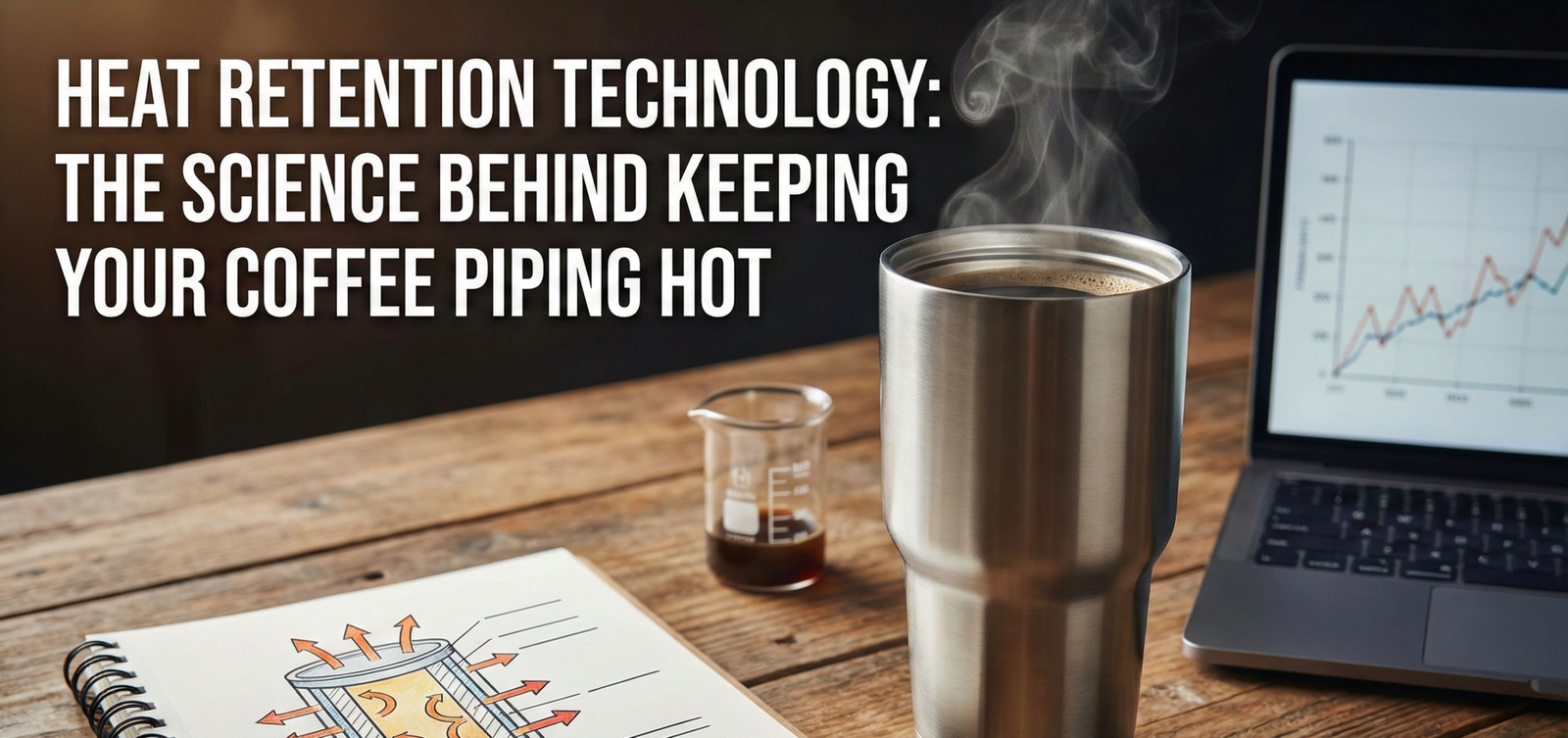
Heat Retention Technology: The Science Behind Keeping Your Coffee Piping Hot
We’ve all been there: you pour a fresh cup of coffee into your travel mug, rush out the door, and an hour later, you take a sip only to be greeted by lukewarm disappointment. The difference between a piping hot lunch at 2 PM and a tepid mess lies entirely in heat retention technology.
Understanding the engineering inside your flask doesn’t just satisfy curiosity—it saves you money. By knowing the difference between simple foam insulation and triple-layer vacuum seals, you can stop buying cheap mugs that fail and start investing in gear that works.
1. The Physics of Heat Loss: The Enemy Trio
To keep something hot, you have to stop heat from escaping. Heat is energy, and it wants to move from hot areas to cold areas until equilibrium is reached. It travels in three ways:
- Conduction: Direct transfer through touch (e.g., the heat traveling through the metal walls of a cup).
- Convection: Transfer through air or liquid movement (e.g., steam rising off your soup).
- Radiation: Heat moving as light waves (infrared) across empty space.
Advanced heat retention technology is simply a battle plan to block these three exits.
2. Vacuum Insulation: The Void That Saves Heat
[Image of vacuum flask cross section]The single most effective technology in modern drinkware is the vacuum seal. Invented by Sir James Dewar in 1892, this tech creates a space between two walls of stainless steel where air is sucked out.
Why does this work? Because heat cannot travel by conduction or convection through a vacuum. Without air molecules to pass the “heat baton,” the energy stays trapped inside your liquid. For a deeper look at the physics, check out our guide on how vacuum insulation works in a thermos.
3. The Copper Lining Advantage
While a vacuum stops conduction and convection, it cannot stop radiation. Heat can still “jump” across the vacuum gap as infrared waves. This is where premium brands like Yeti and S’well step up.
Manufacturers coat the outside of the inner wall with a thin layer of copper. Copper is highly reflective to thermal radiation. It acts like a mirror, reflecting the heat waves back into the drink rather than letting them cross the vacuum. This creates “Triple-Wall” insulation performance without adding bulk.
4. Steel Grades and Thermal Conductivity
Not all metal is created equal. Most high-quality thermal gear uses 18/8 food-grade stainless steel (18% chromium, 8% nickel). This material is chosen not just for durability, but because stainless steel is actually a relatively poor conductor of heat compared to aluminum or plain steel.
If a manufacturer uses thinner, cheaper steel, heat travels faster toward the lid (the weak point), resulting in rapid cooling.
5. Lid Technology: The Thermal Weak Point
You can have the best vacuum flask in the world, but if the lid is thin plastic, you will lose heat. Heat rises, meaning the lid takes the brunt of the thermal attack.
Look for lids that utilize:
- Internal Foam Insulation: Hollow plastic lids conduct heat; foam-filled ones trap it.
- Deep Threads: A deeper screw mechanism creates a longer path for air to escape.
- Small Openings: Flip-top lids retain heat better than wide sliders.
6. Volume vs. Surface Area
It is a law of physics: Larger volumes of liquid stay hot longer. A 40oz thermos will outperform a 12oz mug every time, assuming they use the same tech.
This is due to the ratio of surface area to volume. A small cup has a lot of surface area relative to the small amount of liquid, allowing heat to drain quickly. If you need 24-hour retention, always opt for the larger sizes.
7. The Pre-Heating Variable
Even the best technology needs user assistance. If you pour hot coffee into a cold steel flask, the steel immediately absorbs roughly 10-15 degrees of heat from the coffee to equalize the temperature.
8. Brand Implementations: Who Does It Best?
While most brands use “Vacuum Insulation,” the quality varies. Zojirushi is famous for using an incredibly thin vacuum gap (1mm) which allows for lighter bottles with superior retention. Stanley focuses on thicker steel walls (QuadVac™) for rugged durability that sacrifices some weight for thermal mass.
For a direct comparison of retention capabilities, see our test on Hydro Flask vs. Klean Kanteen ice retention.
9. Food vs. Liquid Retention
Why does soup get cold faster than coffee? Fluid dynamics. Liquids circulate easily, keeping the internal temperature consistent. Chunky foods (like stew or pasta) have air pockets and don’t circulate, creating cold spots.
If you are looking for lunch gear, you need specialized containers. Check out our roundup of the 7 best thermoses for soup in 2026 to ensure your meal stays hot.
10. Durability Factors: Losing the Vacuum
If your flask feels hot to the touch on the outside, the vacuum seal has failed. This usually happens when a drop dents the outer wall enough to touch the inner wall, creating a “thermal bridge” for conduction.
Top-tier heat retention technology includes shock-absorbing bases and thicker steel at impact points to protect that vital vacuum seal.
11. How to Test Retention at Home
Want to verify your gear? Perform this simple test:
- Boil water and measure the temperature (approx 212°F).
- Fill your flask to the top (air gaps kill heat).
- Seal it and leave it in a room temperature environment (70°F).
- Check the temperature after 6, 12, and 24 hours.
A high-quality thermos should still be above 140°F (drinkable hot) after 12 hours.
12. The Future: Aerogel and Titanium
The next frontier in heat retention is Aerogel—a synthetic porous ultralight material derived from a gel. It is the best solid insulator in existence. While currently expensive and used mostly in space exploration, brands are beginning to integrate aerogel composites into lightweight camping gear to replace bulky vacuum walls.
Frequently Asked Questions
Double-wall stainless steel with vacuum insulation is currently the best commercial material for heat retention. Glass is a good insulator but too fragile for travel, and plastic is poor at retaining heat.
This almost always means the vacuum seal is broken. If you dropped it or ran it through a high-heat dishwasher, the seal may have compromised, allowing air between the walls.
Yes, significantly. Screw-top lids retain heat much better than slider lids or straw lids because they form a tighter seal and are often insulated themselves.
Generally, yes. Heavier thermoses often have thicker steel walls and heavier caps, which provide better thermal mass and insulation durability compared to ultra-lightweight travel mugs.
Yes, high-quality stainless steel flasks are designed to handle boiling water. However, be careful when opening it, as pressure can build up inside.
Hand wash with warm soapy water and a bottle brush. Avoid dishwashers (unless rated safe) as the high heat and water pressure can damage the vacuum seal.
It is a layer of copper plating on the outside of the inner bottle (inside the vacuum space). It reflects radiant heat back into the bottle, boosting insulation performance.
Ceramic coatings are mainly for taste (to prevent metallic flavor). They do not significantly add to insulation, but they don’t harm it either as long as the underlying vacuum steel structure is sound.
Wide-mouth bottles expose more surface area of the liquid to the headspace air and the lid, leading to faster heat loss via convection and radiation compared to narrow-neck bottles.
“Thermos” is actually a brand name that became a generic term (proprietary eponym). A thermal flask is the generic name for any vacuum-insulated bottle. They refer to the same technology.




 Home
Home
 Info
Info
 Compare
 Reviews
 Shop
Shop