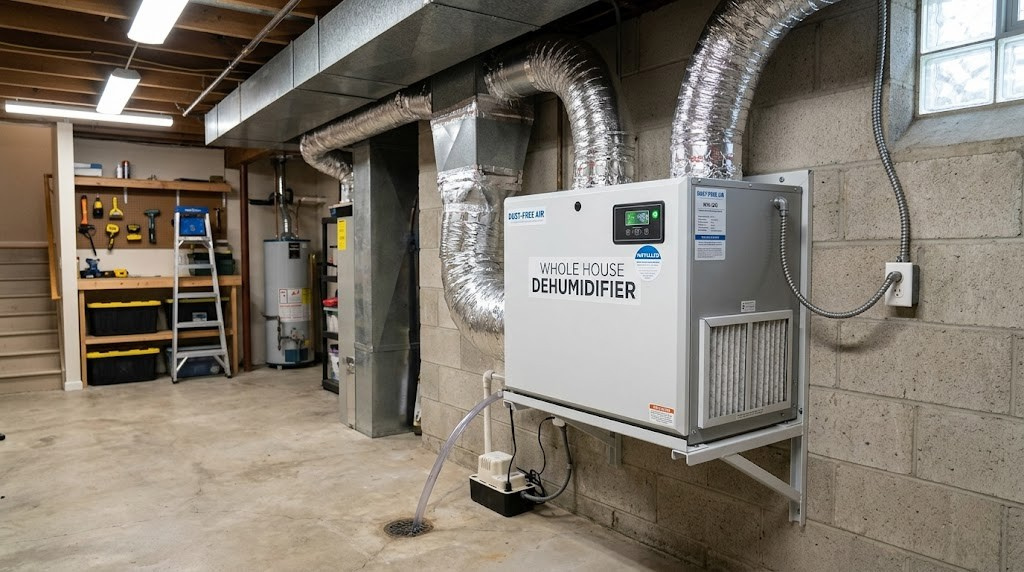
What Is a Whole House Dehumidifier? Everything You Need to Know Before You Buy
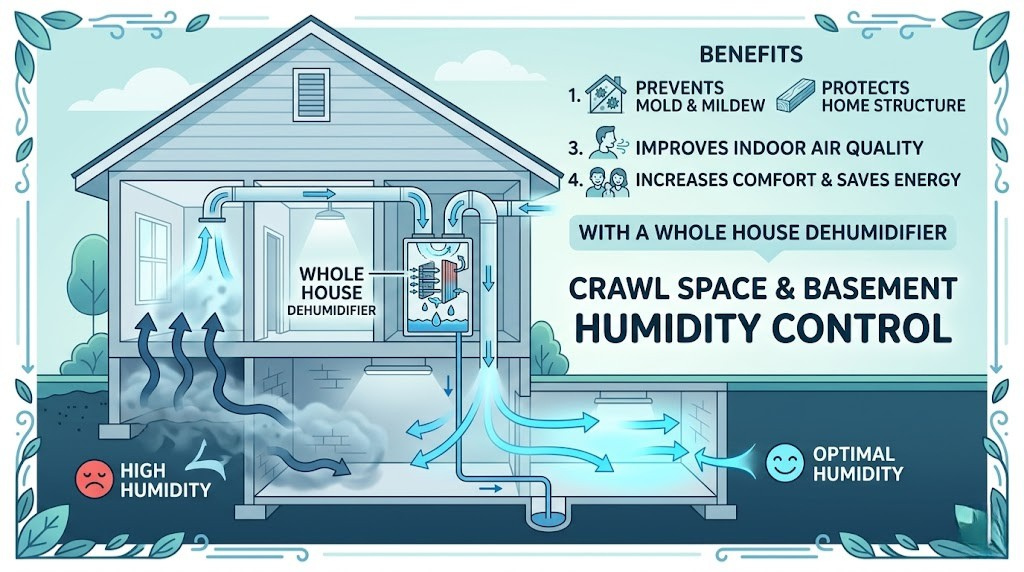
A whole-home dehumidifier tackles humidity at the source — protecting your structure, health, and comfort simultaneously.
What Is a Whole House Dehumidifier?
A whole house dehumidifier is a centralized humidity-control appliance engineered to remove excess moisture from every corner of your home simultaneously. Unlike portable dehumidifiers that tackle one room at a time, a whole-home unit integrates directly into your existing HVAC ductwork — or operates as a standalone ducted system — to regulate relative humidity (RH) across your entire living space, typically targeting the ideal 45–55% RH range recommended by the EPA and ASHRAE.
Think of it as the moisture-management counterpart to your furnace or central air conditioner. Just as your HVAC system maintains temperature throughout every room, a whole house dehumidifier maintains healthy, comfortable humidity levels from your basement to your attic, 24 hours a day, automatically.
These units are permanently installed — most commonly in a basement, crawl space, attic, or mechanical room — and are sized to handle the total square footage and typical moisture load of the home. They come in both ducted configurations (integrated with the central air handler) and standalone configurations (with their own intake and discharge connections). Many modern models communicate directly with smart thermostats and home automation systems, giving you precise, programmable control over indoor humidity.
The term “whole house” is significant. High humidity is rarely confined to one room — moisture migrates through walls, floors, and HVAC ducts throughout the home. A whole-house solution addresses this systemic problem at the root, rather than applying a band-aid fix in one space.
Who Makes These Units?
The whole-house dehumidifier market is led by a handful of trusted manufacturers who specialize in HVAC and indoor air quality equipment. The dominant brands include Aprilaire, Santa Fe (by Therma-Stor), Honeywell Home (now Resideo), Ultra-Aire, and Lennox. Each manufacturer offers different product lines targeting different home sizes, humidity loads, and installation types. Brand selection often comes down to your contractor’s preference, local availability, and the specific challenges your home presents — which we’ll explore in detail throughout this guide.
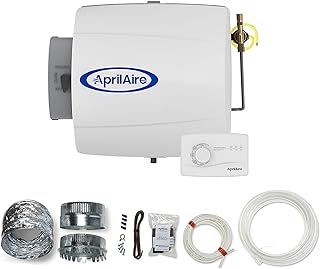
Aprilaire 1850W — Best-Selling Whole House Dehumidifier
95-pint capacity for up to 5,200 sq ft. Auto-adjusts to outdoor conditions. Top-rated by HVAC professionals.
Check Price on Amazon →How a Whole House Dehumidifier Works: The Science Made Simple
To understand why these systems are so effective, it helps to understand the physics behind dehumidification. While this might sound technical, the basic concept is remarkably intuitive — and understanding it will help you make smarter buying decisions.
The Refrigerant Cycle Explained
The vast majority of whole house dehumidifiers use a refrigerant-based condensation cycle — the same core thermodynamic principle used by your air conditioner and refrigerator. Here’s exactly what happens inside the unit when it’s running:
Warm, Humid Air Is Drawn In
A powerful fan draws warm, moisture-laden air from your home (or from outside, in some configurations) across an evaporator coil filled with cold refrigerant. Air is pulled either directly from the room, from the return air duct, or through a dedicated intake port, depending on the installation type.
Moisture Condenses on the Cold Coil
As warm air passes across the frigid evaporator coil, the air temperature drops below its dew point — the temperature at which water vapor condenses into liquid. The water droplets collect on the coil surface and drip into a drain pan below. This is exactly how a cold glass of water beads with condensation on a humid summer day.
Dry Air Is Reheated and Returned
After moisture is stripped from the air, it passes over a condenser coil where it’s slightly reheated (typically 5–10°F above intake temperature). This reheating is crucial — it prevents the unit from cooling the room (which is your AC’s job) and ensures the dehumidified air feels comfortable, not cold and clammy.
Water Is Drained Away Automatically
The collected condensate water drains through a pipe connected to a floor drain, utility sink, sump pit, or condensate pump. Unlike portable dehumidifiers that require manual bucket emptying, whole-house units drain continuously and automatically — a major quality-of-life advantage.
The Humidistat Monitors and Controls Everything
A built-in or remote humidistat continuously monitors the relative humidity level. When humidity rises above your set point, the unit activates. When the target level is reached, it shuts off. Modern units use digital humidistats that are far more accurate than old-fashioned mechanical types, often maintaining humidity within ±3% of the target.
The Role of the Refrigerant Compressor
The heart of the system is the hermetically sealed compressor, which circulates refrigerant (typically R-410A or the newer R-454B in eco-friendly models) through the evaporator and condenser coils. The compressor pressurizes the refrigerant, causing it to release heat as it condenses in the condenser coil and absorb heat (getting very cold) as it evaporates in the evaporator coil. This heat differential is what creates the cold surface needed for moisture to condense out of the air.
Higher-end whole house dehumidifiers now feature variable-speed compressors that modulate their output based on the current humidity load — similar to inverter technology used in modern HVAC systems. This variable-speed operation is dramatically more energy-efficient than single-speed compressors that cycle on and off repeatedly.
Energy Factor (EF) and AHAM Ratings
Whole house dehumidifiers are rated by the Association of Home Appliance Manufacturers (AHAM) using Energy Factor (EF), measured in liters of water removed per kilowatt-hour of electricity consumed (L/kWh). Higher EF ratings mean more efficient operation. Look for units with an Energy Factor of 2.5 L/kWh or higher. ENERGY STAR certified models meet stringent efficiency thresholds and will save meaningfully on electricity bills over their lifetime.
Types of Whole House Dehumidifiers: Which One Is Right for You?
Not all whole house dehumidifiers are created equal — and not all installation configurations suit every home. Understanding the four primary types will help you and your HVAC contractor choose the most effective solution for your specific situation.
1. Ducted (HVAC-Integrated) Dehumidifiers
The most common whole-house configuration. These units are plumbed directly into your home’s existing ductwork — typically connected to the return air side of the air handler. They draw air from the central return plenum, dehumidify it, and discharge the dry air back into the supply side. Some configurations use dedicated intake and discharge ducts instead.
Best for: Homes with central forced-air HVAC systems (the majority of American homes). Works in conjunction with your furnace and air conditioner. Installation is typically done by your HVAC contractor at the same time as system upgrades.
If you’re considering an HVAC system upgrade like a split system installation, ducted dehumidifiers can often be added simultaneously, reducing overall installation labor costs.
2. Standalone Basement/Crawl Space Dehumidifiers
Heavy-duty units designed specifically for basement, crawl space, or utility room installation. They have their own self-contained air circuit — drawing from one area, dehumidifying, and returning air to the same space. Many are rated for low-temperature operation (down to 33–40°F), which is critical for basements and crawl spaces where temps can drop significantly.
Best for: Homes with finished or unfinished basements, crawl spaces with moisture problems, or homes with hydronic/radiant heating (no ductwork). Brands like Santa Fe and Ultra-Aire dominate this segment with purpose-built crawl space dehumidifiers rated for sub-basement conditions.
3. Fresh Air Ventilating Dehumidifiers
A more advanced category that combines dehumidification with controlled fresh air ventilation. These units draw outside air in, filter and dehumidify it, and introduce it into the home — balancing both humidity control and ventilation. They address the challenge of tightly-sealed modern homes that can develop high humidity due to poor air exchange.
Best for: Tightly-built new construction homes, homes that have been recently air-sealed for energy efficiency, or situations where indoor air quality and ventilation are primary concerns alongside humidity control.
4. Energy Recovery Ventilators (ERVs) with Dehumidification
ERV-based systems recover energy from exhaust air and use it to pre-condition incoming fresh air. High-end models integrate dehumidification functionality, making them the most sophisticated — and most expensive — whole-home moisture management solution. They’re particularly popular in extremely energy-efficient homes and passive house designs.
| Type | Best Application | Typical Cost | Requires Ductwork? | Low-Temp Rated? |
|---|---|---|---|---|
| Ducted HVAC-Integrated | Central forced-air homes | $1,200–$2,500 | Yes | No |
| Standalone Basement/Crawl | Below-grade spaces | $800–$2,000 | No | Yes |
| Fresh Air Ventilating | Tight new construction | $1,500–$3,500 | Optional | Varies |
| ERV with Dehumidification | Passive/ultra-efficient homes | $2,500–$5,000+ | Yes | Varies |
The Real Benefits of a Whole House Dehumidifier (Beyond Just “Comfort”)
Most people associate dehumidifiers with comfort — and yes, lower humidity makes 80°F feel far more tolerable. But the genuine benefits of whole-home dehumidification go much deeper than personal comfort. They affect your health, your home’s structural integrity, your energy bills, and even the longevity of your belongings.
Dramatically Reduces Mold & Mildew
Mold requires moisture to grow. Keeping humidity below 50% RH creates an inhospitable environment for mold spores, protecting your lungs and your structure.
Kills Dust Mite Populations
Dust mites thrive at humidity above 50%. Studies show that maintaining 45% RH reduces dust mite populations by up to 85% within weeks.
Reduces AC Runtime & Energy Bills
When your AC handles less moisture, it runs shorter cycles to hit your comfort target — saving 10–15% on cooling energy costs in humid climates.
Protects Your Home’s Structure
High humidity causes wood framing to swell, warp, and rot. It accelerates corrosion of metal components and degrades drywall and insulation over years.
Preserves Belongings & Finishes
Furniture, wood floors, books, electronics, instruments, and art are all damaged by prolonged high humidity. Whole-house dehumidification protects your investment.
Eliminates Musty Odors
That persistent “damp house” smell is caused by mold, mildew, and bacteria — all of which disappear when humidity is consistently controlled.
Makes Lower Thermostat Settings Comfortable
Dry air feels cooler. Many homeowners raise their thermostat by 2–4°F after installing whole-home dehumidification without sacrificing comfort.
Improves Sleep Quality
High humidity disrupts sleep cycles, causes night sweats, and worsens snoring and sleep apnea symptoms. Controlled humidity promotes deeper, more restful sleep.
The Mold Connection: Why This Matters More Than You Think
The EPA states that mold can begin growing on indoor surfaces within 24–48 hours when relative humidity exceeds 60%. In basements and crawl spaces — where moisture from the ground migrates upward constantly — sustained humidity above 70% is common during summer months without active dehumidification. This creates an environment where mold colonies can establish themselves inside wall cavities and beneath subfloors — invisible to you until the problem is severe and expensive to remediate.
A whole house dehumidifier eliminates this risk systematically. Rather than reacting to mold after it appears (requiring costly remediation that can run $3,000–$30,000 for whole-home infestations), proactive humidity control prevents mold from ever getting a foothold. Considered this way, a $1,500–$2,500 whole house dehumidifier installation is actually a significant insurance policy for your home.
The Energy Savings Equation
Here’s a fact that surprises many homeowners: your air conditioner is a dehumidifier by default — but a very inefficient one. Your central AC removes moisture as a byproduct of cooling, but it’s not optimized for this job. It must cool the air significantly to condense moisture, which means it’s simultaneously fighting humidity and temperature — doing both jobs somewhat mediocrely.
When you add a dedicated whole-house dehumidifier, you relieve your AC of the dehumidification burden. The AC can now focus purely on temperature control and run shorter, more efficient cycles. Meanwhile, the dehumidifier handles moisture with far greater efficiency per unit of energy consumed. The net effect in humid climates is often a 10–20% reduction in total HVAC energy consumption.
If you’re researching ways to cut HVAC energy costs holistically, our guide on HVAC energy efficiency tips covers this and many other strategies for reducing your home’s energy footprint.
✅ Benefits of Whole House Dehumidification
- Prevents mold and structural moisture damage
- Improves indoor air quality and allergy symptoms
- Reduces AC load and energy bills
- Protects wood floors, furniture, and belongings
- Eliminates musty odors permanently
- Fully automatic — no manual emptying
- Covers entire home from one unit
- 10+ year lifespan with proper maintenance
⚠️ Considerations & Drawbacks
- Higher upfront cost vs. portable units
- Professional installation usually required
- Adds to monthly electricity bill
- Requires annual filter cleaning/replacement
- Overkill for homes in dry climates
- May need supplemental crawl space unit
- Requires drain line installation
Signs Your Home Needs a Whole House Dehumidifier
How do you know if your home actually needs a whole-house solution? Many homeowners struggle with high humidity for years, addressing symptoms (a musty smell here, a damp corner there) without realizing the root cause. Here are the telltale signs that your home has a systemic humidity problem that warrants a whole-house fix.
Physical Signs Inside the Home
- Persistent musty or “earthy” odors — especially in basements, closets, and bathrooms. This smell is produced by mold and mildew actively colonizing moist surfaces.
- Visible condensation on windows — water droplets or frost on the interior surfaces of windows, particularly during winter, indicate excessive indoor humidity.
- Peeling paint or bubbling wallpaper — moisture migrates through walls, pushing paint and adhesives off surfaces from behind.
- Warping, cupping, or gapping hardwood floors — wood expands when it absorbs moisture. A floor that was flat last year and is now noticeably uneven has a humidity problem.
- Sticking doors and windows — wood frames expand in high humidity, making doors and windows difficult to open and close smoothly.
- Visible mold spots — black, green, or white patches on walls, ceilings, grout, or around window frames are a direct sign of excessive moisture.
- Rust on metal surfaces — tools in the garage, nails in wood framing, metal pipes, and HVAC components corroding faster than expected.
- Efflorescence on basement walls — white, chalky mineral deposits on concrete or masonry indicate water migration through the foundation.
Health-Related Signs
- Worsening allergy symptoms indoors — dust mites and mold spores are the two leading triggers of indoor allergy attacks. Both thrive in humid conditions.
- Frequent respiratory infections — high humidity promotes the growth and spread of bacteria and viruses. Homes with sustained RH above 60% see higher incidences of respiratory illness among occupants.
- Skin irritation, itching, or rashes — some individuals react to mold spores with skin symptoms even without diagnosed mold allergies.
- Persistent fatigue or brain fog — low-level mold exposure is associated with neurological symptoms in sensitive individuals.
Measure It: The Humidity Test
The most definitive way to determine if your home needs a dehumidifier is to measure your actual indoor humidity. A simple digital hygrometer costs $10–$25 on Amazon and is accurate enough to give you reliable readings. Take measurements in multiple locations — main living area, basement, master bedroom, and any known “problem” areas like closets or bathrooms — across several days and at different times of day.
| Relative Humidity Level | Risk Assessment | Recommended Action |
|---|---|---|
| Below 30% | ⚠️ Too Dry | Consider humidification (see our best whole house humidifier guide) |
| 30–45% | ✅ Optimal Range | No action needed |
| 45–55% | ✅ Acceptable | Monitor; consider dehumidifier in summer |
| 55–65% | ⚠️ Elevated | Portable dehumidifier may be sufficient |
| 65–75% | 🔴 High Risk | Whole house dehumidifier strongly recommended |
| Above 75% | 🔴 Critical | Immediate whole house dehumidification + mold inspection |
Sizing Your Whole House Dehumidifier: Getting the Capacity Right
Sizing is one of the most commonly misunderstood aspects of whole house dehumidifier selection. Buy too small and the unit runs constantly, wears out prematurely, and never hits your target humidity. Buy too large and you may experience short-cycling (rapid on-off cycles) and higher-than-necessary energy costs. Getting sizing right requires considering several interconnected factors.
Pints Per Day: What It Actually Means
Dehumidifier capacity is measured in pints of water removed per day (pints/day or ppd), rated under standardized conditions of 80°F / 60% RH (AHAM standard). Whole house dehumidifiers typically range from 65 to 130+ pints/day. Note that manufacturers also publish ratings at 65°F, which will show lower (and frankly more honest for cooler basements) numbers — always confirm the 80°F/60%RH rating for apples-to-apples comparisons.
The Four Sizing Factors
A proper Manual S calculation (used by HVAC engineers) accounts for these variables:
Home Square Footage and Volume
Larger homes with higher ceiling volumes contain more air — and therefore more potential moisture. A 4,000 sq ft home at 9-foot ceilings has 60% more air volume than a 2,500 sq ft home at 8-foot ceilings.
Geographic Climate and Outdoor Humidity
A home in Houston, TX faces dramatically higher outdoor humidity loads than the same-sized home in Phoenix, AZ. The ASHRAE Design Conditions database defines outdoor design humidity for thousands of US cities — your HVAC contractor will use this to calculate peak moisture loads.
Home Construction Type and Infiltration Rate
Older, leaky homes allow more outdoor air infiltration, bringing more outdoor humidity inside. Well-sealed modern homes actually trap internally-generated moisture more effectively. Basement and crawl space conditions — and whether they are properly encapsulated — also significantly affect the total moisture load.
Internal Moisture Sources
Activities like cooking, showering, doing laundry, and having many occupants all add significant moisture to indoor air. A family of 5 generates roughly 3–6 pints of moisture per day just through respiration and perspiration — before any cooking or bathing.
Quick Sizing Reference Table
| Home Size (Sq Ft) | Mild Humidity Climate | Humid Climate | Very Humid / Gulf Coast |
|---|---|---|---|
| Up to 1,500 sq ft | 50–65 ppd | 65–70 ppd | 70–90 ppd |
| 1,500–2,500 sq ft | 65–70 ppd | 70–90 ppd | 90–105 ppd |
| 2,500–3,500 sq ft | 70–90 ppd | 90–105 ppd | 105–130 ppd |
| 3,500–5,000 sq ft | 90–105 ppd | 105–130 ppd | 130+ ppd or dual units |
| 5,000+ sq ft | 105–130 ppd | Dual units recommended | Dual units required |
Whole House Dehumidifier Installation: What to Expect
Installation is where whole house dehumidifiers differ most dramatically from portable units. Proper installation requires planning, HVAC knowledge, and in many cases a licensed contractor. Here’s a realistic picture of what the installation process involves, what choices you’ll face, and how to ensure it’s done right.
DIY vs. Professional Installation
While some technically skilled homeowners do install whole house dehumidifiers themselves — particularly standalone basement models — professional installation is strongly recommended in most cases. HVAC-integrated (ducted) models require modifications to your ductwork and air handler that, if done incorrectly, can impair the performance of your entire HVAC system. Electrical work (usually 240V/30A dedicated circuit) is required in most installations. Many manufacturers also require professional installation to maintain the warranty.
Understanding the overall cost of your HVAC system and how dehumidifiers fit into that picture is easier when you have context — our detailed HVAC system replacement cost guide provides that broader framework, including how accessory equipment like dehumidifiers factors into total project costs.
The Five Key Installation Decisions
Decide on Location: Attic, Basement, or Mechanical Room?
Most whole-house dehumidifiers are installed in the same area as the air handler — typically the basement, mechanical room, or attic. The location affects duct routing complexity, drainage options, and how well the unit’s intake air represents the whole-home condition. Basement installations are ideal when basement moisture is a primary concern. Mechanical room installations work best when the dehumidifier is integrated directly with the air handler.
Choose the Airflow Configuration
Ducted dehumidifiers can be configured in several ways: stand-alone with dedicated ducts, integrated into the return air plenum, integrated into the supply air plenum, or bypass configuration. Each has advantages depending on your existing system layout. Your contractor will determine the best approach based on your air handler location and duct layout.
Plan the Drain Line
Whole house dehumidifiers produce significant quantities of water — a 90-pint unit running at full capacity in a humid climate can remove over 5 gallons of water per day. This water must be routed somewhere. Options include a floor drain, utility sink drain, sump pit, or exterior (with appropriate freeze protection in cold climates). If no gravity drain is available, a condensate pump will be needed to lift water to a drain point.
Install the Dedicated Electrical Circuit
Most whole house dehumidifiers require a dedicated 240V/20A or 240V/30A circuit with a proper disconnect. This is electrical work that requires a licensed electrician in most jurisdictions. The cost of this electrical work is typically $150–$350 depending on how far the panel is from the installation location. Factor this into your budget.
Set Up Controls and Integration
Modern whole house dehumidifiers come with a standalone wall-mounted humidistat or integrate with existing thermostat/IAQ control systems. If you have a smart thermostat with humidity control capabilities, your contractor can integrate the dehumidifier so both temperature and humidity are managed from a single interface. This simplifies operation and enables more sophisticated scheduling and control strategies.
Typical Installation Timeline
A straightforward standalone basement installation by an experienced contractor typically takes 3–5 hours. A fully ducted HVAC-integrated installation with new electrical and drain work can take 6–10 hours. Complex installations in tight attic spaces or homes with non-standard ductwork may require 2 days. Most contractors can complete a typical residential installation in a single workday.

Honeywell Home DR90A3000 — Popular Whole House Model
90-pint capacity, designed for easy HVAC duct integration, with smart dehumidistat and Energy Star certification.
Check Price on Amazon →How Much Does a Whole House Dehumidifier Cost? (Full Breakdown)
Cost is one of the first questions homeowners ask — and rightly so. A whole house dehumidifier is a meaningful investment, but understanding all the cost components helps you budget accurately and evaluate the true return on investment.
Equipment Costs
Whole house dehumidifier units range from about $700 for entry-level models to $2,500+ for commercial-grade residential units. The price range reflects differences in capacity, efficiency, features, and build quality. Don’t make the mistake of buying the cheapest unit available — a dehumidifier that’s undersized or energy-inefficient will cost you more in the long run through higher energy bills and premature replacement.
| Price Range | Typical Capacity | Target Use Case | Example Brands |
|---|---|---|---|
| $700–$1,000 | 65–70 ppd | Small homes, mild climate | Frigidaire, hOmeLabs |
| $1,000–$1,500 | 70–90 ppd | Mid-size homes, moderate humidity | Aprilaire 1770A, Honeywell |
| $1,500–$2,000 | 90–105 ppd | Large homes, humid climates | Aprilaire 1850, Santa Fe Max |
| $2,000–$2,500+ | 105–130+ ppd | Large homes, Gulf Coast, basements | Santa Fe Ultra98, Ultra-Aire 155H |
Installation Labor Costs
Professional installation adds $300–$1,000 to the project cost depending on complexity:
- Simple standalone basement installation: $300–$500
- Ducted HVAC-integrated installation: $500–$800
- Complex installation (new duct runs, condensate pump, tight access): $700–$1,000+
- Electrical circuit addition by electrician: $150–$400 (separate from HVAC labor)
Understanding how these accessory installation costs fit into broader HVAC project costs is important. If you’re already planning a new furnace or AC installation, adding a whole house dehumidifier at the same time significantly reduces incremental labor costs. Our guide on furnace replacement cost and AC unit installation cost will give you context for how these projects are typically bundled.
Operating Costs
Electricity consumption is an ongoing cost. A typical 90-pint dehumidifier draws about 700–900 watts when running. If you’re replacing an older PSC-motor unit with a newer ECM motor model, the efficiency gains can be substantial. Our detailed breakdown of PSC vs. ECM motor energy costs explains why motor technology matters so much for long-term operating expenses.
| Operating Scenario | Watts | Daily Hours | Monthly Cost (@ $0.14/kWh) | Annual Cost |
|---|---|---|---|---|
| High-efficiency unit, mild climate | 650W | 6 hrs | ~$16 | ~$80 (seasonal) |
| Mid-efficiency unit, moderate climate | 800W | 8 hrs | ~$27 | ~$165 |
| Standard unit, humid climate, year-round | 900W | 12 hrs | ~$45 | ~$540 |
| Large capacity unit, Gulf Coast, year-round | 1,100W | 14 hrs | ~$65 | ~$780 |
Total Cost of Ownership Analysis
When you account for equipment, installation, and operating costs over a 10-year lifespan, the true cost of whole-house dehumidification typically works out to $2,000–$5,500 total — roughly $200–$550 per year. Against the potential cost of mold remediation ($3,000–$30,000), structural repair, health costs, and the comfort value of dry, fresh air, this investment has a compelling ROI for homeowners in humid climates.
Top Whole House Dehumidifier Models for 2026: Compared
The market has evolved significantly in recent years. Here’s our analysis of the leading whole-house dehumidifier models available in 2026, evaluated on capacity, efficiency, reliability, features, and overall value.
1. Aprilaire 1850W — Best Overall
The Aprilaire 1850W is the benchmark product in the residential whole-house dehumidifier category. With a 95-pint capacity (at 80°F/60%RH), it’s sized for homes up to 5,200 square feet and is designed for either standalone or HVAC-integrated installation. Aprilaire’s Auto Mode automatically adjusts operation based on both indoor humidity and outdoor temperature — a genuinely useful feature that prevents wasteful over-dehumidification in mild weather.
The 1850W uses an efficient R-410A refrigerant system, includes a built-in digital humidistat, and drains continuously. Build quality is exceptional — Aprilaire products are known for 15+ year lifespans with proper maintenance. ENERGY STAR certified.
2. Santa Fe Ultra98 — Best for Basements & Crawl Spaces
Made by Therma-Stor in Wisconsin, the Santa Fe Ultra98 is purpose-built for below-grade applications. It’s rated to operate in temperatures as low as 33°F — critical for unheated basements and crawl spaces. At 98 pints/day capacity and a remarkably compact footprint for a unit of its size, it’s the go-to recommendation for any home with serious basement or crawl space humidity problems. ENERGY STAR certified with an impressive Energy Factor of 3.0+ L/kWh.
3. Honeywell Home DR90A — Best Value Whole-Home Option
The Honeywell DR90A delivers solid 90-pint capacity performance at a lower price point than Aprilaire or Santa Fe. It integrates cleanly with Honeywell’s Redlink thermostat ecosystem, which makes it attractive for homeowners already invested in that control platform. Slightly less efficient than the top-tier units but represents good value for budget-conscious buyers in moderate-humidity climates.
4. Ultra-Aire 155H — Professional Grade
The Ultra-Aire 155H is the choice when capacity and efficiency are paramount. At 155 pints/day, it can handle very large homes or extremely challenging humidity conditions. Its MERV-11 air filtration (included in the unit) also improves indoor air quality beyond just humidity control. The 155H is what HVAC professionals specify for custom homes, luxury residences, and indoor pools. Premium price, premium performance.
Aprilaire 1850W Best Overall
- 95 ppd capacity
- Up to 5,200 sq ft
- Auto outdoor temp mode
- ENERGY STAR certified
- R-410A refrigerant
- 15-year lifespan typical
Santa Fe Ultra98
- 98 ppd capacity
- Works at 33°F
- Best for basements
- ENERGY STAR certified
- EF 3.0+ L/kWh
- Compact footprint
Honeywell DR90A
- 90 ppd capacity
- Up to 4,500 sq ft
- Redlink compatible
- ENERGY STAR certified
- Good value option
- Ducted installation
Ultra-Aire 155H
- 155 ppd capacity
- Very large homes
- MERV-11 filtration
- Professional grade
- Highest efficiency
- For luxury/custom homes

Aprilaire 1770A — Ideal for Mid-Size Homes
70-pint whole-home dehumidifier for homes up to 3,400 sq ft. Auto mode, ENERGY STAR, low-maintenance design.
Check Price on Amazon →Whole House Dehumidifier vs. Portable Dehumidifier: Which Do You Really Need?
This is the question most homeowners ask first — and the honest answer is that both products serve different needs well. The key is matching the solution to the actual problem. Here’s a frank, unbiased breakdown.
When a Portable Dehumidifier Is Sufficient
Portable dehumidifiers are completely adequate in many situations:
- Moisture problem is confined to one room or area (e.g., a single damp basement room, one bathroom with poor ventilation)
- Your home’s overall humidity is acceptable but one area spikes seasonally
- You’re renting and can’t make permanent modifications
- You live in a dry climate and only need dehumidification a few weeks per year
- Your budget is tight and the humidity problem is minor
When You Need a Whole House Unit
Upgrade to a whole-house solution when:
- Humidity is elevated throughout the home, not just in one room
- You’re already on your second or third portable dehumidifier and still fighting the problem
- You have a large basement or crawl space that’s a constant moisture source
- You’re dealing with mold, musty odors, or structural moisture damage
- The constant maintenance of emptying portable units is burdensome
- You want whole-home integration with your thermostat and HVAC system
- Your home is 2,500+ square feet and located in a humid climate
| Feature | Portable Dehumidifier | Whole House Dehumidifier |
|---|---|---|
| Coverage area | 1 room / 500–1,500 sq ft max | Whole home / 1,500–5,000+ sq ft |
| Upfront cost | $150–$400 | $700–$2,500+ |
| Installation required | No | Yes (professional recommended) |
| Drainage | Manual bucket or gravity hose | Continuous automatic drain |
| Noise level | Audible in room (45–55 dB) | Remote/mechanical room — very quiet |
| HVAC integration | None | Full integration possible |
| Maintenance | Daily to weekly bucket emptying | Annual filter clean/replace only |
| Energy efficiency | Good for single room | Better for whole home |
| Lifespan | 5–8 years average | 10–15+ years |
| Smart home integration | Limited | Full thermostat/HVAC integration |
Whole House Dehumidifier Maintenance: Keeping It Running for 15+ Years
One of the most compelling arguments for a whole house dehumidifier over a portable unit is the dramatically lower maintenance burden. But “lower maintenance” doesn’t mean zero maintenance. Follow this schedule to maximize your unit’s lifespan and maintain peak efficiency.
Monthly Tasks (Takes 5 Minutes)
- Check the drain line: Inspect the condensate drain line to ensure it’s flowing freely and not blocked, kinked, or leaking. A blocked drain can cause the unit to shut down on the overflow safety sensor.
- Inspect the unit exterior: Look for any ice buildup on the coils (a sign the unit is operating below its rated minimum temperature) or unusual sounds that might indicate a developing mechanical issue.
Every 3 Months (During Peak Season)
- Clean or replace the air filter: Most whole house dehumidifiers use a mesh or pleated air filter to protect the evaporator coil from dust and debris. A dirty filter reduces airflow, kills efficiency, and can cause coil icing. Washable mesh filters should be rinsed and dried; disposable filters should be replaced with the correct part number.
- Check the humidistat accuracy: Place a calibrated hygrometer next to the unit’s sensor and compare readings. If there’s more than a 5% discrepancy, recalibrate or replace the humidistat.
Annual Service (Schedule with HVAC Contractor)
- Evaporator and condenser coil cleaning: Coils accumulate microbial films and dust over time. A professional coil cleaning with appropriate HVAC coil cleaner maintains heat transfer efficiency and prevents bacterial growth that causes odors.
- Refrigerant charge check: A slow refrigerant leak can significantly impair dehumidification performance. An HVAC technician with gauges can check the system charge and identify leaks before they become serious.
- Electrical connections inspection: Check that all electrical connections are tight and that the dedicated circuit is functioning correctly.
- Drain pan cleaning: Clean the condensate drain pan with a dilute bleach solution to prevent algae and bacterial growth that can block the drain and create odors.
Signs the Unit Needs Immediate Attention
- Ice forming on the evaporator coil
- Unit running but not reducing humidity
- Water leaking from the unit (not the drain line)
- Unusual grinding, squealing, or rattling sounds
- Musty odor emanating from the unit itself
- Circuit breaker tripping when the unit starts

AcuRite Pro Accuracy Hygrometer — Essential for Monitoring
Monitor your whole-home humidity levels in real time. NIST-calibrated accuracy within ±2% RH. Place one in each zone.
Check Price on Amazon →Integrating a Whole House Dehumidifier With Your HVAC System
A whole house dehumidifier doesn’t operate in isolation — it’s one component of your home’s complete indoor environmental system. Understanding how it interacts with your HVAC equipment helps you get the most out of both systems and avoid the common pitfalls of poorly integrated installations.
Coordinating With Your Air Conditioner
The most important integration consideration is the relationship between the dehumidifier and your central air conditioner. Both systems remove moisture — but they should do so in a complementary, non-competing way. The key coordination points are:
- Don’t dehumidify into the AC return: Some installers incorrectly dump dehumidified air into the return air stream just before the AC coil. This can cause the AC coil to see air that’s already dry, causing the coil to get excessively cold and potentially ice over. Best practice is to discharge dehumidified air into the supply duct side, or use a standalone air circuit.
- Thermostat coordination: Many homeowners set the dehumidifier to handle humidity during “shoulder season” periods when the AC isn’t running. The dehumidifier fills the gap between AC cycles and shoulder season operation — maintaining humidity control when the AC alone is insufficient.
- Latent vs. sensible load: In humid climates, a significant portion of your home’s cooling load is “latent” (removing moisture) rather than “sensible” (reducing air temperature). A dedicated dehumidifier offloads the latent portion to specialized equipment, freeing the AC to handle sensible cooling more efficiently.
Integration With Heat Pumps
Homes with heat pumps face a specific challenge: heat pumps in cooling mode remove less moisture per unit of energy than dedicated dehumidifiers, especially at part load conditions (when outdoor temperatures are mild). This means heat pump homes — particularly those with modern inverter-type heat pumps that run at low capacity for long periods — often benefit disproportionately from supplemental whole-house dehumidification. The heat pump handles sensible cooling while the dehumidifier handles latent (moisture) loads efficiently.
If you have a multi-zone heat pump system or are considering one, proper humidity control integration becomes even more important. Our guide on multi-zone heat pump thermostat systems covers how humidity control fits into whole-home comfort management.
Smart Thermostat and IAQ Controller Integration
Modern whole house dehumidifiers increasingly integrate with smart thermostats and dedicated indoor air quality (IAQ) controllers. This integration enables:
- Simultaneous temperature and humidity control from a single interface
- Coordinated operation schedules — run the dehumidifier during off-peak electricity hours
- Humidity-based “comfort cooling” algorithms — some smart systems adjust the temperature set point based on current humidity
- Remote monitoring and control via smartphone apps
- Fault alerts and maintenance reminders
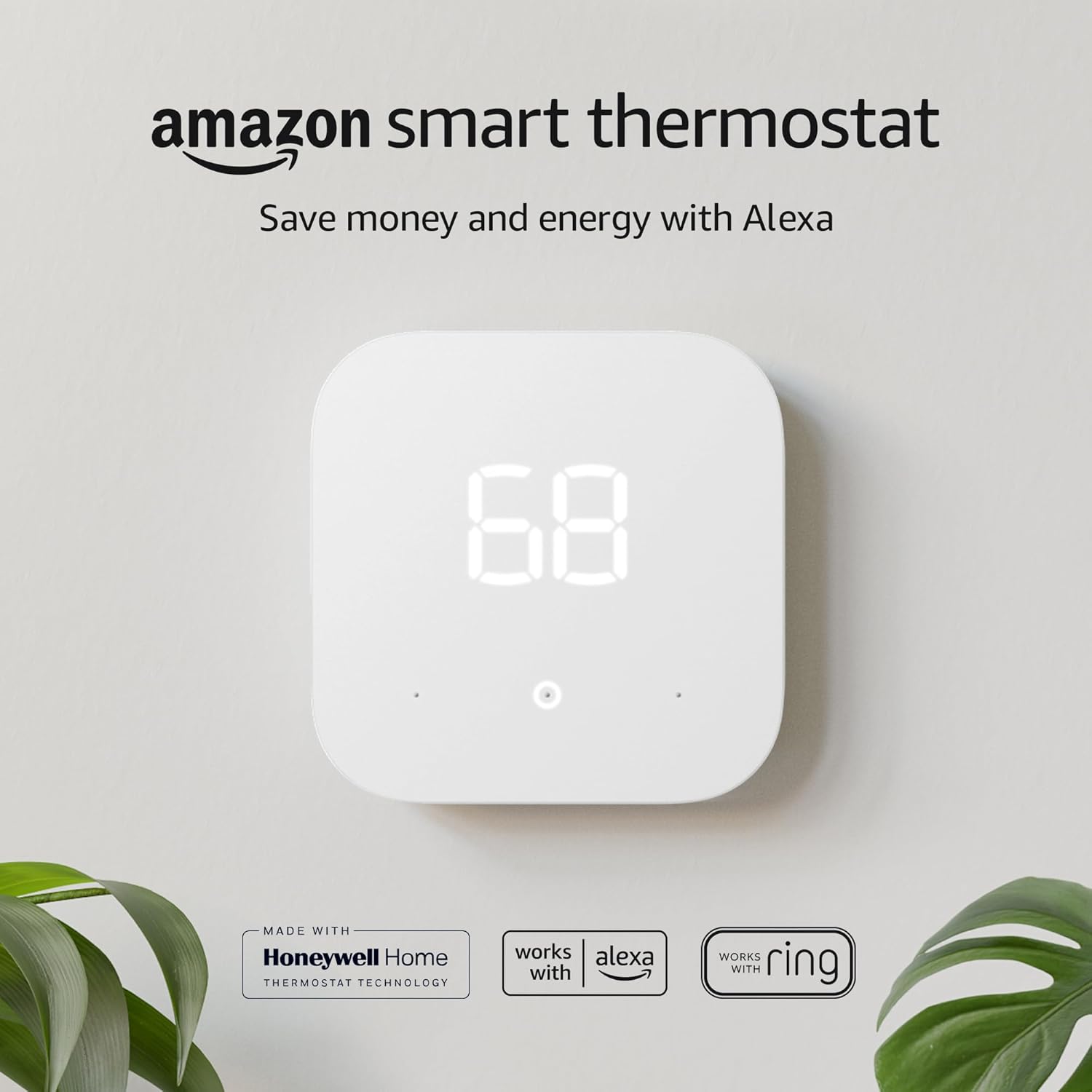
Premium HVAC control brands like Aprilaire’s own IAQ controller, Ecobee, and Nest all offer varying levels of dehumidifier integration. If you’re building a truly smart home comfort system, choosing compatible equipment from the outset simplifies installation and enables more sophisticated automation.
Ductwork Considerations
A poorly designed duct system will undermine even the best whole house dehumidifier. Key ductwork considerations for dehumidifier integration include ensuring adequate return airflow to the dehumidifier intake, properly sizing any new duct connections to avoid excessive static pressure, and sealing all duct connections thoroughly to prevent moisture infiltration. In older homes where ductwork is leaky, dehumidifying the air only to have it escape through duct leaks before reaching living spaces is a common and frustrating problem. Address duct leakage before or simultaneously with dehumidifier installation for best results.
The Broader HVAC System Context
A whole house dehumidifier is most effective when it’s part of a well-maintained, properly functioning HVAC system. If your central system is aging and inefficient, it’s worth understanding the complete picture of modern HVAC equipment technology and whether system-level upgrades might deliver better overall value than adding accessories to an older system.

Aprilaire 8910W Thermostat — Best IAQ Integration
Controls temperature, humidity, ventilation, and air purification from one interface. Designed specifically for Aprilaire dehumidifiers.
Check Price on Amazon →Frequently Asked Questions: Whole House Dehumidifiers
What relative humidity level should I set my whole house dehumidifier to?
The EPA and ASHRAE both recommend maintaining indoor relative humidity between 30% and 50%. For most homes, setting your dehumidifier’s humidistat to 45–50% RH is the ideal starting point. This range suppresses mold growth, discourages dust mite populations, and maintains structural safety for wood components — without drying the air so much that it causes respiratory irritation, static electricity problems, or wood shrinkage. In very humid climates, achieving 50% may require more dehumidifier capacity; don’t set the target below 35% as this can cause its own problems including dry skin, cracked wood, and respiratory irritation.
Can a whole house dehumidifier run year-round, or only in summer?
This depends on your climate and home construction. In the Southeast US, Gulf Coast, and other persistently humid regions, year-round operation is common and necessary — outdoor humidity remains high even in winter. In the Midwest and Northeast, dehumidifiers typically run May through October during the humid season and are effectively dormant in winter. In very cold climates, operating a whole house dehumidifier in winter can actually over-dry the home — in this case, a humidifier is needed in winter while the dehumidifier handles summer moisture. Most whole house dehumidifiers have adjustable humidistats and can be programmed or manually shut off seasonally. Low-temperature-rated basement models can run in colder temperatures without damage.
How long does a whole house dehumidifier last?
A quality whole house dehumidifier from a reputable brand (Aprilaire, Santa Fe, Ultra-Aire) typically lasts 10–15 years with proper maintenance. Some units exceed 20 years in ideal conditions. Key factors that determine lifespan include: maintenance frequency (annual filter cleaning and coil maintenance significantly extends life), operating environment (lower temperatures and cleaner air extend compressor life), and the quality of the initial installation. Cheap imported units or aggressively priced “whole home” portable units at big box stores typically last only 3–7 years. This is why the purchase price of a premium unit pays off over its lifespan.
Does a whole house dehumidifier cool the air?
Not significantly. This is an important distinction from portable dehumidifiers, which can raise room temperature noticeably. Whole house dehumidifiers are designed with a reheat coil that warms the air back to approximately its original temperature after dehumidification — typically 3–8°F above intake temperature. The net effect on room temperature is minimal. The slight heating actually means the dehumidifier is recovering energy from the refrigeration cycle, which is thermodynamically efficient. You should not expect your whole house dehumidifier to provide meaningful cooling — that’s your air conditioner’s job.
What’s the difference between a dehumidifier and an air conditioner for removing moisture?
Both use refrigerant coils to condense moisture, but they’re optimized for different purposes. An air conditioner is optimized for sensible heat removal (lowering air temperature) and removes moisture as a byproduct of cooling. It’s relatively inefficient at moisture removal and must cool the space significantly to achieve meaningful dehumidification. A dedicated dehumidifier is optimized specifically for moisture removal — its refrigerant system, airflow, and coil design are tuned for maximum moisture extraction per unit of energy consumed. Critically, a dehumidifier returns air to room temperature after removing moisture, while an AC delivers cold air. In humid climates, a dedicated dehumidifier working alongside the AC delivers dramatically better comfort and efficiency than an AC alone.
Do I need a whole house dehumidifier if I already have central air conditioning?
In many humid climates, yes — for several reasons. First, your AC only removes moisture when it’s actively cooling. On cool but humid spring and fall days when the AC isn’t running, indoor humidity can rise significantly. Second, modern high-efficiency variable-speed AC systems actually remove less moisture per unit of airflow than older single-speed systems — they run at lower capacity for longer periods, which reduces their moisture removal effectiveness. Third, if your home is tight and well-insulated (as modern homes should be), you may have elevated indoor humidity even with the AC running simply because the system isn’t sized to handle the full latent load. A dedicated dehumidifier fills all these gaps.
How noisy is a whole house dehumidifier?
Significantly quieter than portable units in practice, primarily because whole house units are installed in mechanical rooms, basements, or attics — away from living spaces. The unit itself produces about 45–55 dB of operating noise (similar to a quiet dishwasher), but this noise stays in the mechanical space. In living areas with closed doors and normal ductwork insulation, occupants typically cannot hear the dehumidifier operating. Some high-end units with variable-speed fans operate at remarkably low noise levels when running at reduced capacity. Vibration isolation pads can further reduce any structural noise transmission.
Will a whole house dehumidifier solve my condensation-on-windows problem?
It will help significantly but may not completely eliminate the problem depending on the cause. Window condensation in winter is caused by warm, moist indoor air contacting cold window surfaces — the same dew point physics the dehumidifier exploits. By reducing indoor relative humidity to 40–45%, you raise the dew point enough that window surfaces need to be significantly colder before condensation forms. In moderate climates, this often eliminates condensation entirely. In very cold climates with single-pane or poorly insulated windows, condensation may still occur on extremely cold nights even at 40% RH. The real fix for severe window condensation in cold climates is window replacement, but a dehumidifier will meaningfully reduce the problem in the meantime.
Can a whole house dehumidifier help with allergies and asthma?
Yes, and the evidence is well-established. Maintaining indoor relative humidity below 50% creates an inhospitable environment for both dust mites (the most common indoor allergy trigger, which can’t survive below 50% RH) and mold (which requires moisture to grow and reproduce). Multiple peer-reviewed studies have demonstrated significant reductions in dust mite populations and related allergy symptoms in homes where humidity is consistently controlled. For asthma sufferers, reduced mold spore counts and dust mite allergens translate directly to fewer attacks and reduced medication use. Whole-house dehumidification is a core recommendation in the EPA’s guidelines for managing indoor allergen levels.
What happens if my whole house dehumidifier is too big for my home?
An oversized whole house dehumidifier will short-cycle — it will reach the target humidity quickly and shut off, then cycle back on frequently. This is less efficient than sustained operation and puts more wear on the compressor (which is stressed most at startup). In extreme cases, short-cycling can prematurely wear out the compressor in as few as 5–7 years instead of the expected 10–15 years. A grossly oversized unit also won’t run long enough to adequately dehumidify all areas of the home — it will pull the humidity reading down quickly near the humidistat sensor while remote areas remain humid. This is why proper sizing by a professional matters: bigger is not always better.
Conclusion: Is a Whole House Dehumidifier Right for Your Home?
After walking through everything from the underlying physics to specific product recommendations, here’s the bottom line: if you live in a humid climate and your home regularly sees indoor relative humidity above 60%, a whole house dehumidifier isn’t a luxury — it’s a fundamental component of a healthy, well-maintained home.
The benefits are broad and compounding: mold prevention, structural protection, allergy and asthma relief, lower AC energy costs, better sleep, and the simple comfort of living in air that feels clean and dry rather than heavy and clammy. The initial investment of $1,500–$3,000 installed looks very different when you consider that a single moderate mold remediation project can cost $5,000–$10,000, a full structural repair from moisture damage can run tens of thousands, and the daily comfort and health value is continuous over a 10–15+ year product lifespan.
For most homeowners in the Southeast, Mid-Atlantic, Great Lakes, and Pacific Northwest — the decision isn’t really whether to get a whole house dehumidifier, but which model to choose and when to install it. Our recommendation for most homeowners is the Aprilaire 1850W for its proven reliability, Auto Mode intelligence, and long-term service support. For basement-dominated moisture problems, the Santa Fe Ultra98 is the specialist’s choice. Budget-conscious homeowners in moderate climates will be well served by the Honeywell DR90A.
Whatever model you choose, work with a licensed HVAC contractor for installation — it’s the single most important factor in whether the system performs as intended. A properly installed system from a good brand, maintained annually, will deliver a decade or more of reliable, automatic whole-home humidity control.
Related Guides on ThermoInformer
- Best Whole House Humidifiers for 2026 — the other side of indoor humidity management
- What Is Inverter Technology in HVAC? — understand the efficiency gains in modern systems
- HVAC Energy Efficiency Tips — maximize your whole-system performance
- HVAC System Replacement Cost Guide 2026 — complete budgeting framework




 Home
Home
 Info
Info
 Compare
 Reviews
 Shop
Shop