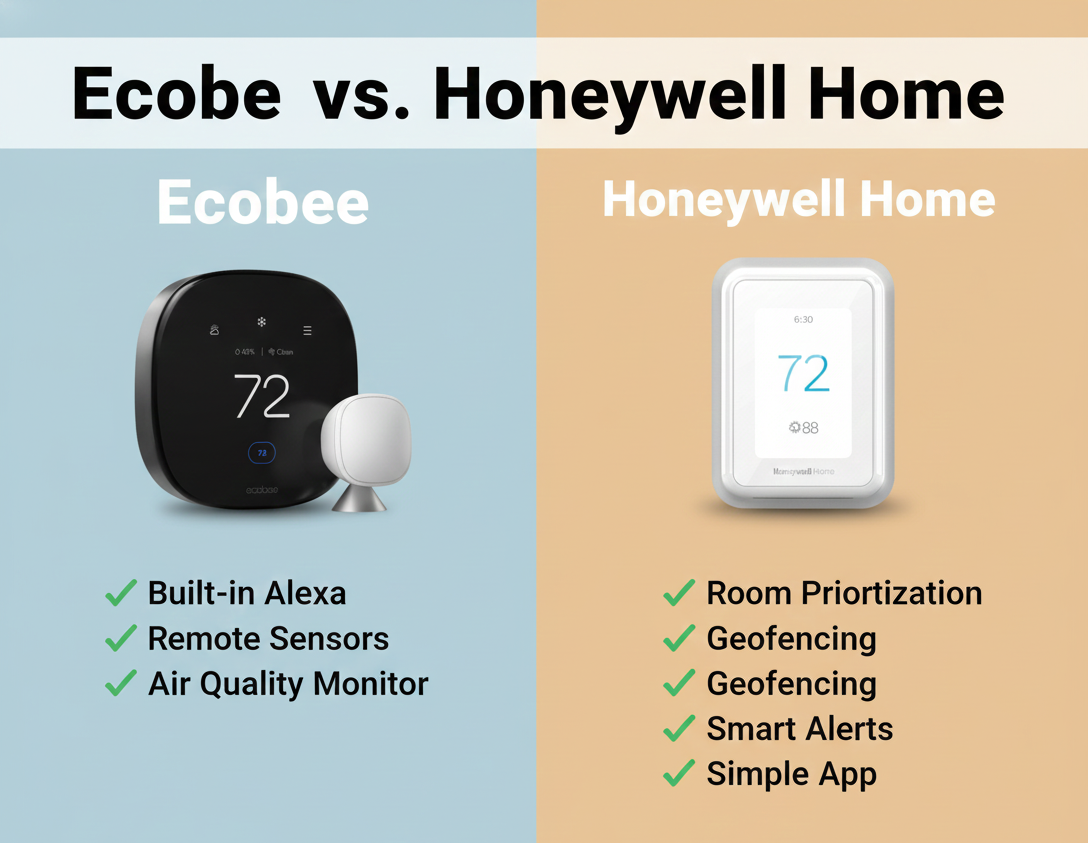
Ecobee vs. Honeywell Home: Which Smart Thermostat Reigns Supreme?
The battle for the modern wall is fierce. On one side, you have Honeywell Home (now under Resideo), a brand with over a century of HVAC heritage. If you grew up in a house with a thermostat, it was likely a round, beige Honeywell dial. On the other side is Ecobee, the Canadian tech disruptor that invented the smart thermostat category before Nest even existed.
Choosing between them isn’t just about picking a device; it’s about choosing a philosophy. Do you want the tried-and-true reliability of an HVAC giant, or the slick, app-driven innovation of a tech startup? In this comprehensive “Ecobee vs. Honeywell Home” comparison, we break down installation, features, app experience, and real-world energy savings to help you decide. We’ll also explore core concepts like what is a thermostat and how do thermostats work to establish a baseline for this ultimate showdown.
At a Glance: The Tale of the Tape
Before we dive deep, here is how the flagship models—the Ecobee Smart Thermostat Premium and the Honeywell Home T9—stack up against each other on the key features to compare when buying a smart thermostat.
| Feature | Ecobee Smart Thermostat Premium | Honeywell Home T9 |
|---|---|---|
| Build Material | Zinc & Glass (Premium Feel) | Plastic (Utilitarian) |
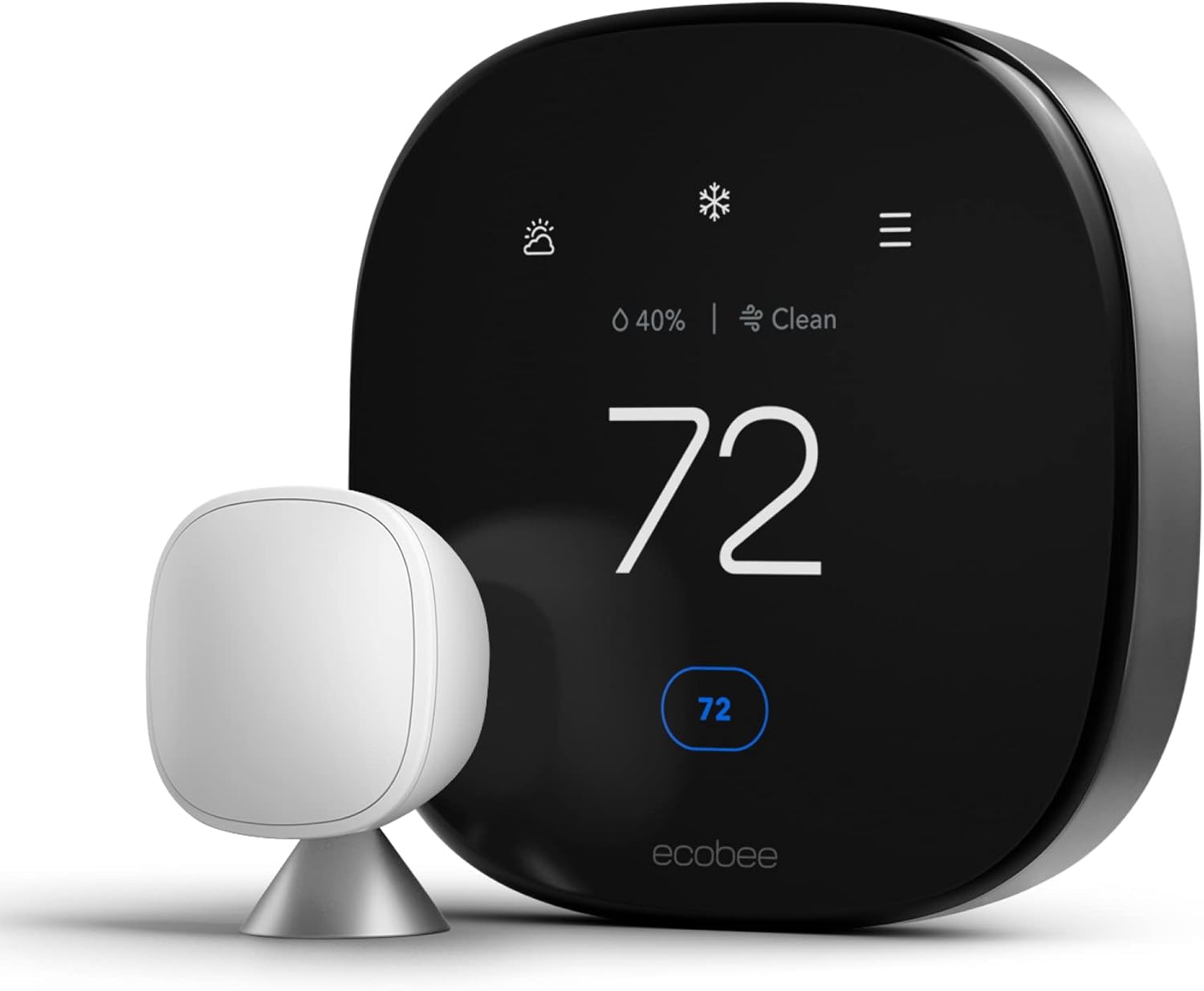
| Remote Sensors | 1 SmartSensor Included, supports up to 32 | 1 Smart Room Sensor Included, supports up to 20 |
| Air Quality Monitoring | Yes (VOCs & CO2 estimate) | No (Humidity only) |
| Voice Control | Built-in (Alexa & Siri) | Compatible (Needs external speaker) |
| C-Wire Adapter | Included (PEK) | Included (C-Wire Adapter) |
| Smart Home Ecosystem | HomeKit, Alexa, Google, SmartThings, IFTTT | HomeKit, Alexa, Google, SmartThings |
| App Rating | 4.7/5 (Consistently High) | 4.2/5 (Improved, but laggy) |
Round 1: Design & Aesthetics
When you mount something on your wall for the next decade, looks matter. The physical design must also be practical; you might even consider our 25 thermostat cover ideas that actually blend into your home or the best wall color behind your thermostat to make either model shine.
Ecobee: The Modernist
Ecobee has refined its “squircle” design over the years. The Ecobee Smart Thermostat Premium review units reveal a stunning glass face housed in a zinc body. It feels heavy, expensive, and futuristic. The interface is high-resolution, resembling a smartphone screen. It uses a radar sensor to wake up as you approach, which feels magical.
Honeywell: The Utilitarian
Honeywell Home focuses on function over form. The T9 and T10 Pro models are white, rectangular, and made of plastic. They look like thermostats. For many homeowners, this is a plus—they don’t want a “gadget” on the wall; they want a control panel. However, compared to the Ecobee, the Honeywell T9 feels a bit dated. Our Honeywell Home T9 review dives deeper into this.
Winner: Ecobee. It simply looks better in a modern home.

Round 2: Installation & Compatibility
Both brands excel here, but they take different approaches to the dreaded “C-wire” issue. Before you even buy, you must learn how to tell if thermostat can be upgraded in house. If your old thermostat didn’t have a common wire, you might see thermostat low battery symptoms with cheaper models.
The Wiring Solution
Ecobee includes a Power Extender Kit (PEK). It’s a small module you install at your furnace control board. The instructions are phenomenal. We have a guide on how to switch out an hz311 thermostat for an ecobee thermostat that highlights just how adaptable the Ecobee backplate is. For a broader look at wiring, consult our thermostat wiring guide.
Honeywell also includes a C-wire adapter with the T9 and T5 models. However, Honeywell’s legacy means it supports a wider range of obscure HVAC systems, including dual-fuel and complex zoning systems, right out of the box. If you are debating Honeywell vs Emerson thermostat for an older boiler system, Honeywell is often the safer bet. You can use our line voltage vs low voltage thermostat 2-minute wiring test to check your system.
Beyond the Basics: Deep HVAC Compatibility
For complex systems, the choice becomes clearer. If your home has a split HVAC system or uses inverter technology, you must verify compatibility meticulously.
Multi-Stage Equipment & Heat Pumps
Both brands handle multi-stage furnaces and heat pumps. However, Honeywell’s deep integration with proprietary communicating protocols (like some Carrier or Trane units) often makes it the only option for drop-in replacement without losing efficiency features. Trane vs Carrier spine fin coil vs Greenspeed explained highlights how premium equipment expects premium controllers.
Accessory Control: Humidifiers, Dehumidifiers, and Ventilators
Ecobee Premium has dedicated ACC terminals to control a whole-house dehumidifier, a humidifier, or an ERV. The Honeywell T9 lacks direct accessory control; you need the T10 Pro for that. If you’re investing in the best whole-house humidifier 2026, Ecobee Premium is the more seamless controller.
Dual Fuel & Zoning
Honeywell arguably wins on dual-fuel systems (heat pump with gas backup), a configuration common in northern climates. Its algorithm for the balance point is slightly more conservative and reliable. If you have a Honeywell HZ311 zoning panel, our guide on how to switch out an hz311 thermostat for an ecobee thermostat shows you can still upgrade, but Honeywell’s own T-series talks natively to these panels.
Round 3: Remote Sensors & Temperature Control
This is where the magic happens. Both brands use what is a thermostat remote sensor to solve the problem of a thermostat not reaching set temperature in upstairs bedrooms.
Honeywell Smart Room Sensors
Honeywell’s sensors are powerful. They can detect temperature, humidity, and motion. Their range is impressive—up to 200 feet. The Honeywell Home T9 review highlights that these sensors are excellent at prioritizing occupied rooms. If you choose to prioritize a specific room, the T9 will aggressively work to get that room to the set point, sometimes sacrificing the rest of the house.
Ecobee SmartSensors
Ecobee invented this category. Their sensors are smaller and magnetically mount to stands. The “Follow Me” feature is smoother than Honeywell’s implementation, gradually averaging the temperature of occupied rooms rather than abrupt switching. This is a central theme in our Ecobee vs Honeywell remote sensor range multi-zone breakdown.
However, Ecobee takes the lead with the Premium model because it also monitors indoor air quality. If you are comparing Ecobee vs Wyze thermostat, the sensor ecosystem of Ecobee is vastly superior.
Winner: Ecobee, primarily for the aesthetic of the sensors and the “Follow Me” algorithm smoothness. However, Honeywell wins for pure range.Redefining Comfort: How Sensors Create Pseudo-Zoning
Without motorized dampers, a single thermostat cannot truly create separate temperature zones. But using sensors, both Ecobee and Honeywell can average temperatures across your house or prioritize an occupied room, creating a “smart average.” This directly influences the home/away feature and thermostat adaptive learning.
Sensor Placement Strategy
Getting this wrong renders the sensors useless. You must avoid “thermal bridging”—placing a sensor on a cold exterior wall or near a heat-generating appliance. Our guide on why thermostat shows wrong room temperature explains how a poorly placed sensor can drive your energy bills through the roof by constantly calling for heat or cooling.
Occupancy Detection: Motion vs. Radar
Ecobee’s Premium uses a radar sensor for proximity and motion, allowing it to detect an empty room almost instantly and switch its averaging algorithm. Honeywell relies on passive infrared (PIR). PIR detects “gross motion” (walking across a room) but often fails to detect a person sitting still reading a book. Ecobee’s radar is a generational leap forward that prevents the thermostat from inadvertently entering “away” mode while you’re still home.
Comparing the Apps: Sensor-by-Sensor Control
Honeywell’s Resideo app assigns sensors to a master schedule, letting you pick which room is “active” at which time. Ecobee’s app has a timeline feature that visualizes this beautifully, letting you drag rooms in and out of the comfort profile. You can also check how to set change lock reset your thermostat to optimize these profiles.
The Green Potential: Do They Truly Save You Money?
The core question remains: do smart thermostats really save money? Both manufacturers claim significant savings, but their methods differ. Use our 2026 smart thermostat rebates ultimate guide savings calculator to find local deals.
Ecobee’s Eco+ Engine
Eco+ uses time-of-use (TOU) rates to pre-heat or pre-cool your home when energy is cheaper and then coast through peak price periods. This is a direct application of how does a smart thermostat save money. It also provides detailed “Home IQ” reports that gamify your savings.
Honeywell’s Adaptive Recovery
Honeywell uses an algorithm called “Adaptive Intelligent Recovery.” Instead of rigidly waiting for a scheduled time, it learns how long your system takes to hit a target temperature and turns on the equipment at the last possible moment to hit the setpoint precisely on schedule. It’s durable, conservative, and relies on local logic in the device, not the cloud. This reliability is a hallmark of HVAC energy efficiency tips put into practice.
The Utility Rebate Differential
Both are Energy Star certified and widely rebated. Because Honeywell’s T5 and T9 often have lower upfront costs, a utility rebate can sometimes make the base model free, whereas the Ecobee Premium usually remains a premium purchase even after a rebate. Read our comparison of Hive vs dumb thermostat real savings to see the jump from programmable to smart.
Round 4: The App Experience & Smart Features
A smart thermostat is only as good as its app. Understanding how smart thermostat connectivity works is key to troubleshooting app delays.
Ecobee App
The Ecobee app is user-friendly and mirrors the thermostat interface perfectly. It provides “Eco+” reports, showing exactly how does a smart thermostat save money by leveraging time-of-use rates. It also integrates deeply with home automations, like those detailed in our HomeKit thermostat automation geofencing scenes guide.
Resideo (Honeywell Home) App
The Resideo app is functional but lacks the polish of Ecobee or Nest. It has improved, but users often report geofencing lag. If you are asking what is a geofencing thermostat capability, Honeywell was one of the first to do it, but Ecobee does it more reliably today.
Voice Control
Ecobee wins hands down. The Ecobee Premium has a speaker and microphone built-in. You can talk directly to Alexa or Siri through the thermostat. Honeywell requires you to buy a separate Echo Dot or Google Home device.

The Cloud vs. The Local Brain: Privacy and Reliability
Your choice has a trade-off. Ecobee processes much of its sensor and schedule data in the cloud to provide refined reports and features like geofencing accuracy. Honeywell Home devices, particularly the T9, store the critical control algorithms locally.
Internet Outage Behavior
In an internet outage, both thermostats will continue executing their saved local schedule. However, Honeywell’s “Adaptive Intelligent Recovery” runs on the device. Ecobee’s more advanced “Eco+” time-of-use features require a cloud connection to check peak pricing. Without Wi-Fi, an Ecobee reverts to a standard programmable thermostat, while the Honeywell retains most of its advanced heating/cooling intelligence. Our guide on are wifi thermostats worth it covers this dependency.
Data Collection and Anonymization
Ecobee has a clear privacy policy regarding its “Donate Your Data” program, which provides large-scale energy efficiency studies. Honeywell/Resideo collects data but has been historically more opaque about its use. If privacy is a primary concern, consult our 2026 smart thermostat rebates guide which also touches on data sharing for utility programs.
Head-to-Head: Specific Model Comparisons
It’s not fair to compare the most expensive Ecobee to the cheapest Honeywell. Let’s break it down by tier.
Flagship: Ecobee Premium vs. Honeywell T9
The Ecobee Premium costs more but gives you a speaker, air quality monitoring, and a metal body. The T9 is a workhorse that focuses purely on temperature. If you check our Honeywell thermostat vs Nest articles, you’ll see Honeywell often loses on “tech” but wins on “HVAC control.” Against Ecobee, the T9 feels like a generation behind. For a deeper spec comparison, see our Honeywell Home T9 vs T10 Pro analysis.
Budget: Ecobee3 Lite vs. Honeywell T5
The ecobee3 Lite Smart Thermostat review shows it is a stripped-down version of the premium (no voice, no accessory support). The Honeywell T5 review reveals a solid budget option, but it lacks support for remote sensors (unless you get the T5+).
If you want remote sensors on a budget, Ecobee3 Lite is the winner because it remains compatible with the full Ecobee sensor suite. For more on the Ecobee line, read our ecobee3 lite energy savings eco plus tou guide.
Five-Year Total Cost of Ownership
The purchase price is just the beginning. Factor in energy savings, battery replacements, and potential equipment wear, including a HVAC system replacement cost if an incompatible thermostat damages hardware.
Warranty and Cartridge Life
Honeywell’s history is built on decades-long reliability. It’s rare to see a “dead” Honeywell control board. Ecobee is younger, but its premium materials (zinc, glass) suggest longevity. Ecobee’s warranty (3 years on Premium) mirrors Honeywell’s standard warranty. For longevity, you might also consider best battery powered smart thermostats if wiring is a concern.
Short-Cycling and Equipment Wear
A poorly configured thermostat can cycle your AC unit too frequently, burning out the compressor. Ecobee’s installer settings allow you to set minimum on/off times and temperature differentials (the “swing” setting) with surgical precision. Honeywell also offers this, but it’s more hidden in the “Installer Setup” menu. Our guide on can a bad thermostat cause AC not to cool explains the root causes. Understanding your system’s minimum cycle time is an advanced HVAC energy efficiency tip.
Compatibility with Aging Furnaces
If your furnace is older, check its compatibility carefully. Our article on is your thermostat compatible with your furnace is essential pre-reading. A smart thermostat drawing excess power from an old transformer can cause shorts or logic failures.
Reliability & Troubleshooting
Honeywell is a legend for a reason. Their systems are incredibly durable. We rarely see issues where a Honeywell thermostat keeps rebooting unless there is a severe wiring fault. However, even reliable units can exhibit thermostat low battery symptoms in wireless configurations.
Ecobee is also reliable, but being more cloud-dependent, it can suffer from occasional server outages that prevent app control (though manual control always works). For deep diagnostics, such as a thermostat says heat on but no heat 24v signal vs furnace issue, both companies offer robust support.
If you ever find your thermostat says heat on but no heat, Honeywell’s display often gives error codes that technicians understand immediately. Ecobee gives more user-friendly alerts, like emails warning you that your furnace is “acting up.”
If you think your unit is failing, consult our guide: how to tell if your thermostat is bad. You can also use our specific reset guides for how to reset Honeywell thermostat or how to reset thermostat in general.
Seasonal Smart Home Health Check
Your thermostat is the conductor, but the orchestra needs tuning twice a year. Whether you’re following our recommended thermostat settings for winter or setting what temperature to set your thermostat when on vacation in winter, a physical check is wise.
Fall Pre-Heating Tune-Up
Check your sensor batteries (CR2032 in Ecobee, AAA in Honeywell). Remove the unit from the wall and check that the wires are tightly secured in their terminals. A loose wire is the top cause of a why thermostat doesn’t start furnace failure on the first cold day. Also, resetting your schedule is a smart move; see our guide on how to set change lock reset your thermostat.
Spring Cooling Prep
Flip the system mode from “Heat” to “Cool” and test immediately. A common post-winter problem is a stuck reversing valve in a heat pump, which mimics a thermostat failure. Also, clean any air quality sensors (on the Ecobee Premium) with compressed air to remove winter dust. Our why thermostat keeps turning on AC article is a good resource if something sounds wrong.
Pros & Cons: The Verdict
Ecobee (The Smart Choice)
Pros
- Superior design and build quality.
- Built-in Alexa and Siri support.
- Air Quality Monitoring (Premium).
- Excellent HomeKit integration (see our HomeKit thermostat automation guide).
- Smooth “Follow Me” sensor averaging.
- Accessory terminals for humidifier/ERV.
Cons
- More expensive than equivalent Honeywell models.
- Server reliance for data features.
Honeywell Home (The Safe Bet)
Pros
- Extremely reliable hardware.
- Sensors have excellent range (200ft).
- Often cheaper than Ecobee.
- Trusted by every HVAC technician on earth.
- Superior legacy system compatibility.
Cons
- App interface feels dated.
- Plastic design looks cheap.
- No built-in voice assistants.
- Geofencing can be glitchy.
- No accessory control on T9 (requires T10 Pro).
How They Stack Up Against the Rest of the Market
This duel isn’t in a vacuum. You should know how they compare to Nest vs Honeywell thermostat, and the ecobee3 lite vs nest temperature sensor occupancy comfort debate. Ecobee’s cross-platform philosophy contrasts sharply with the Google Nest vs Amazon Smart Thermostat walled gardens. If you’re looking for a cheap alternative, we’ve covered the best smart thermostats under 50 alexa cwire options.
For those in the UK, the Nest vs Hive vs Tado comparison is essential. We also pit feature sets against each other in Sensi thermostat vs Ecobee and Wyze vs Ecobee thermostat.
Frequently Asked Questions
Does Honeywell T9 work with Ecobee sensors?
No. Honeywell uses its own proprietary Smart Room Sensors, and Ecobee uses its own SmartSensors. They are not interchangeable.
Which is better for Apple HomeKit: Ecobee or Honeywell?
Ecobee is widely considered the best thermostat for Apple HomeKit. It integrates natively and deeply, while Honeywell’s HomeKit support is present but more basic.
Do these thermostats save money?
Yes. If you ask “do smart thermostats really save money?“, studies show Ecobee can save up to 23% on heating/cooling costs annually through its Eco+ algorithms.
Can I install Ecobee if I have a humidifier?
Yes, the Ecobee Premium and SmartThermostat models have accessory terminals (ACC) to control humidifiers, dehumidifiers, or ventilators. The Honeywell T9 does NOT support humidifiers, but the T10 Pro does.
What if my thermostat keeps clicking but not turning on?
This is often a system issue, not the thermostat. Check our guide on why is my thermostat clicking but not turning on to diagnose capacitor or relay failures.
Can I use Ecobee sensors with a Honeywell T9?
No. For a full breakdown of how these ecosystems compare, see our Ecobee vs Honeywell remote sensor range guide. The protocols are entirely proprietary.
Final Verdict: Which Should You Buy?
The decision between Ecobee vs. Honeywell Home comes down to what you value most: Tech or Tradition.
Choose Ecobee if: You want the absolute best smart features, you use Apple HomeKit, you want a premium design, or you want to monitor your indoor air quality. It is the best smart thermostat for energy savings due to its advanced Eco+ software and features like thermostat adaptive learning.
Choose Honeywell Home if: You want a “set it and forget it” device that is rock-solid reliable, you have a very large home where sensor range is critical (over 60ft from the thermostat), or you want to save $50-$80 upfront. Its broad legacy compatibility is also a win for complex systems.
For most modern smart homes, Ecobee is the winner. But Honeywell’s reputation for durability makes it the rightful champion for the pragmatic homeowner.
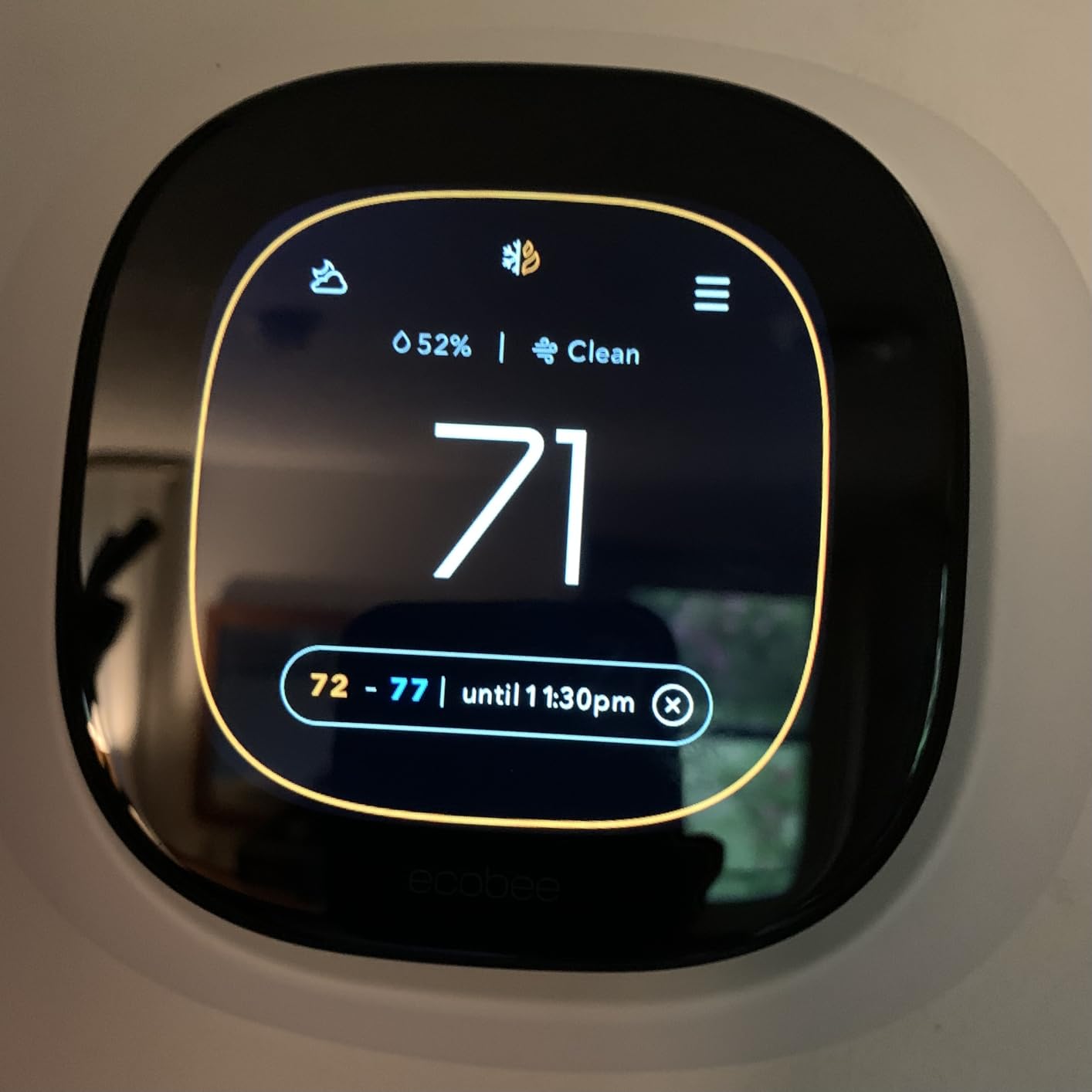
Our Top Pick: Ecobee Smart Thermostat Premium
Upgrade your home with the smartest thermostat on the market.
Check Ecobee Price on AmazonNeed to keep things warm on the go? Don’t forget to check our complete thermos guide and find the most durable thermos options for your winter commute.



 Home
Home
 Info
Info
 Compare
 Reviews
 Shop
Shop