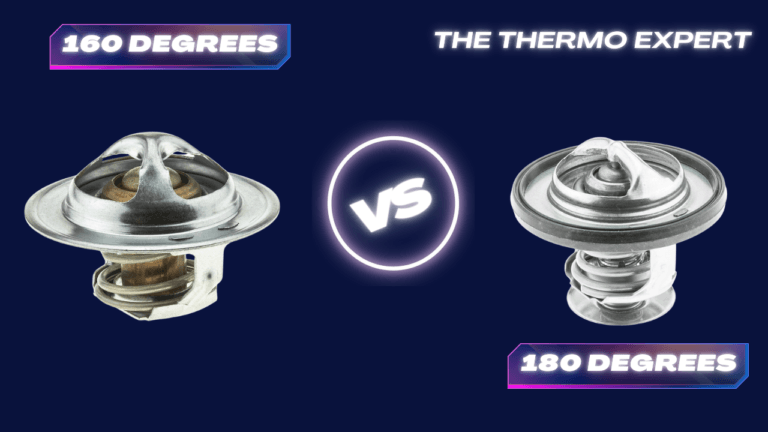
160° vs. 180° Thermostat: The Ultimate Performance Showdown
In the world of performance tuning, few components generate as much debate as the humble engine thermostat. This small, crucial valve dictates your engine’s minimum operating temperature, and swapping it out is one of the most common first mods for enthusiasts seeking to unlock more power. The two most popular performance options are the 160-degree and 180-degree thermostats, but choosing between them is more complex than simply “cooler is better.”
This in-depth guide will demystify the choice. We’ll explore the significant engineering trade-offs between these two temperatures, covering their impact on everything from raw horsepower and fuel efficiency to engine wear and daily drivability. By the end, you’ll understand the science and be able to make an informed decision for your specific build and climate.
The Quick Verdict: Which Thermostat is Right for You?
For most daily-driven, stock, or lightly modified cars, the 180°F thermostat is the superior choice. It provides a safe reduction in temperature for a greater performance margin without the significant drawbacks of running the engine too cold. The 160°F thermostat is a specialized part for high-compression, forced-induction (turbo/supercharged), or dedicated race cars, especially in hot climates, and it absolutely requires a corresponding ECU tune and fan adjustments to be effective.
Understanding the Thermostat’s Critical Role
Before comparing, let’s be clear on what a thermostat does. It’s a temperature-sensitive valve that regulates coolant flow. The number on the thermostat (e.g., 160°F) is the temperature at which it *starts* to open. It is not the constant temperature your engine will run at. The actual operating temperature will typically be 15-20 degrees hotter, as the thermostat modulates to maintain stability. To truly understand the mechanics, it’s helpful to learn how a car thermostat wax pellet valve works, as this ingenious component is the heart of the system.
Most factory thermostats are set even higher, often at 195°F or more. Engineers choose this higher temperature for reasons of efficiency and emissions. Swapping to a 160°F or 180°F unit is a deliberate choice to run the engine cooler than designed, which comes with both benefits and consequences.
The Case for the 180-Degree Thermostat: The All-Rounder Upgrade
Think of the 180°F thermostat as the sensible, balanced performance upgrade. It’s a popular first mod because it offers a tangible safety margin for performance driving without severely compromising the engine’s daily-driving manners.
Key Benefits of a 180°F Thermostat:
- A Safer Performance Window: By beginning the cooling process sooner, a 180°F thermostat provides a greater buffer against engine knock (detonation). This gives tuners more room to safely add ignition timing, which is a primary source of horsepower gains.
- Better Efficiency Than a 160°F: An engine with a 180°F thermostat can still reach its “closed-loop” operating temperature relatively quickly. In this mode, the Engine Control Unit (ECU) uses data from the oxygen (O2) sensors to fine-tune the air-fuel ratio for maximum efficiency. This means better gas mileage and cleaner emissions compared to a colder setup.
- Reliable Cabin Heat: For anyone not living in a year-round hot climate, this is a major factor. The coolant still gets hot enough to provide strong performance from your car’s heater during the winter months.
- Reduced Risk of Overcooling: It keeps the engine in a healthy temperature range, hot enough to ensure engine oil flows properly and can burn off harmful moisture and fuel contaminants.
Who Should Use a 180°F Thermostat?
- ✅ Daily-driven vehicles with performance aspirations.
- ✅ Lightly modified cars (cold air intake, cat-back exhaust, basic ECU tune).
- ✅ Owners in moderate to warm climates looking for an extra safety margin.
- ✅ Most naturally aspirated V8s and V6s used for spirited street driving.
The Case for the 160-Degree Thermostat: The Hardcore Specialist
The 160°F thermostat is not a casual upgrade; it’s a dedicated performance part for specific, demanding applications. Its goal is to provide the maximum possible cooling headroom for engines pushed to their absolute limit.
Major Benefits of a 160°F Thermostat:
- Maximum Knock Prevention: This is the primary reason for its existence. For engines with high compression, superchargers, or turbochargers running high levels of boost, keeping temperatures down is critical. A cooler engine is less prone to detonation, allowing for much more aggressive tuning of spark timing and boost levels, unlocking significant horsepower.
- Essential for Hot Climates & Track Use: In places like Arizona, Texas, or Florida, or during a 20-minute track session, ambient heat is a major enemy. A 160°F thermostat starts the cooling process as early as possible, giving the radiator and fans a head start in the constant battle against heat soak.
The Serious Drawbacks of a 160°F Thermostat on a Street Car
Installing a 160°F thermostat without proper supporting mods can do more harm than good:
- Prolonged “Open-Loop” Mode: The ECU may never receive the signal that the engine is fully warm. It will remain in its “warm-up” phase, ignoring O2 sensor data and running a permanently rich fuel mixture. This kills fuel economy, fouls spark plugs, and can wash oil from cylinder walls.
- Increased Engine Wear & Oil Sludge: This is a critical risk. Engine oil needs heat (~200°F+) to evaporate condensation and unburnt fuel. Running too cool allows this moisture to accumulate, leading to the formation of engine-killing sludge. Furthermore, internal components like pistons are designed to expand to a specific size at operating temperature. Running too cold can result in improper clearances and accelerated wear.
- Requires a Full Tune: To reap any benefit, the ECU must be tuned to adjust fueling tables, and the electric fan activation temperatures must be lowered. If your fans are still programmed to turn on at 210°F, your low-temp thermostat is doing nothing while you’re sitting in traffic.
- Weak to Non-Existent Cabin Heat: In any cool climate, your heater will be lukewarm at best.
Who Should Use a 160°F Thermostat?
- ✅ Heavily modified engines with forced induction (supercharged/turbocharged).
- ✅ Dedicated track, drag, or racing vehicles.
- ✅ Owners in consistently hot climates (e.g., southern Florida) who *also* have supporting tunes and fan adjustments.
160°F vs. 180°F: Head-to-Head Comparison Table
| Feature | 160-Degree Thermostat | 180-Degree Thermostat |
|---|---|---|
| Primary Goal | Maximum Cooling Headroom | Balanced Performance & Safety |
| Knock Prevention | Excellent | Good |
| Fuel Efficiency | Poor (without tune) | Good |
| Engine Wear Risk | Higher (sludge, clearances) | Low (as designed) |
| Cabin Heating | Poor | Good |
| Requires Fan/ECU Tune? | Yes, Absolutely | Recommended, but not essential |
| Ideal User | Hardcore Racer / Forced Induction | Daily Driver / Spirited Enthusiast |
Essential Gear for Your Cooling System Upgrade
A new thermostat is only one part of the equation. To ensure your cooling system is reliable, consider these essential tools and products.

Mishimoto 180°F Racing Thermostat
A trusted name in performance cooling, Mishimoto thermostats are built for reliability under stress. This 180°F unit is a perfect upgrade for most enthusiast vehicles, providing a tangible safety margin for performance driving.
Check Price on Amazon
Hypertech 160°F PowerStat Thermostat
For those with a high-horsepower, forced-induction build that demands the lowest possible operating temperature, this Hypertech 160°F thermostat is a popular choice among serious tuners and racers.
Check Price on Amazon
Engine Ice High Performance Coolant
Standard coolant works, but a high-performance coolant like Engine Ice offers superior heat transfer and corrosion protection. It’s an excellent way to maximize the efficiency of your entire cooling system, regardless of your thermostat choice.
Check Price on AmazonThe Deep Science of Engine Temperature and Combustion
To truly appreciate the difference a 20-degree thermostat change can make, we must first journey into the combustion chamber. The battle between performance and longevity is fought on a microscopic level, where metal surfaces interact with a firestorm of burning air and fuel. The temperature of your coolant directly influences the temperature of the cylinder head, piston crown, and cylinder walls. When these surfaces get too hot, they can become a source of pre-ignition, where the air-fuel mixture ignites from the hot metal before the spark plug fires. This is far more destructive than detonation (knock), which occurs after the spark. A lower-temperature thermostat doesn’t magically add power; it simply pulls the pin on a thermal hand grenade, giving your tuner a wider safety margin to advance ignition timing closer to the knife’s edge of Maximum Brake Torque (MBT) without crossing into self-destruction.
The concept of thermal efficiency is often misunderstood. A hotter engine is, in theory, a more thermally efficient engine, as less energy is lost to the cooling system and more is converted to mechanical work. This is why modern engines run at scalding 210°F+ temperatures and use tight piston-to-wall clearances. However, this efficiency is only possible on pump gas if the engine’s compression ratio and spark curve are perfectly managed. When you add boost or compression, the thermal load skyrockets. The heat of compression itself can raise the charge temperature hundreds of degrees. At this point, the thermodynamic advantage of a 195°F thermostat is utterly negated by the ECU’s need to pull massive amounts of timing or dump excessive fuel to cool the catalytic converters, a strategy that kills both power and fuel economy. If you are experiencing symptoms like poor fuel economy and suspect your current unit is failing, you must consult our guide on how to tell if a car thermostat is bad before chasing a tune.
Material Wars: Thermostat Housings and Thermal Stress
When upgrading your thermostat, it’s not just the opening temperature that matters; the physical housing it sits in is a critical, often overlooked component. The market is split between OEM-style plastic housings and aftermarket aluminum ones. With a 160°F thermostat, your engine experiences a wider thermal cycle range, from a very cold start to an operating temperature that might still be lower than stock. This extreme thermal cycling puts immense stress on the housing. A deep dive into the plastic vs. aluminum thermostat housing debate reveals that repeated expansion and contraction can cause plastic housings to warp, crack, and leak, especially when combined with high-pressure racing radiator caps. Aluminum housings, while more expensive, offer a robust, warp-resistant seal that matches the durability needs of a high-performance cooling system.
Furthermore, the gasket material must be chosen carefully. Standard paper gaskets can become brittle under the aggressive thermal swings of a 160°F setup. Many performance builders opt for reusable rubber-coated metal gaskets or apply a high-quality RTV silicone sealant. A coolant leak from a failed housing doesn’t just leave you stranded; it causes rapid, localized overheating that can warp cylinder heads in seconds. This risk is amplified if your thermostat is stuck closed, a situation where a robust aluminum housing is far more likely to survive the intense pressure until you can safely shut the engine down.
The 180°F Thermostat and Its Relationship with the Stock 195°F Unit
The 180°F thermostat doesn’t exist in a vacuum. It’s essential to understand it as the middle ground between the conservative 195°F stock piece and the aggressive 160°F race part. The stock thermostat is designed to get the oil hot quickly, specifically to boil off water vapor that condenses inside a cold engine. At 195°F, the chemical reaction rates of combustion are high, leading to an efficient burn. So, why drop to 180°F? For a deeper technical breakdown, our comparison of the 180 vs. 195 thermostat highlights the delicate balance between engine wear, sludge formation, and fuel economy. Essentially, the 180°F version sacrifices a tiny percentage of thermal efficiency to dramatically increase the engine’s resistance to knock on hot days or during hard pulls. It’s a safety buffer, not a magic power mod.
In many modern engines, particularly those with direct injection, the 180°F thermostat can help mitigate carbon buildup on intake valves. While not a cure (media blasting is the only real fix), a slightly lower combustion chamber temperature can reduce the rate at which oil vapor bakes onto the valve stems. Additionally, for trucks used for towing, a 180°F thermostat is often a non-negotiable upgrade. Pulling a heavy load up a grade generates immense heat, and the earlier opening of the thermostat provides a crucial head start for the radiator, preventing the temperature gauge from spiking dangerously before the fans can react.
The 160°F Risks: Diagnosing the Open-Loop Drivability Nightmare
The primary danger of the 160°F thermostat is the engine’s failure to reach “closed-loop” status, particularly in cooler weather. When an engine is in open-loop, it references pre-set fuel tables rather than live oxygen sensor feedback. These tables are almost always programmed to be rich to protect the engine during warm-up. If you drive a car with a 160°F thermostat on a 45°F day, the coolant temperature might plateau right at the open/closed-loop threshold (typically around 130°F-160°F coolant temp). The ECU can flip-flop between modes, causing erratic surging, stumbling, and a severe drop in MPG. If you’re facing a situation where your system seems to be starting and stopping erratically, our guide on why a thermostat clicks but HVAC won’t start covers similar electrical logic issues that can mirror sensor failures.
The fuel wash scenario is a silent engine killer. When the ECU commands a rich mixture continuously, the excess, unburned gasoline washes the oil film off the cylinder walls. Piston rings scrape against a dry bore, dramatically accelerating wear. This fuel also dilutes the engine oil, thinning it out and reducing its ability to protect bearings. To fully understand why this specific unit is dangerous for a daily driver, you must read our dedicated guide on the 160 thermostat risks, including sludge and open-loop issues. The moisture contamination combines with fuel dilution to create a sludge that blocks oil passages, leading to catastrophic lubrication failure. This isn’t a theoretical risk; it’s a well-documented cause of engine failure in modified street cars that never see track time but are set up like race cars.
Smart Cooling Control: Can a Smart Home Thermostat Logic Apply to Your Car?
While your car’s ECU is vastly different from your home’s thermostat, the logic of optimization is universal. In the home HVAC world, the debate between controlled scheduling and adaptive learning mirrors the choice between a fixed 160°F and a tuned 180°F setup. A thermostat schedule vs. learning system shows that rigid, fixed settings (like a 160°F stat) often waste energy unless constantly monitored and adjusted by an intelligent observer (the tune). Similarly, home devices use remote sensors and home/away features to dynamically adjust, just as a good ECU tune uses IAT, ECT, and MAP sensors to adapt fueling. If you want to understand the pinnacle of adaptive technology in the smart home space, explore how the Nest Auto-Schedule compares to Ecobee Smart Sensors—it’s a perfect analogy for how adaptive logic trumps static presets.
Home thermostats have also evolved to manage humidity and air quality via tools like the Ecobee Premium’s air quality features, a concern parallel to managing oil moisture in an engine. Just as you monitor sleep temperature science for optimal human performance, you must monitor oil temperature for optimal engine performance. You can’t just set a house to 65°F constantly and ignore humidity, any more than you can set a car to 160°F without considering fuel condensation. The advanced algorithms in Nest Learning Thermostat vs. Amazon Alexa Hunches show how modern systems predict and pre-cool rooms, much like a predictive engine fan controller. The parallels between a home’s winter thermostat schedule and a car’s warm-up routine are striking: both require a carefully managed entry into peak efficiency temperature.
The Tuning and Sensor Feedback Loop
Speaking of smart home parallels, the data feedback loop in a performance car must be flawless. A car thermostat without a tune is like a smart thermostat with a thermostat showing the wrong room temperature—the hardware is useless if the brain receives garbage data. The Engine Coolant Temperature (ECT) sensor must be accurate, and the fan setpoints must match the new thermostat. If your car is switching modes unexpectedly, similar to a thermostat switching from heat to cool, it signals a logic conflict. This conflict often arises from mismatched fan activation. For an overview of how variable speed fans can operate your cooling system with the precision of a room thermostat, our explanation of how much electricity a thermostat fan uses illustrates the principle of load management—a critical concept when you upgrade your alternator to handle high-CFM electric fans for a 160°F thermostat setup.
Installation Pitfalls and System Diagnostics
Installing a thermostat seems simple, but it’s a task fraught with potential for error. A common issue is trapping air in the system, which causes the thermostat to open late or erratically. Drilling a small 1/8-inch bleed hole in the thermostat flange is a widely adopted trick among engine builders to allow air to escape during the filling process. Without it, an air pocket can insulate the wax pellet, causing it to not see the actual water temperature. This leads to a spike in temperature before the thermostat violently snaps open. If your cooling system seems unresponsive after a swap, you might need to diagnose the electrical loop, much like diagnosing a Sensi thermostat connected but not to cloud issue, where a physical link exists but the logical handshake fails.
Furthermore, you must use the correct water-to-coolant ratio. Pure water has the best heat transfer capacity but offers no corrosion protection, while pure coolant has poor heat transfer. A 70/30 water-to-coolant mix, combined with a product like Red Line Water Wetter, is a classic track-day cocktail that maximizes heat rejection but requires a thermostat to maintain a minimum temperature. If you are experiencing a situation where the furnace won’t turn on, the diagnostic logic is similar to a fan controller failure. For instance, a furnace that won’t turn on but the fan works points to a control signal issue, much like a fan relay that receiveing power but no signal due to a bad ECU ground reference. The diagnostics we use for a faulty thermostat in 10 minutes translate perfectly to the automotive world: check the signal, check the ground, check the power.
Comparative Technology: Homegrown Innovation Informing Car Mods
The cross-pollination between home HVAC zoning and engine cooling is a rich intellectual field. The way an Ecobee compares to Honeywell in remote sensor range is conceptually identical to placing coolant temp sensors before and after the radiator to gauge efficiency. Multi-zone home systems, like the Honeywell HZ311 zone thermostat upgrade, teach us about balanced flow, a concept critical for reverse-flow engine cooling setups. Even the protective measures of a winter vacation thermostat setting find a parallel in storing a performance engine during winter: you must keep the block warm or ensure the coolant mix is rich enough to prevent freeze-cracking a bored-out cylinder wall.
The physical construction of the valve matters, too. The debate between the compact performance of a Wyze vs. Govee budget thermostat for addressing hot/cold rooms resembles the choice between a cheap auto parts store thermostat and a high-flow racing unit. In cars, a high-flow thermostat uses a larger valve disk that provides less restriction at high RPM, preventing cavitation at the water pump impeller. This is the same principle behind why a robust Nest vs. Sensi power-stealing comparison matters: a robust connection prevents throttling. Sensi’s approach to battery backup highlights the importance of fail-safes, like a thermostat that fails in the open position. To understand that mechanism better, our piece on thermostat low battery fading display relay click identifies the tell-tale sign of a weak actuator, similar to a weakening wax pellet.
The UK Perspective on Zoning and Car Tuning
Interestingly, the UK smart thermostat market offers specific insights into heating system optimization that map directly to the car world. The popular Hive vs. dumb thermostat debate mirrors the chip-tune vs. stock ECU debate: a smarter controller always unlocks hidden value. In forced induction cars, boost is the ultimate zone valve. Hive vs. Tado geofencing automation is comparable to boost-by-gear or flex-fuel sensor logic—adaptive systems that react to external conditions. The Tado Smart Radiator Thermostat uses PID control, which is exactly the same algorithm a modern ECU uses to control a boost solenoid or an electronic wastegate, pulsing the signal to prevent overshoot. Nest, Hive, Tado comparison highlights communication protocols—OpenTherm is analogous to the CAN bus in your performance car, carrying rich digital data rather than a simple on/off signal like a mechanical fan switch.
The Honeywell Evohome local zoning philosophy of 12 independent zones translates to a supercar’s individual cylinder fuel trim and knock control—every “room” gets exactly what it needs. If you’re installing electronic engine management, following the steps to pair an Ideal Halo thermostat is exactly the mental checklist you need for pairing a new wideband O2 controller with your standalone ECU. The Drayton Wiser backplate installation is the home equivalent of installing a new thermostat housing and wiring pigtails. Additionally, the growing market for HomeKit thermostat automation mirrors the car world’s move toward integrated ECU dashboards and track-focused PIDs, where thermodynamic ROI metrics quantify exactly how much heat (or horsepower) you’re managing.
Contaminant Management: The Humidity Analogy
We’ve established that a 160°F thermostat can cause sludge, but let’s dig into the chemistry. Water is a natural byproduct of combustion. For every gallon of fuel burned, over a gallon of water is produced. Some of this blows past the rings into the crankcase. At normal engine temperatures (212°F+ internal, 195°F+ coolant), this water remains a vapor and is evacuated by the PCV system. When coolant temps hover around 160°F-170°F, the internal surfaces are cool enough that this water condenses into liquid form, mixing with the oil. This is exactly why a vacuum insulated Thermos can keep contents hot for 24 hours—it prevents thermal loss, which in an engine context means preventing the escape of heat necessary to boil off contaminants. For a visual on material degradation, check our ranking of the most durable Thermos lunch boxes, which showcases stainless steels that resist acidic corrosion, much like the alloys needed for performance coolant passages.
The battle against thermal loss is crucial for engine oil health. To ensure a sealed system, you need quality gaskets, just as you need a leak-proof cap on a thermos coffee mug for a commute. This brings us to an unlikely but accurate parallel: the science of an Owala Freesip lid. A perfect seal and controlled flow prevent spills, while in an engine, a perfect radiator cap seal prevents boil-over. The choice of a 160°F thermostat is like choosing an Hydro Flask over a Klean Kanteen for ice retention—it’s a specific tool for maximum cold retention, where maximum heat rejection is needed. The Stanley Quencher vs. YETI cup-holder fit debate reminds us that universal fit (like a “one-size-fits-all” thermostat housing) doesn’t guarantee optimal performance; a perfect fit equals no leaks. Finally, the Simple Modern Trek vs. Stanley leak resistance serves as a metaphor: failure points (seals) define the reliability of the system. In performance, a Corkcicle triple insulation vs. YETI double-wall test shows that engineering for thermal extremes requires specialized tools, not just a generic bucket.
HVAC Protocols, Specs, and Forced Induction Economics
When you step up to a 160°F thermostat on a supercharged build, you’re entering the territory of split HVAC systems in the sense that the intercooler system and the engine cooling system are now two distinct, massive heat exchangers that must be managed. You must understand inverter technology in HVAC to appreciate how a brushless water pump or a PWM fan controller works—variably adjusting flow to hold the perfect temperature. This is the same precision that allows a line voltage floor heating thermostat to keep a room from overshooting, and it must happen in a 1,000 HP engine. Without that variable control, you shock the engine with cold water. The Trane vs. Carrier coil comparison highlights how surface area and fin density (like radiator core design) dictate heat transfer capacity.
If your vehicle is heavily modified, you might be running an aftermarket radiator comparable to installing an entirely new Schluter Ditra-Heat floor system—it’s a holistic system, not a patch. Wiring a special high-flow pump might require a line voltage vs. low voltage test to avoid frying your ECU. The “always feeling cold at home” phenomenon translates directly to an engine running too cool when its thermostat is too low—the heat never builds. To determine that, a Honeywell thermostat longevity study reminds us that even a quality part fails eventually, and a faulty car thermostat must be replaced immediately. The guide to reading home thermostats is foundational; half the battle in automotive tuning is knowing when you need a new thermostat—staying open or closed unpredictably.
The Electrical and Sensor Symphony
The humble thermistor is the sensor that reads this critical temperature, and its calibration is everything. Just as critical is the unit’s ability to send its signal reliably. One of the most annoying failure modes is a thermostat not charging, a power delivery failure that has an exact automotive analog in a corroded ECT sensor plug showing skewed resistance. This leads to situations where you need a thermostat reset, just as you might need to reflash an ECU that has “learned” bad values. A smart thermostat improves home safety by detecting low temperatures, and an accurate ECT sensor prevents melting a piston by detecting dangerously high ones. The process of adding Nest to HomeKit is exactly like adopting an unfamiliar gauge protocol—a CAN translator might be needed.
The guide to upgrading a home thermostat preaches checking for a C-wire, the “constant power” that a smart ‘stat needs. That’s your ECU’s 5V reference line! If you don’t have it, you install an adapter. The Honeywell reset with no button is the procedure of pulling the PCM fuse to fully drain the capacitors. Like the differences between heating and cooling thermostats, the calibration data for a 160°F thermostat demands toggling a flag in the ECU logic to tell it a new “normal” temperature is acceptable. The ultimate “ah ha!” moment comes when you realize that a thermostat rebooting and AC turning on during a voltage drop is the exact same root cause as an MSD ignition box cutting out at high RPM due to alternator voltage sag—inadequate supply for the load. The thermostat doesn’t start the furnace issue mimics an ECU not grounding a relay. And the thermostat keeps turning on the AC behavior is a logic loop error, similar to a fan controller short-cycling. The ultimate guide to a bad unit is the complete 12 symptoms of a failing thermostat, a troubleshooting framework essential for reading a vacuum gauge and temperature gun. The Honeywell reset procedure is the “turning it off and on again” that fixes infinite loop errors, and adjusting a Honeywell thermostat is learning to navigate a complex PID menu system.
The Portable Heat Transfer Analogy
Your engine block is a pressurized vessel holding thermal mass. The world of keeping soup hot in a Thermos applies directly to understanding thermal mass concepts. You wouldn’t pour cold water into a piping hot engine; similarly, you pre-heat your Thermos by preheating for 5-10 minutes, a “burp cycle” to stabilize the core temperature. The best food jar for soup requires a wide mouth for cleaning, and a wide-mouth thermostat allows high-volume flow. The budget insulated tumblers market shows that “triple-walled” can sometimes be marketing fluff—stick to a known radiator core brand. When choosing a food jar for a construction site, durability is key, just as a copper/brass radiator is prized for repairability. The most durable Thermos for job site drops is like an all-aluminum racing radiator—built for vibration and impact, not just heat rejection. A worksite lunch system relies on compartmentalization, an engine’s cooling system relies on cylinder-to-cylinder equalization (steam tubes). Finally, a Thermos lunch system separating hot and cold mimics a charge air cooler’s separation of intake air temperature from engine coolant heat. For example, kindergarten Thermos kits have easy-open lids; a performance engine needs an easily accessible, high-flow thermostat bleed plug. The search for the slimmest iced coffee mug for commutes translates exactly to the search for a thin, efficient heat exchanger core that fits in a tight engine bay, and the debate over Thermos vs. single-wall dog flasks is essentially the argument between a pressurized coolant recovery tank and an open-to-atmosphere overflow pipe. The vacuum insulation in a Thermos creates a near-zero thermal conduction barrier—this is the logic of heat wrapping exhaust manifolds: stop the heat transfer to stop the heat soak of the intake manifold above it. A thermos food jar stores thermal energy; a coolant reservoir stabilizes hydraulic pressure. Whether you’re at a track day or just packing a lunch, it’s all about heat retention technology—a phase change that resists entropy. Your stainless steel meal jar is like a stainless steel exhaust valve: durable and resistant to thermal cycling fatigue. For the ultimate durability guide, our hiking hydration gear page demonstrates how thermal isolation affects human endurance, just as engine endurance relies on isolating the combustion heat. Keeping an outdoor worker hydrated depends on water staying cool; a 160°F thermostat on a hot day is the inverse—cooling the “worker” (the engine) so it doesn’t overheat. A best thermos for gym review teaches us about fitting into cage holders, while an aftermarket radiator must fit a radiator support. The best thermos for camping relies on durable construction—rubber grommets and flexible mounts. A Wyze vs. Ecobee multi-story home comparison touches on the challenges of multi-zone pressure differences—similar to balancing coolant flow in a V-engine where the back cylinders run hotter than the front.
Advanced Tuning, Geofencing, and System Architecture
The concept of smart thermostat geofencing to cut HVAC runtime is critical automotive logic. A 160°F thermostat *must* be paired with a tune that only enables the aggressive timing map when on the throttle (geofenced to “track mode”). A “home” or “away” logic based on GPS radius is identical to a flex-fuel tune that adjusts ignition based on ethanol content. Our guide to geofencing radius and Eco mode is exactly the approach used for valet mode rev limiters—restricting power when outside a geographic area or vehicle speed. The smart thermostat geofencing guide explains how pre-cooling reduces peak load, and a 160°F thermostat on a street car tries to “pre-cool” the block before a stoplight WOT pull.
The search for the best Bosch heat pump thermostat leads to understanding Bosch inverter SEER2/HSPF2 specs—the metric for how efficiently energy is transferred. This is analogous to a water-to-air intercooler’s efficiency rating. If you’re piecing together a system, the landlord thermostat lockout strategy mirrors rev-limiters that prevent engine damage: a hard stop to prevent misuse. The Tekmar 561 vs. 519 radiant control review shows how mixing valves hold exact temperatures—exactly what your oil thermostat or laminova oil cooler brick does. The Lux TX9600TS vs. Orbit Clear Comfort head-to-head focuses on energy savings via optimized cycles; an optimized engine cycle requires the right thermostat. The Honeywell Home T9 vs. T10 Pro comparison highlights sensor differences, and an ECT sensor vs. a cylinder head temp sensor is a similar generational gap—the T10 scans for IAQ, the car scans for knock. The Ecobee Premium vs. Enhanced debate is reflected in aluminum vs. plastic housing: one has a metal PIR, the other plastic. The Honeywell T5 geofencing accuracy guide shows that a geo-fence radius must be tight; a narrow throttle angle sensor must be calibrated to perfectly match the 160°F tune window. The Honeywell Home T9 review suggests it’s the best for multiple rooms, just as a 180°F stat is best for multiple driving scenarios. The Mysa baseboard heater review tackles line-voltage switching; the ignition system in a race car uses a high-voltage trigger. The Mysa V2 Triac switching vs. relay noise is the difference between a solid-state fan controller and a mechanical relay, with Triac being silent, precise, and reliable. The Mysa vs. Sinope electric baseboard guide is a high-voltage battle paralleling the choice of high-amp alternators. The Amazon Smart Thermostat review proves that low cost doesn’t mean low feature count, similar to the value of a basic 180°F thermostat upgrade. The Amazon vs. Ecobee Premium review points out quality differences that match a stamped steel thermostat housing versus CNC billet. The Sensi Touch illuminated terminals feature is a “user-friendly” nod, just like a swivel thermostat neck makes a mechanic’s life easier. The Sensi vs. Ecobee c-wire installation showdown shows that the lack of a simple constant power wire stops a job cold; a missing vacuum line reference does the same. The Ecobee3 Lite vs. Nest sensor comparison is a lesson in occupancy-based logic, similar to a driver-selectable map switch. The Ecobee3 Lite review emphasizes savings, and the right thermostat saves your engine. The Ecobee3 Lite energy savings guide shows time-of-use logic, which is similar to limiting boost by time in RPM. The Ecobee Premium radar sensor detects presence through materials (like a cylinder head temp sensor measuring metal temp, not fluid). The Nest Learning Thermostat power-stealing problem is a bad ground loop. Nest’s 4th Gen Soli radar represents a breakthrough, like switching from speed density to mass airflow sensing. The Wyze thermostat review details a budget approach, suitable for a budget 180°F thermostat swap. The smart thermostats under $50 article makes the point that you can limit spending, but logic must match the system. The smart thermostat energy savings guide explains ROI, while the WiFi payback calculator asks: do you track tuning dollars per horsepower? What a battery-powered smart thermostat is—a portable brain—is exactly what a handheld tuner provides. Battery-powered smart thermostats for 2026 use WiFi, Thread, Z-Wave—like your vehicle ECU protocols. How smart thermostat connectivity works explains the 2.4 GHz grip; your ECU OBD-II relies on 500 kbps CAN. The key features to compare when buying a smart thermostat checklist mirrors “the checklist for a new ECU”: triggers, load sensing, I/O count. Reviewing 2026 smart thermostat rebates is like chasing tax credits for EV conversions—fiscal sense. Programmable thermostats with keypad lock are exactly “valet mode” or parental boost control. Touchscreen thermostats with backlight are akin to a digital dash where you can monitor coolant temp precisely. The Nest vs. Honeywell multi-stage comparison contrasts discrete staging with a progressive pump. The Honeywell Smart Color vs. Sensi Touch battle touches on iOS compatibility, just as your Haltech needs PC compatibility. The smart vs. programmable AI learning is an AI vs. preset argument: an adaptive ECU self-learns, a piggyback is static. Finally, the 25 thermostat cover ideas page teaches a surprising lesson: hiding things from sight keeps them cool, which is why heat shielding is vital under a blower. The best wall color for a thermostat analysis states dark colors absorb radiated heat, just like a black intercooler pipe radiates less heat. Hiding thermostat wires is exactly wire tucking an engine harness for a clean, heat-reflective firewall. The massive HVAC system replacement cost guide puts a full system overhaul into context, just as the full engine build sheet justifies all supporting mods. The compatibility guide stresses matching voltage, same as a 12V thermostat in a 24V truck. HVAC energy efficiency tips help cut load, like water-methanol injection stopping knock. The thermostat wiring guide is the universal translator for ECT wires, and the furnace replacement cost page helps you contextualize the price of a new radiator. AC unit installation cost parallels the cost of custom intercooler fabrication. The question “Can a bad thermostat cause AC not to cool?” is directly analogous to an overheating engine nullifying intercooler gains. “Can a bad thermostat cause heater failure?”—yes, and a stuck-open performance thermostat stops your cabin heat. Using the best greenhouse heater guide, we understand preventing thermal soaking; in a car, it’s preventing heat soak. The calibrating a thermostatic shower guide perfectly maps to setting a fan controller to 160. The budget thermostatic shower kits prove a concept: a cheap kit oscillates wildly, a cheap thermostat fails erratically. The diagnostic flowchart for not reaching set temp is ideal for tracking highway overcooling. The heat-on but no-heat fault mirrors a fan relay clicking but no fan running. Thermostat battery failure causes a no-start, just as a dead ECU causes no-spark. The wire extension splicing guide is essential for any custom ground kit. The greenhouse heater sizing tool helps calculate thermal mass, vital for BTU rejection capacity. The best whole house humidifier guide reminds us that moisture control matters, just like combustion byproduct management. Finally, the Sensi reset failed diagnostic reminds us to always check the fuse before condemning a “failed” thermostat, whether at home or under the hood.
Frequently Asked Questions (FAQ)
Will a 160° thermostat fix my overheating problem?
Absolutely not. A thermostat only sets the minimum temperature. If your car is overheating, it means your cooling system (radiator, fans, etc.) cannot get rid of the heat being produced. A colder thermostat will only delay when the overheating starts; it will not prevent it. You must fix the root cause.
Do I have to tune my fans if I install a colder thermostat?
To get the full benefit, yes. If you install a 160°F thermostat but your fans are still set to turn on at 210°F, the thermostat will be wide open long before the fans provide any help in low-speed situations, partially defeating the purpose.
Is there a noticeable horsepower difference between the two?
Not from the thermostat itself. The horsepower gains come from the more aggressive ignition timing that a cooler engine allows a tuner to implement. The 160°F thermostat simply provides a larger window for that tuning.
What about the stock 195°F thermostat?
The 195°F thermostat is designed for optimal efficiency and emissions on a stock vehicle. While the 180°F thermostat is a popular first step for performance, it’s crucial to understand how it compares to the factory standard. You can learn more in our detailed 180°F vs. 195°F thermostat guide.

About the Author
Alex Reid is a performance tuning specialist and ASE-certified technician with over 15 years of experience building and tuning high-performance street and track cars. He has a passion for engine science and helping fellow enthusiasts make informed decisions about their modifications.




 Home
Home
 Info
Info
 Compare
 Reviews
 Shop
Shop